
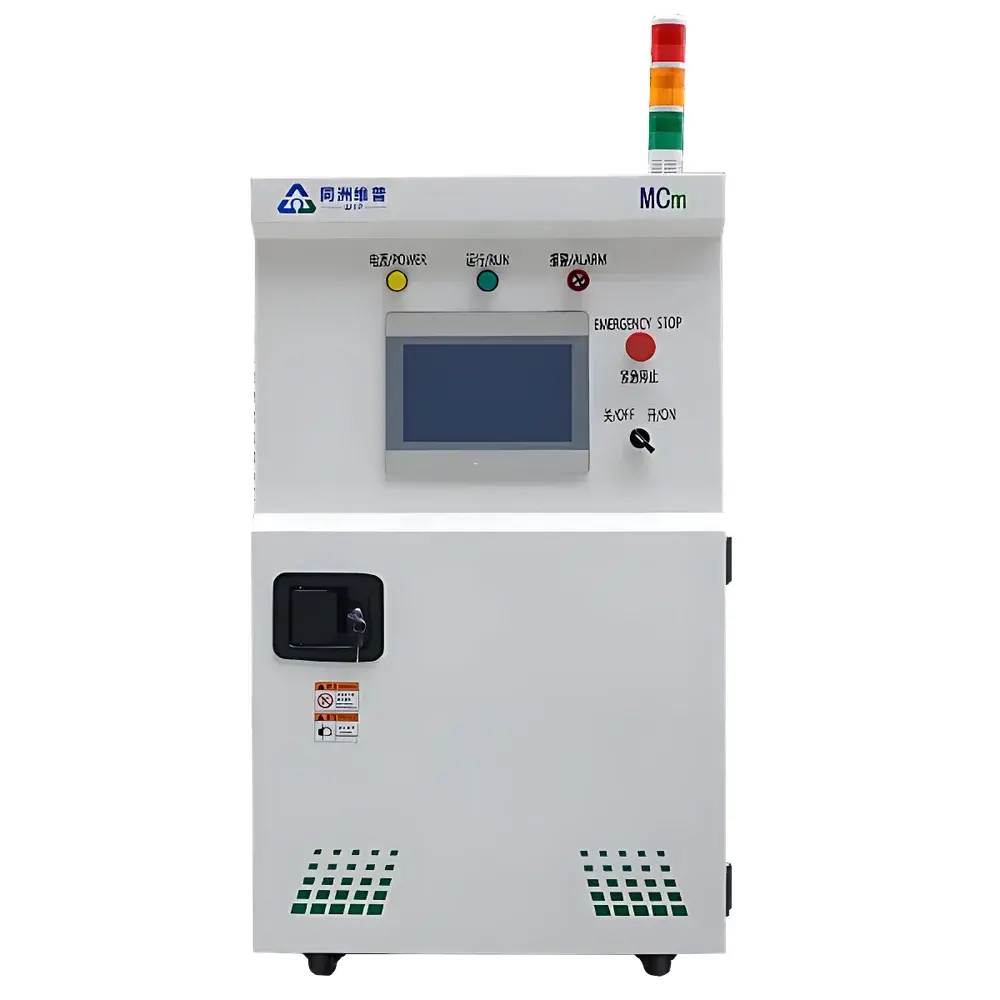
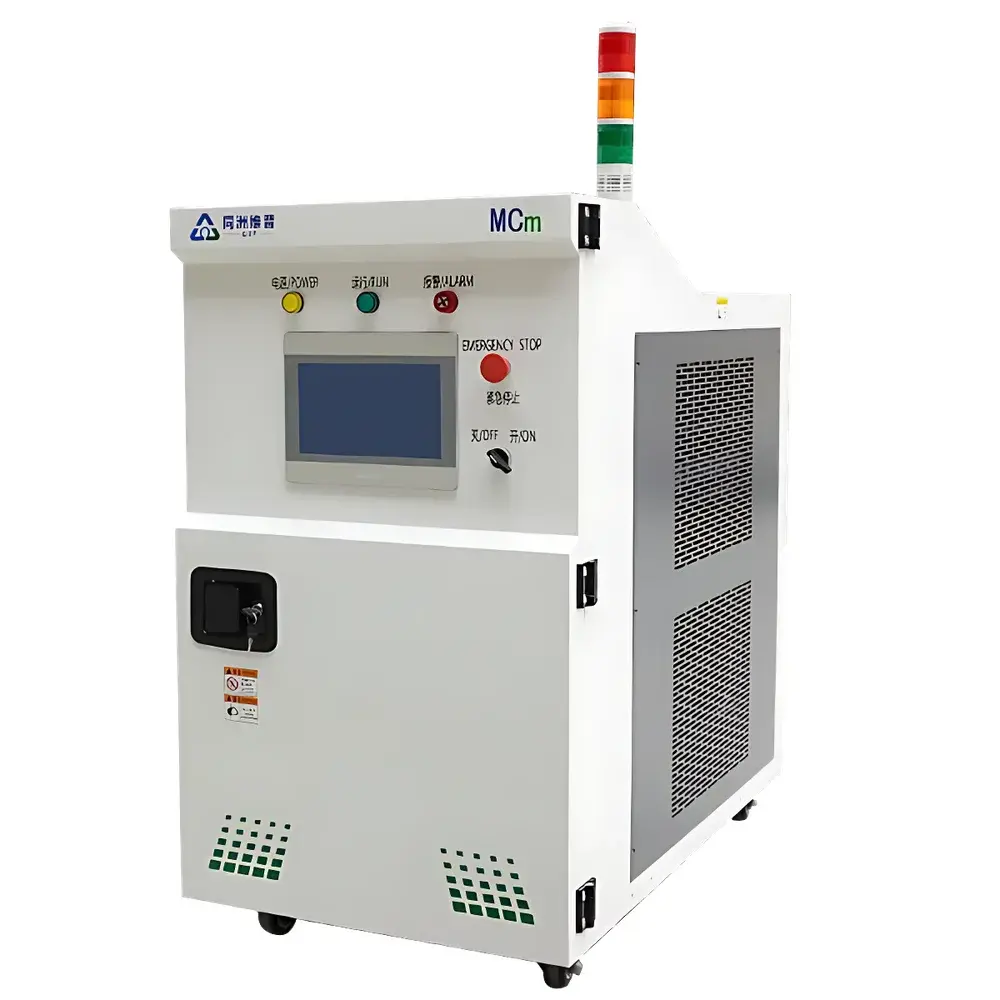
Tongzhou Weipu MCm Integrated Circulating Chiller for EV Battery Module Testing
| Brand | Tongzhou Weipu |
|---|---|
| Origin | Beijing, China |
| Manufacturer Type | Direct Producer |
| Instrument Type | Integrated (All-in-One) |
| Temperature Control Range | –20 °C to 95 °C |
| Cooling Capacity | 3 kW to 15 kW |
| Temperature Stability | ±0.5 °C |
| Application Class | Battery Cell, Module & Pack Thermal Test System |
Overview
The Tongzhou Weipu MCm Integrated Circulating Chiller is an engineered thermal management solution specifically designed for high-fidelity temperature control during electrochemical performance evaluation of lithium-ion battery components. It operates on a closed-loop refrigeration cycle with integrated heating and cooling capability, enabling precise, dynamic thermal conditioning across the full operational envelope of modern EV battery systems—from individual prismatic or cylindrical cells to large-format modules and complete packs. Unlike generic laboratory chillers, the MCm architecture incorporates dual-mode thermal regulation (refrigerant-based compression cooling + electric resistance heating), allowing seamless transition between sub-zero cold soak, rapid thermal ramping, and high-temperature hold conditions without external auxiliary units. Its compact footprint and front-access service design align with space-constrained test cell environments typical in automotive R&D labs and battery qualification facilities.
Key Features
- Integrated dual-temperature control system delivering continuous operation from –20 °C to 95 °C with ±0.5 °C stability under load—validated per ISO 17025-compliant calibration protocols.
- Modular cooling capacity range (3–15 kW) scalable via optional expansion kits, supporting single-cell thermal cycling up to multi-kW battery pack-level thermal load simulation.
- Dedicated EV test mode firmware enabling programmable thermal profiles for standardized test sequences including IEC 62660-2 cold/hot soak, UN GTR 20 thermal shock, and GB/T 31485 thermal runaway propagation studies.
- Corrosion-resistant stainless-steel internal reservoir and fluid path, compatible with standard glycol-water mixtures (e.g., 30% propylene glycol) and low-conductivity dielectric coolants used in high-voltage battery testing.
- Real-time flow rate monitoring (0.5–15 L/min), pressure differential sensing (±0.1 bar resolution), and integrated leak detection logic to ensure thermal interface integrity during high-power charge/discharge cycles.
- Industrial-grade PLC controller with Ethernet/IP and Modbus TCP interfaces for synchronization with battery cyclers (e.g., Arbin, Digatron, Bitrode) and environmental chamber orchestration systems.
Sample Compatibility & Compliance
The MCm chiller interfaces directly with battery test fixtures via standardized quick-connect fluid couplings (DIN 2353, 1/2″ NPT) and supports both internal recirculation (for cell-level thermal plate coupling) and external open-loop configurations (for immersion or jacketed pack testing). Its fluid temperature accuracy and response time meet requirements specified in SAE J2464 Annex C for thermal validation of EV battery safety testing. All electrical components comply with CE marking directives (EMC 2014/30/EU, Low Voltage Directive 2014/35/EU), while software logging functions support audit-ready data traceability aligned with GLP and ISO/IEC 17025 documentation standards.
Software & Data Management
The embedded control interface provides intuitive profile programming, real-time PID tuning, and event-triggered data capture (temperature, flow, power draw, fault logs) at configurable intervals down to 100 ms. Optional PC-based software (Tongzhou Weipu ThermalSuite™) enables remote monitoring, multi-chiller fleet coordination, and export of timestamped CSV/Excel datasets compliant with FDA 21 CFR Part 11 requirements—including electronic signatures, audit trails, and user role-based access control. Historical thermal profiles can be cross-referenced with battery cycler voltage/current logs using synchronized UTC timestamps for root-cause analysis of thermal-electrochemical coupling effects.
Applications
- Dynamic thermal characterization of NMC, LFP, and solid-state battery cells under variable C-rate cycling at controlled ambient temperatures.
- Accelerated life testing (ALT) involving repeated thermal cycling (–20 °C ↔ 60 °C) to evaluate seal integrity, electrolyte decomposition, and interfacial degradation.
- Thermal runaway propagation studies requiring precise pre-conditioning and controlled heat injection into adjacent cells within a module array.
- Calorimetric validation of battery thermal models (e.g., lumped-parameter or 3D CFD inputs) through boundary condition replication.
- Support of UL 2580 and GB/T 31467.3 certification testing workflows where temperature uniformity and repeatability are critical pass/fail criteria.
FAQ
What coolant types are compatible with the MCm chiller?
Propylene glycol/water mixtures (20–40% vol), ethylene glycol/water, and certified low-conductivity dielectric fluids (e.g., 3M™ Novec™ 7200) are supported; compatibility verification with specific formulations is recommended prior to deployment.
Does the MCm support external communication protocols for automated test sequencing?
Yes—it features native Modbus TCP and EtherNet/IP drivers, enabling bidirectional integration with LabVIEW, Python-based test automation frameworks, and commercial battery test platforms.
Can the MCm maintain ±0.5 °C stability while delivering 15 kW cooling at 95 °C outlet temperature?
Stability specification applies under nominal load conditions; maximum cooling capacity is rated at 25 °C ambient and 30 °C return fluid temperature—derating curves are provided in the technical datasheet for elevated ambient or high-return-temp operation.
Is the system validated for use in explosion-proof (ATEX/IECEx) environments?
The base MCm unit is rated for Zone 2/Class I Div 2 environments; ATEX-certified variants with enhanced enclosure sealing and intrinsically safe I/O are available upon request.
How is calibration traceability maintained across the operating temperature range?
Each unit ships with a NIST-traceable calibration certificate covering five points (–20 °C, 0 °C, 25 °C, 60 °C, 95 °C); annual recalibration services include uncertainty budget reporting per ISO/IEC 17025 Clause 6.5.



