
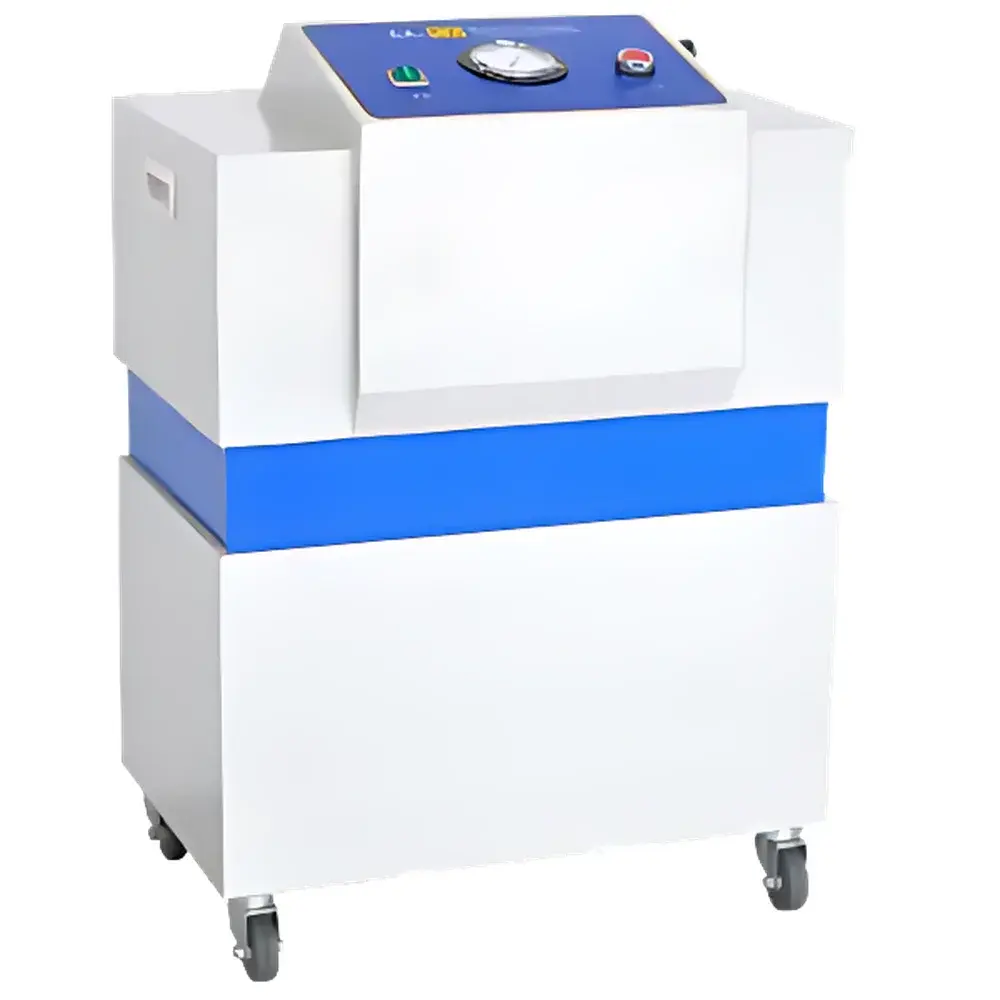
Tongzhou Weipu TZWP-OC2050 Oil-Free Quiet Air Compressor
| Brand | Tongzhou Weipu |
|---|---|
| Origin | Beijing, China |
| Manufacturer Type | Direct Manufacturer |
| Country of Origin | China |
| Model | Oil-Free Air Compressor |
| Price Range | USD 700–1,400 (FOB) |
| Compression Principle | Dual-Piston Oil-Free Mechanism |
| Flow Rate | 20–50 L/min |
| Operating Pressure | 0.05–0.55 MPa (0.5–5.5 bar) |
| Dew Point | +3 °C |
| Particulate Filtration Efficiency | ≥99.999% for particles ≥0.01 µm |
Overview
The Tongzhou Weipu TZWP-OC2050 is an oil-free, low-noise laboratory air compressor engineered for precision gas supply in analytical instrumentation environments. It employs a dual-piston compression architecture with PTFE-coated cylinders and self-lubricating components—eliminating hydrocarbon contamination without requiring lubricating oil. This design ensures ISO 8573-1 Class 1:2:1 compressed air quality (solid particles ≤0.01 µm, dew point +3 °C, oil content <0.01 mg/m³), making it suitable for applications demanding ultra-clean, dry, and pressure-stable air. Unlike oil-flooded compressors, the TZWP-OC2050 avoids downstream oil carryover, filter saturation, or volatile organic compound (VOC) interference—critical when supporting flame atomization in atomic absorption spectrometry (AAS), plasma stabilization in ICP-OES and ICP-MS, or carrier gas consistency in nitrogen evaporation systems.
Key Features
- Ultra-low acoustic emission: <52 dB(A) at 1 m distance—enabling integration into shared lab spaces without acoustic shielding.
- Dual-piston oil-free compression mechanism with integrated thermal overload protection and auto-start/stop pressure control (0.05–0.55 MPa adjustable setpoint).
- Integrated multi-stage filtration: pre-filter (coalescing), desiccant dryer (dew point maintained at +3 °C), and final 0.01 µm absolute particulate filter (HEPA-grade).
- Energy-efficient brushless DC motor with power consumption ≤350 W at rated flow—optimized for continuous 24/7 operation under variable load conditions.
- Modular chassis design with vibration-dampening rubber mounts and IP20-rated electrical enclosure compliant with IEC 61000-6-3 EMC standards.
Sample Compatibility & Compliance
The TZWP-OC2050 delivers compressed air compatible with flame AAS (e.g., PerkinElmer PinAAcle, Thermo iCE 3000), plasma-based instruments (Agilent 5110 ICP-OES, Thermo Scientific iCAP RQ ICP-MS), and automated sample preparation platforms (e.g., Biotage SPE-DEX, Gilson GX-271). Its output meets ASTM D6345 requirements for instrument-grade air and aligns with ISO 8573-1:2010 Class 1:2:1 specifications for solid particle size, moisture content, and total oil concentration. The unit is CE-marked and conforms to EN 60335-1 (Household and Similar Electrical Appliances Safety) and EN 61000-6-2/6-3 (EMC immunity and emissions). While not FDA 21 CFR Part 11-certified as a standalone device, its stable output supports GLP/GMP-compliant workflows when paired with validated analytical instruments.
Software & Data Management
The TZWP-OC2050 operates as a standalone hardware system with no embedded firmware or digital interface. Pressure, flow, and runtime status are monitored via analog gauges and LED indicators (power, pressure, filter life). For integration into centralized lab infrastructure, optional analog 4–20 mA pressure output and dry-contact relay signals (for remote start/stop and fault alarm) are available upon request. No proprietary software is required; however, users may log operational parameters using third-party SCADA or LabVantage systems via standard industrial I/O protocols. Maintenance records—including filter replacement intervals (recommended every 2,000 operating hours) and desiccant regeneration cycles—are tracked manually per ISO/IEC 17025 Clause 6.4.10 documentation requirements.
Applications
- Flame and graphite furnace atomic absorption spectroscopy (AAS): providing consistent combustion air for acetylene/air or nitrous oxide/air flames.
- Inductively coupled plasma optical emission spectrometry (ICP-OES) and mass spectrometry (ICP-MS): supplying nebulizer gas, plasma support gas, and collision cell gas with minimal particulate or moisture-induced signal drift.
- Nitrogen blow-down evaporators (e.g., Organomation N-EVAP): delivering clean, dry air for solvent removal without introducing contaminants that compromise LC-MS or GC-MS analysis.
- Gas chromatography auxiliary systems: powering pneumatic controllers, autosampler purge valves, and detector make-up gas lines where oil-free integrity is mandatory.
- Cell culture incubator air supply and environmental test chambers requiring non-reactive, sterile-grade compressed air.
FAQ
Does this compressor require oil changes or periodic lubrication?
No—the dual-piston mechanism uses self-lubricating PTFE composites and requires zero oil maintenance throughout its service life.
What is the expected service life under continuous lab use?
Rated for ≥15,000 hours of operation with scheduled filter replacement every 2,000 hours and desiccant regeneration every 6 months.
Can the output pressure be adjusted to match specific instrument requirements?
Yes—pressure is continuously adjustable between 0.05 and 0.55 MPa (0.5–5.5 bar) via an integrated precision regulator with ±0.02 MPa repeatability.
Is the +3 °C dew point sufficient for long-term use with ICP-MS systems?
Yes—when combined with instrument-integrated secondary drying (e.g., membrane dryers or chilled mirrors), this dew point prevents condensation in plasma torch interfaces and RF generator cooling lines.
How often must the 0.01 µm final filter be replaced?
Under typical lab conditions (20–30 L/min, 8 h/day), replacement is recommended every 12–18 months—or sooner if differential pressure across the filter exceeds 0.1 bar.



