
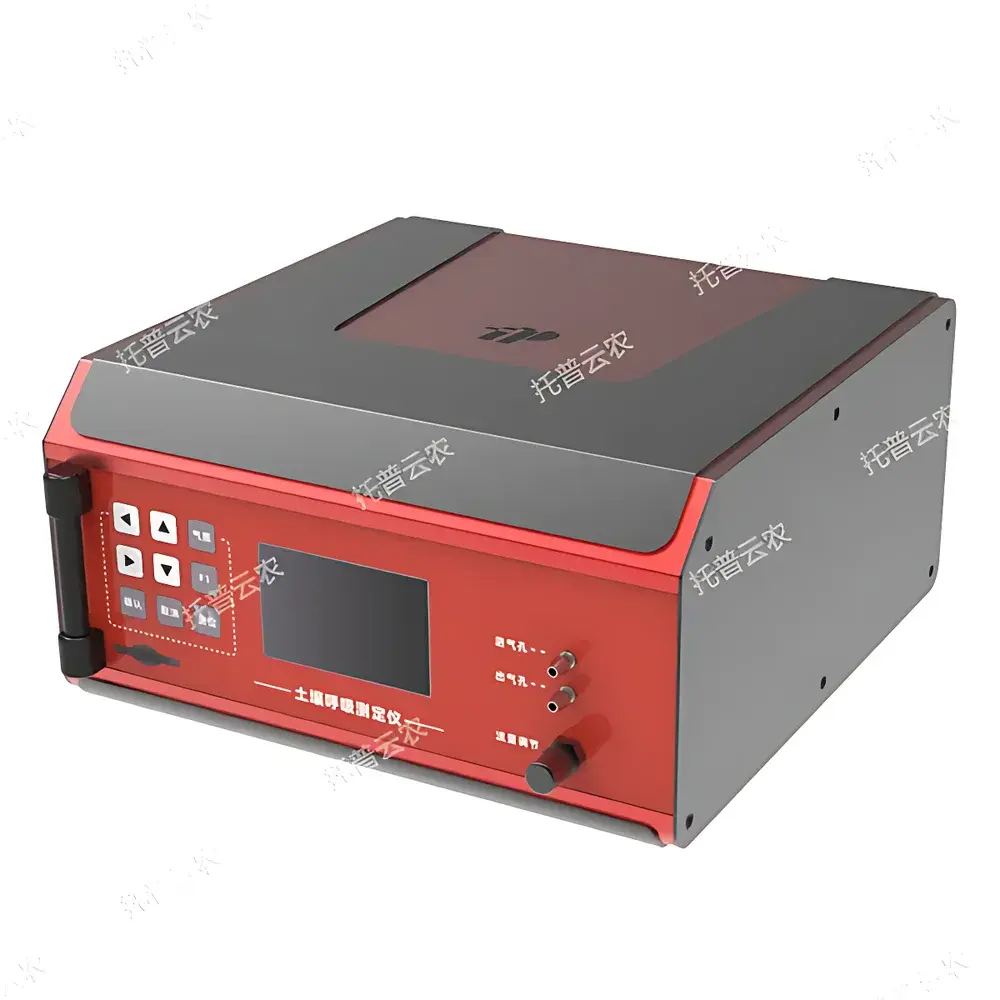
Top Cloud-agri 3051T Soil Respiration Measurement System
| Brand | Top Cloud-agri |
|---|---|
| Origin | Zhejiang, China |
| Manufacturer Type | OEM/ODM Producer |
| Country of Origin | China |
| Model | 3051T |
| Price | Upon Request |
| Display | 256×160 Dot-Matrix LCD (Chinese UI) |
| Operating Temp | –20°C to +60°C |
| Storage Temp | 0°C to +50°C |
| RH Range | 0–100% (non-condensing) |
| Power | DC 8.4 V Li-ion Battery (≥10 h continuous operation) |
| Data Storage | 2 GB SD card (≥1,000,000 records) |
| Soil Chamber Volume | 1 L |
| Chamber Dimensions | 160 mm × 110 mm × 240 mm (overall) |
| Insertion Depth | φ94 mm × 50 mm |
| Effective Volume Section | φ94 mm × 145 mm |
| Chamber Material | Outer — UPVC |
| CO₂ Sensor | NDIR, 0–5000 ppm, 0.1 ppm resolution, ±3 ppm accuracy |
| Temperature Sensor | –20°C to +80°C, 0.1°C resolution, ±0.2°C error |
| Relative Humidity Sensor | 0–100% RH, 0.1% RH resolution, ≤±1.8% RH error |
| PAR Sensor | 0–3000 µmol·m⁻²·s⁻¹, 1 µmol·m⁻²·s⁻¹ resolution, <±5 µmol·m⁻²·s⁻¹ error, spectral response 400–700 nm |
| Mass Flow Meter | 0–1.5 L/min, 0.01 L/min resolution, ±2% full-scale error |
| Flow Control | Automatic pump shutdown upon flow obstruction with diagnostic alert |
Overview
The Top Cloud-agri 3051T Soil Respiration Measurement System is a field-deployable, closed-chamber infrared gas analyzer designed for quantitative assessment of soil-atmosphere CO₂ exchange fluxes. It operates on the principle of non-steady-state closed-chamber methodology: a sealed chamber is placed over undisturbed soil, and the rate of CO₂ accumulation within the headspace is measured over time using a high-precision NDIR sensor. Concurrent in-chamber measurements of temperature, relative humidity, and photosynthetically active radiation (PAR) enable real-time environmental correction of respiration rates—critical for ecological interpretation under variable field conditions. The system supports both manual deployment and semi-automated sequential monitoring across multiple plots, making it suitable for long-term carbon flux studies in agricultural ecosystems, afforestation sites, degraded land rehabilitation zones, and climate change impact assessments.
Key Features
- Integrated multi-parameter sensing architecture: Simultaneous acquisition of CO₂ concentration (ppm), air temperature (°C), relative humidity (%RH), and PAR (µmol·m⁻²·s⁻¹) within the measurement chamber.
- Dual-material soil chamber: 1 L effective volume chamber constructed with corrosion-resistant AISI 304 stainless steel interior and UV-stabilized UPVC outer shell—optimized for mechanical durability and thermal stability during extended field exposure.
- Intelligent flow management: Micro-electromechanical mass flow meter with automatic fault detection; pump ceases operation and issues visual alert upon inlet obstruction or pressure anomaly.
- High-fidelity sensor suite: Swiss-made NDIR CO₂ sensor (±3 ppm accuracy), capacitive RH sensor (≤±1.8% RH error), and thermistor-based temperature probe (±0.2°C error) ensure metrological traceability under ambient field conditions.
- Onboard data logging: 2 GB SD card storage capacity accommodates >1 million timestamped records; configurable sampling intervals (1–3600 s) and user-defined metadata fields (operator ID, site code, protocol version).
- Field-rugged human interface: 256×160 dot-matrix LCD with Chinese-language menu navigation, real-time graphical trend display, and intuitive cursor-guided parameter configuration.
Sample Compatibility & Compliance
The 3051T system is calibrated and validated for in situ soil surface respiration measurements across diverse pedological and climatic contexts—including clay-loam agricultural soils, peatlands, alpine tundra, and post-mining reclamation sites. Its modular chamber design permits optional replacement with alternative volumes (e.g., 0.5 L or 2 L chambers) for specialized applications such as seed germination respiration assays, insect metabolic rate quantification, or postharvest fruit/vegetable shelf-life monitoring. While not certified to ISO 14064 or ASTM D6866, the instrument’s measurement protocol aligns with widely adopted field methodologies described in IPCC Good Practice Guidance for Land Use, Land-Use Change and Forestry (LULUCF) and USDA ARS Technical Bulletin 1938. Data output formats (CSV, TXT) support integration into GLP-compliant laboratory information management systems (LIMS) when paired with audit-trail-enabled data import workflows.
Software & Data Management
Raw measurement logs are exported via standard SD card reader to Windows/macOS platforms. Proprietary desktop software (compatible with Windows 10/11) enables batch processing of CO₂ slope derivation using linear regression (R² ≥ 0.95 threshold enforced), temperature-normalization via Q₁₀ correction (default Q₁₀ = 2.0), and PAR-dependent partitioning of autotrophic vs. heterotrophic contributions where root exclusion controls are applied. Exported datasets include UTC timestamps, sensor diagnostics flags, and raw analog-to-digital converter (ADC) values for traceability. No cloud connectivity or remote firmware updates are implemented—ensuring data sovereignty and compliance with institutional cybersecurity policies governing environmental field instrumentation.
Applications
- Long-term soil carbon flux monitoring in agroecosystems under varying tillage regimes, cover cropping, or organic amendment treatments.
- Evaluation of microbial community activity shifts following drought-recovery cycles or nitrogen fertilization events.
- Quantification of rhizosphere respiration dynamics in perennial crop systems (e.g., orchards, vineyards) using collar-insertion protocols.
- Baseline carbon efflux characterization in ecological restoration projects targeting degraded grasslands or afforested marginal lands.
- Controlled-environment validation of eddy covariance tower-derived net ecosystem exchange (NEE) estimates.
- Cross-species comparative respiration physiology studies involving seeds, larvae, pupae, or excised plant organs.
FAQ
What is the recommended calibration frequency for the CO₂ sensor?
Field recalibration is advised every 6 months using certified zero gas (N₂) and span gas (1000 ppm CO₂ in air), per manufacturer guidelines. Drift verification should be performed before each intensive campaign.
Can the 3051T operate unattended for multi-day deployments?
Yes—when powered by the internal 8.4 V Li-ion battery and configured for 10-minute measurement intervals, the unit sustains >72 hours of autonomous operation. External 12 V DC power input is supported for permanent station setups.
Is the PAR sensor cosine-corrected and calibrated against NIST-traceable standards?
The silicon photodiode-based PAR sensor incorporates a precision diffuser meeting ISO 9060:2018 Class B angular response specifications; factory calibration is traceable to PTB (Physikalisch-Technische Bundesanstalt) reference irradiance sources.
Does the system comply with FDA 21 CFR Part 11 requirements?
No—the 3051T is not intended for regulated pharmaceutical or clinical use; it lacks electronic signature capability, audit trail generation, or role-based access control required under Part 11.
How is chamber placement standardized across replicate measurements?
The instrument includes a stainless-steel insertion guide ring (φ94 mm) with depth stop (50 mm), ensuring consistent soil contact area and minimal root disturbance—aligned with methods published in Soil Biology & Biochemistry Vol. 42, pp. 1893–1902 (2010).
Related Products







