
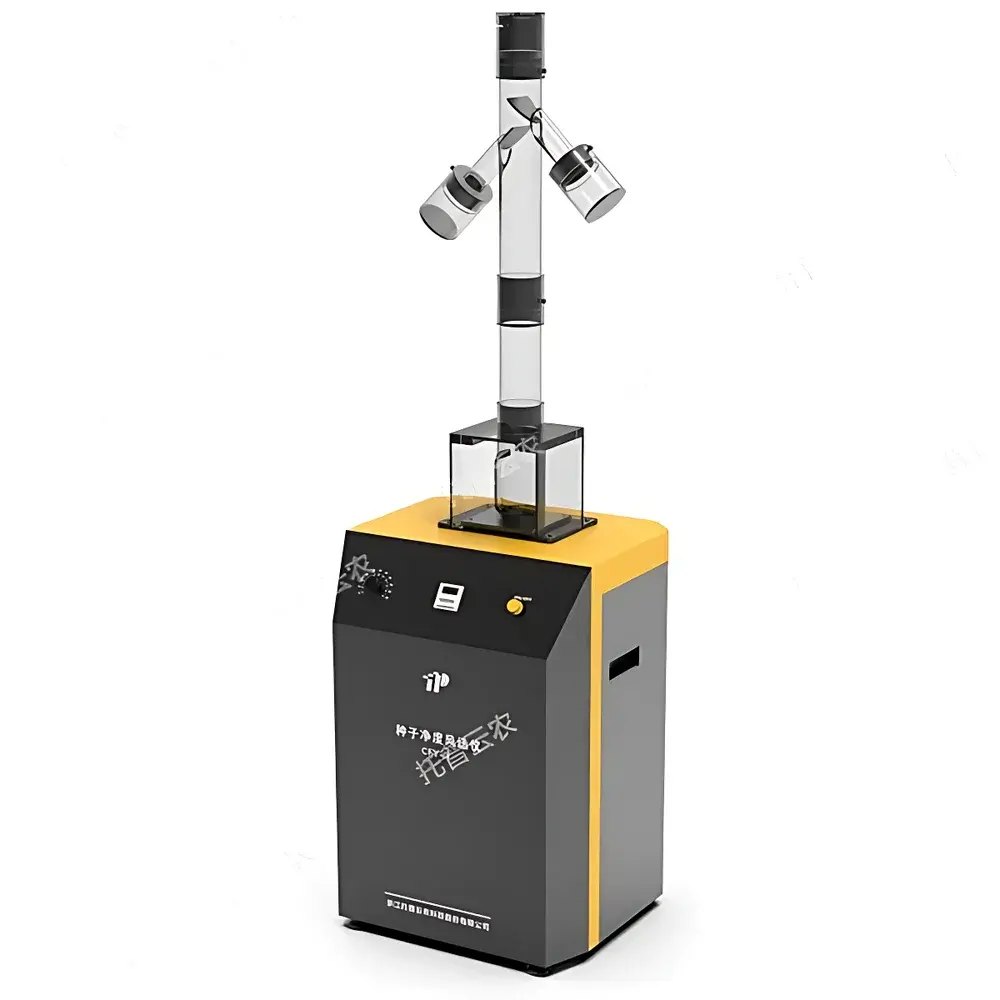
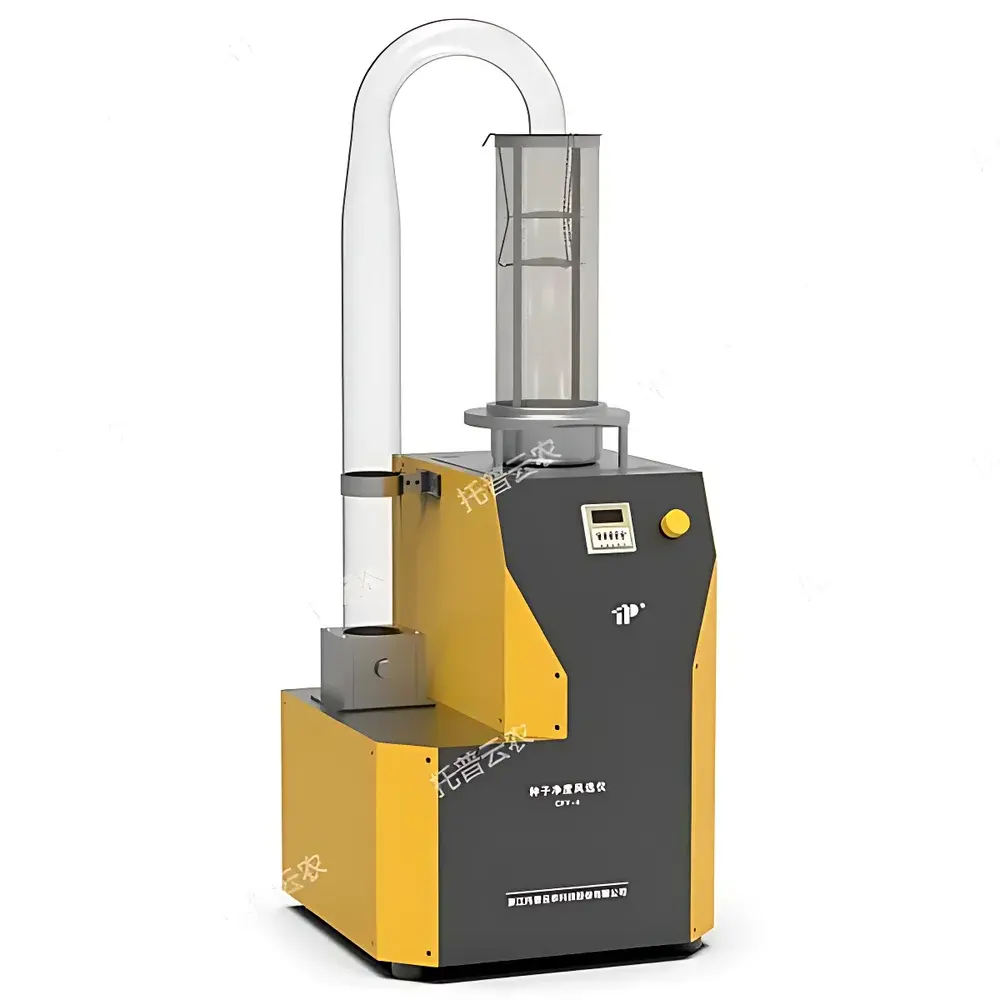
Top Cloud-agri CFY-3/CFY-4 Air-Driven Seed Purity Analyzer
| Brand | Top Cloud-agri |
|---|---|
| Origin | Zhejiang, China |
| Manufacturer Type | Direct Manufacturer |
| Country of Origin | China |
| Model | CFY-3 / CFY-4 |
| Instrument Category | Seed Purity Analyzer |
| Maximum Air Pressure | 47 Pa |
| Motor Power | 85 W |
| Timer Range | 0–99.99 h |
| Dimensions (W×D×H) | 350 × 350 × 900 mm |
| Operating Voltage | 220 V, 50 Hz |
| Sieve Mesh Size | 40 mesh |
| Motor Speed | 2600 rpm |
| Sound Pressure Level | ≤70 dB(A) |
| Air Velocity | 8.5 m/s |
| Airflow Rate | 0.250 m³/min |
Overview
The Top Cloud-agri CFY-3 and CFY-4 Air-Driven Seed Purity Analyzers are precision-engineered instruments designed for standardized seed purity testing in accordance with international seed testing protocols—including ISTA (International Seed Testing Association) and GB/T 3543.3–1995 (Chinese National Standard for Seed Testing: Purity Analysis). These analyzers operate on the principle of aerodynamic separation: particles—seeds, chaff, dust, broken fragments, and shriveled or lightweight seeds—exhibit distinct terminal velocities in a controlled vertical air stream. By precisely regulating airflow velocity, the instrument selectively lifts and removes low-density contaminants while retaining high-density viable seeds in the feed chamber or directing them into designated collection zones. This physical separation method eliminates reliance on manual sieving or subjective visual sorting, significantly improving repeatability, reducing operator bias, and enabling objective quantification of purity percentages per regulatory reporting requirements.
Key Features
- Fully metallic enclosure engineered for structural rigidity, electromagnetic shielding, and long-term durability in laboratory and field-deployable environments;
- Optically transparent borosilicate glass separation column enabling real-time observation of particle trajectory, flow dynamics, and separation efficiency without interrupting operation;
- Adjustable air velocity control via calibrated rotary dial (0–8.5 m/s range), allowing fine-tuned optimization for diverse seed morphologies—from large-grain cereals (CFY-3) to fine-seeded forage and oilseed species (CFY-4);
- Integrated timer module with 0.01-hour resolution (0–99.99 h), supporting unattended batch processing and GLP-compliant time-stamped run logging;
- Dual-path airflow architecture: primary upward draft lifts impurities into a dedicated debris cup; secondary filtered exhaust through stainless-steel mesh vent tube prevents particle rebound and ensures clean recirculation or safe ambient discharge;
- Low-noise brushless induction motor (2600 rpm, 85 W) delivering stable airflow at ≤70 dB(A), compliant with ISO 7779 acoustic emission standards for laboratory instrumentation.
Sample Compatibility & Compliance
The CFY-3 model is optimized for seeds with equivalent spherical diameters ≥2.0 mm and densities >1.1 g/cm³—such as maize, wheat, rice, soybean, adzuki bean, and black bean. The CFY-4 variant accommodates smaller, lower-density seeds (0.3–2.0 mm diameter, density ≥0.8 g/cm³), including sesame, rapeseed, brassica species, lettuce, pine nuts, and wildflower mixes. Both models support full compliance with ISTA Rule 5 (Purity Analysis), AOSA Handbook Chapter 4, and national seed certification frameworks requiring documented mechanical purification prior to germination or genetic purity assessment. All internal contact surfaces are non-reactive and cleanable, facilitating cross-sample traceability and minimizing carryover risk in multi-species workflows.
Software & Data Management
While the CFY-3/CFY-4 operates as a stand-alone electromechanical system without embedded firmware or digital connectivity, its design inherently supports audit-ready documentation under GLP and GMP regimes. Each test run is timestamped and duration-controlled, enabling direct correlation with laboratory notebooks, LIMS entries, or electronic batch records. Optional integration with external digital scales and barcode scanners allows semi-automated data capture of pre- and post-separation mass values. For regulated environments, users may configure standard operating procedures (SOPs) referencing specific air velocity setpoints, timer durations, and sieve specifications—fully traceable to ISO/IEC 17025 clause 7.2.2 (Method Validation) and FDA 21 CFR Part 11 Annex A (electronic record integrity).
Applications
- Official seed certification laboratories performing statutory purity analysis for registration and labeling;
- Agricultural research institutes conducting varietal trials, hybrid purity verification, and seed lot homogeneity studies;
- Seed production facilities implementing QC checkpoints before packaging, export, or storage;
- University breeding programs requiring reproducible separation of true-to-type progeny from off-types or mechanical admixtures;
- Phytosanitary inspection units screening imported seed consignments for quarantine-relevant contaminants.
FAQ
What standards does the CFY-3/CFY-4 comply with for official seed testing?
It aligns with ISTA Rule 5, AOSA Chapter 4, and GB/T 3543.3–1995 for mechanical purity analysis—supporting accredited lab submissions.
Can the same unit process both large and small seeds?
No. CFY-3 and CFY-4 are mechanically differentiated: CFY-3 uses higher-mass feed funnels and coarser airflow calibration for cereals; CFY-4 employs refined nozzle geometry and lower-velocity thresholds for fine seeds.
Is calibration required before use?
Yes. Users must verify airflow velocity using a traceable anemometer at the glass column inlet and confirm timer accuracy per ISO/IEC 17025 Section 6.5.2 prior to first use and at defined intervals.
How is contamination prevented between samples?
The glass column, feed cup, debris cup, and mesh vent tube are fully disassemblable and autoclavable or ethanol-rinsable; validated cleaning SOPs are provided in the technical manual.
Does the instrument require compressed air or external vacuum?
No. It is self-contained with an integrated centrifugal blower and requires only standard 220 V / 50 Hz AC power.






