
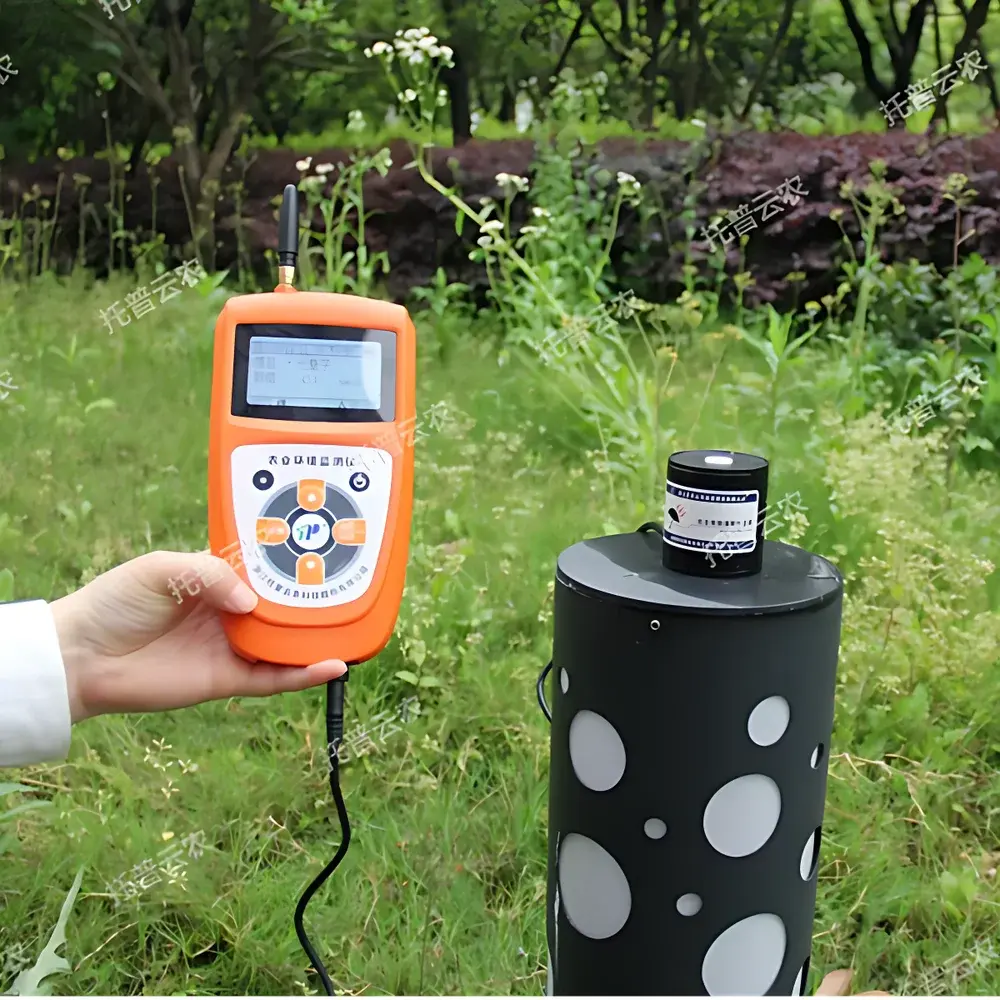
Top Cloud-agri GLZ-B-G & GLZ-C-G Photosynthetically Active Radiation (PAR) Data Logger
| Brand | Top Cloud-agri |
|---|---|
| Origin | Zhejiang, China |
| Manufacturer Type | Manufacturer |
| Model | GLZ-B-G (Single-Channel PAR), GLZ-C-G (Dual-Channel PAR + Illuminance) |
| Measurement Range | 0–2700 μmol·m⁻²·s⁻¹ |
| Resolution | 1 μmol·m⁻²·s⁻¹ |
| Illuminance Range (GLZ-C-G only) | 0–200,000 lux |
| Illuminance Resolution | 1 lux |
| Linearity Error | ±1% FS |
| UV/IR Rejection | ≤0.5% |
| GPS Accuracy | <3 m (CEP) |
| Internal Storage | 30,000 records (Flash) + optional 4 GB microSD |
| Data Transmission | GPRS, USB, RS485 |
| Power Supply | 7.4 V / 2.8 Ah Li-ion battery (with low-voltage warning & charge protection) |
| Operating Current | 10 mA (standby), configurable per sensor load |
| Sampling Interval | 5 min – 99 h |
| Display | Backlit Chinese LCD with real-time timestamp, GPS coordinates, and status indicators |
Overview
The Top Cloud-agri GLZ-B-G and GLZ-C-G Photosynthetically Active Radiation (PAR) Data Loggers are field-deployable, precision-grade instruments engineered for continuous, long-term monitoring of photosynthetically active radiation (400–700 nm) in agricultural, ecological, and environmental research applications. These devices operate on the principle of cosine-corrected silicon photodiode detection, calibrated against NIST-traceable standards to ensure spectral responsivity aligned with the quantum action spectrum of photosynthesis. The GLZ-B-G model is optimized for single-parameter PAR quantification, while the GLZ-C-G extends functionality with simultaneous dual-channel measurement of PAR (μmol·m⁻²·s⁻¹) and broadband illuminance (lux), enabling cross-modal validation and light quality assessment. Both models integrate onboard GPS geotagging, high-capacity non-volatile storage, and bidirectional GPRS telemetry—making them suitable for unattended operation across remote agroecosystems, greenhouse networks, phenotyping platforms, and flux tower auxiliary monitoring stations.
Key Features
- Cosine-corrected optical sensor head with <0.5% UV/IR spectral leakage—ensuring minimal deviation from ideal PAR quantum response
- Real-time GPS positioning (CEP <3 m) synchronized with each measurement timestamp for spatially referenced data integrity
- Dual-tier storage architecture: 30,000 records retained in internal Flash memory + expandable 4 GB microSD card for archival-grade continuity
- GPRS-enabled remote data transmission with programmable upload intervals (5 min to 99 h) and manual trigger capability
- Low-power embedded design: 10 mA standby current; intelligent power management extends field deployment to >6 months on a single battery charge
- RS485 industrial interface supporting Modbus RTU protocol—enabling integration into SCADA systems or multi-sensor data acquisition hubs
- Configurable voice alerts in Mandarin Chinese (on/off/over-limit mode) with audible threshold notification for rapid field diagnostics
- Expandable architecture: up to 32 sensor types via IP67-rated junction box—maintaining measurement independence and calibration traceability per channel
- Backlit Chinese-language LCD display showing live PAR/illuminance values, GPS coordinates, battery status, storage utilization, and system time
Sample Compatibility & Compliance
The GLZ series is designed for outdoor and semi-controlled environments—including open-field cropping systems, orchards, vineyards, controlled-environment agriculture (CEA), and ecological transects. Its weather-resistant enclosure (IP65-rated main unit, IP67 sensor cable connectors) ensures operational stability under variable humidity, temperature (-20°C to +60°C), and solar loading conditions. While not certified to IEC 61215 or ISO 9022 for photovoltaic testing, the instrument adheres to ASTM E2847-21 guidelines for spectral irradiance measurement uncertainty reporting and complies with ISO 17025-aligned calibration practices performed by Top Cloud-agri’s in-house metrology lab. Sensor linearity (±1% FS) and angular response meet FAO-recommended tolerances for agronomic PAR monitoring, and GPS metadata generation supports geospatial reproducibility required under GLP-compliant field trial protocols.
Software & Data Management
Data acquisition and visualization are managed through the proprietary Top Cloud-agri Instrument Cloud Platform—a secure, browser-based SaaS environment accessible via desktop or mobile clients (iOS and Android). The platform implements role-based user access, audit-trail logging for all data modifications, and export-ready formats including CSV, Excel, PDF, and PNG. Time-series plots support overlay analysis across multiple sensors and locations, with customizable interpolation, smoothing, and statistical aggregation (mean, min/max, standard deviation). All uploaded data are stored redundantly across geo-distributed servers with daily backups, satisfying ISO/IEC 27001-aligned data persistence requirements. Firmware updates are delivered over-the-air (OTA), and platform-side analytics tools support automated anomaly detection, threshold-based alerting (email/SMS), and scheduled report generation—facilitating compliance with internal QA workflows and external regulatory submissions where raw sensor logs must be retained for ≥5 years.
Applications
- Quantifying diurnal and seasonal PAR dynamics in crop canopy studies to model photosynthetic photon flux density (PPFD) and inform irrigation/fertilization scheduling
- Validating light distribution uniformity in vertical farms and multi-layer hydroponic systems
- Supporting eddy covariance flux tower networks by providing ground-truth PAR inputs for gross primary productivity (GPP) modeling
- Monitoring light stress thresholds in horticultural species during photoperiod manipulation trials
- Calibrating satellite-derived PAR estimates (e.g., MODIS, Sentinel-3 OLCI) using ground reference measurements with geotagged metadata
- Long-term ecological monitoring of forest understory light penetration and successional change
- Integration into smart irrigation controllers where PAR-driven evapotranspiration (ETo) algorithms require high-temporal-resolution input
FAQ
What is the spectral response range of the PAR sensor?
The sensor employs a silicon photodiode with optical filter assembly tuned to 400–700 nm, with <0.5% out-of-band (UV/IR) sensitivity—validated per DIN 5032-7 Class L specifications.
Can the GLZ-C-G differentiate between photosynthetic photon flux density (PPFD) and energy-based irradiance?
Yes—the device reports PAR as photosynthetic photon flux (μmol·m⁻²·s⁻¹) and concurrently measures illuminance (lux) using a separate broadband photopic sensor; however, it does not compute W·m⁻² or convert between photometric and radiometric units internally.
Is the GPRS module compatible with international cellular networks?
The module supports quad-band GSM (850/900/1800/1900 MHz) and is pre-configured for APN settings used in mainland China; configuration files for EU/NA carriers can be provisioned via USB or platform-side firmware update.
How is calibration traceability maintained over time?
Each sensor ships with a factory calibration certificate referencing NIST-traceable irradiance standards; users may perform field verification using a reference PAR meter, and recalibration services are available through Top Cloud-agri’s accredited service center.
Does the cloud platform support API access for third-party integration?
Yes—an authenticated RESTful API is available under enterprise licensing agreements, enabling direct ingestion into LIMS, farm management software (FMS), or custom dashboard environments with OAuth 2.0 authentication and rate-limited endpoints.






