
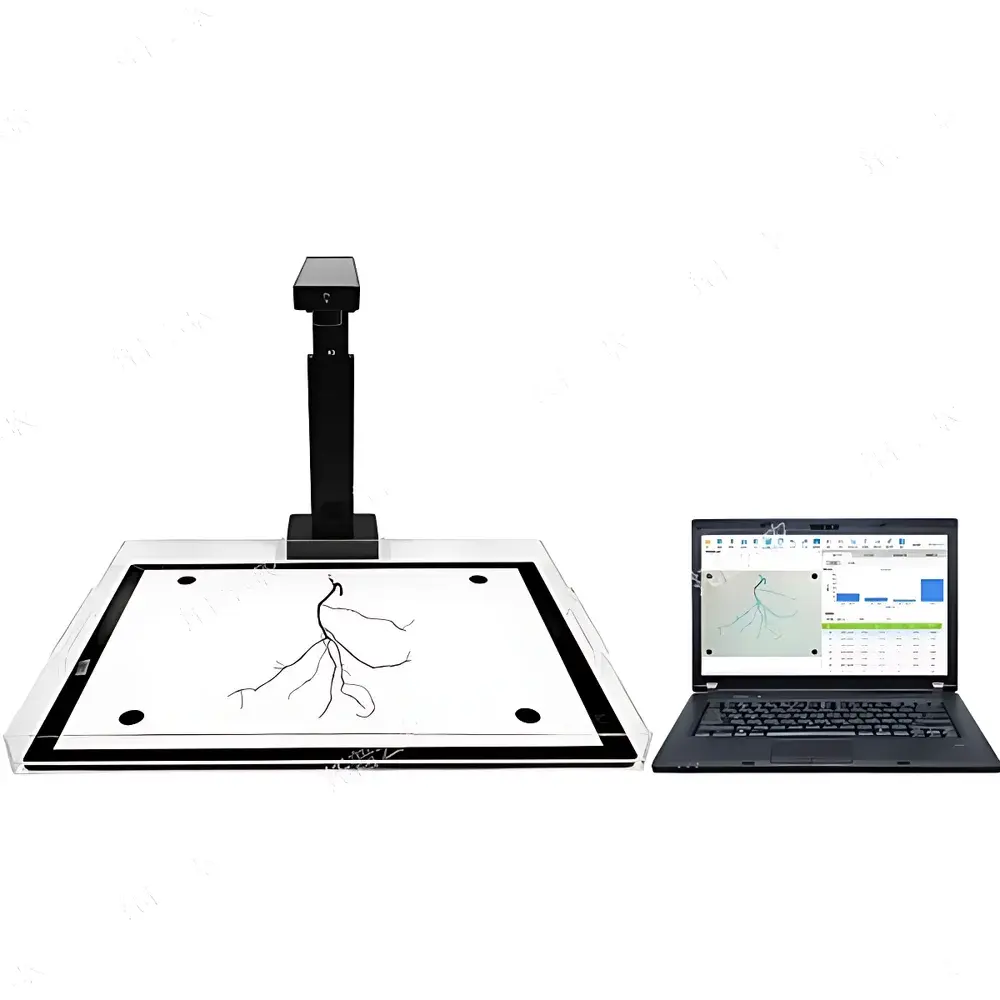
Top Cloud-agri GXY-B Photo-Based Plant Root Image Analysis System
| Brand | Top Cloud-agri |
|---|---|
| Origin | China |
| Manufacturer Type | Manufacturer |
| Model | GXY-B |
| Price | USD 7,700 (approx.) |
Overview
The Top Cloud-agri GXY-B Photo-Based Plant Root Image Analysis System is a dedicated digital image analysis platform engineered for quantitative morphometric characterization of excised plant root systems. It operates on the principle of high-resolution digital image acquisition followed by algorithm-driven segmentation, skeletonization, and topological graph reconstruction—enabling precise extraction of structural, geometric, and spatial parameters from two-dimensional root images captured under standardized lighting and scale conditions. Designed for post-washing root samples placed on flatbed scanners or digital cameras with calibrated backgrounds, the system supports non-destructive, reproducible quantification essential for plant phenotyping, root architecture modeling, rhizosphere interaction studies, and breeding program validation. Its core analytical framework aligns with established methodologies in root phenomics, including those referenced in the Root System Architecture (RSA) ontology and FAO/IAEA guidelines for root trait standardization.
Key Features
- Automated Topological Graph Reconstruction: Generates hierarchical root architecture maps with up to six defined branching orders; distinguishes primary, lateral, and higher-order roots based on connectivity and diameter gradients.
- Multi-Parameter Segmentation Engine: Performs adaptive thresholding, noise suppression, and edge enhancement to isolate root structures from heterogeneous backgrounds—supporting manual intervention for merging/splitting segments, tip correction, and fork resolution.
- Customizable Diameter-Based Binning: Enables user-defined diameter intervals (e.g., 0–0.2 mm, 0.2–0.5 mm, >0.5 mm) to compute length-weighted distributions of projection area, surface area, volume, and branching frequency per class.
- RGB & RHS Color Space Quantification: Measures chromatic attributes (Red, Green, Blue intensities; Hue, Saturation, Brightness) across root segments—supporting physiological inference such as senescence staging, nutrient deficiency mapping, or symbiotic nodule detection.
- Region-of-Interest (ROI) Analysis: Allows polygonal or rectangular selection of sub-regions within an image for localized parameter extraction—critical for heterogeneous root zones (e.g., apical meristem vs. mature zone).
- Batch Processing Workflow: Processes ≥100 images sequentially with auto-saving of intermediate results, progress checkpointing, and configurable output naming conventions compliant with FAIR data principles.
- Hardware-Agnostic Calibration: Accepts user-input pixel-to-mm conversion factors derived from embedded scale bars or reference objects—ensuring traceability across imaging devices (flatbed scanners, DSLR setups, macro lenses).
Sample Compatibility & Compliance
The GXY-B system is validated for washed, spread root specimens of dicotyledonous and monocotyledonous species—including Arabidopsis thaliana, maize (Zea mays), rice (Oryza sativa), soybean (Glycine max), and wheat (Triticum aestivum). Samples must be fully hydrated, non-overlapping, and imaged against uniform neutral-toned backgrounds (e.g., white acrylic, gray card). The software adheres to ISO/IEC 17025 documentation standards for measurement uncertainty reporting and supports audit-ready metadata tagging (operator ID, date/time stamp, instrument ID, calibration certificate reference). While not FDA 21 CFR Part 11-certified out-of-the-box, its encrypted dongle + dynamic QR authentication enables controlled access logging—facilitating GLP-compliant deployment when integrated with institutional LIMS platforms.
Software & Data Management
The proprietary analysis suite features dual-layer security: hardware-bound USB dongle authentication paired with time-limited dynamic QR code validation tied to registered institutional credentials. All processed data—including raw images, annotated skeletons, parameter tables, histograms, and ROI masks—are stored in structured folder hierarchies with ISO 8601 timestamps. Export formats include CSV and Excel (.xlsx) with column headers conforming to MIAPPE v1.1 metadata standards. Integrated cloud synchronization via the “Zhi Jian Geng Yun” mobile application enables cross-device access, role-based sharing, and version-controlled backups. Local database indexing allows rapid retrieval by experiment ID, genotype, treatment group, or phenotypic trait cluster.
Applications
- Quantitative comparison of root architectural responses to abiotic stresses (drought, salinity, low phosphorus)
- Validation of QTLs or CRISPR-edited alleles affecting root growth angle, lateral density, or basal root whorl number
- Time-series analysis of root development dynamics during seedling establishment
- Correlation of root morphology with soil penetration resistance or microbial colonization patterns
- Standardized trait extraction for international phenotyping networks (e.g., EMPHASIS, EPPN2020)
- Teaching modules in plant physiology, agronomy, and ecological modeling curricula
FAQ
What imaging equipment is required to use the GXY-B system?
A flatbed scanner (≥600 dpi optical resolution) or a DSLR/mirrorless camera equipped with macro lens and fixed-focus rig is recommended. No proprietary hardware is mandatory—the software accepts TIFF, PNG, and JPEG inputs with embedded or manually entered scale calibration.
Can the system analyze live roots in soil or hydroponic media?
No. The GXY-B is designed exclusively for ex situ, washed root systems imaged on planar surfaces. In situ root imaging requires complementary technologies such as minirhizotrons or X-ray CT.
Is batch processing compatible with mixed-species image sets?
Yes—provided consistent imaging protocols and background conditions are maintained. However, species-specific preprocessing thresholds (e.g., contrast, binarization) may require individual optimization prior to full automation.
Does the software support third-party statistical packages?
Exported Excel files are natively compatible with R, Python (pandas), SAS, and JMP. The system does not include built-in statistical inference modules but provides clean, columnar outputs optimized for downstream multivariate analysis.
How is measurement traceability ensured across laboratories?
Each analysis session logs the applied pixel-to-mm conversion factor, image preprocessing settings, and version-stamped software build number—enabling inter-laboratory reproducibility assessment per OECD Guidance Document 194 (Root Phenotyping).





