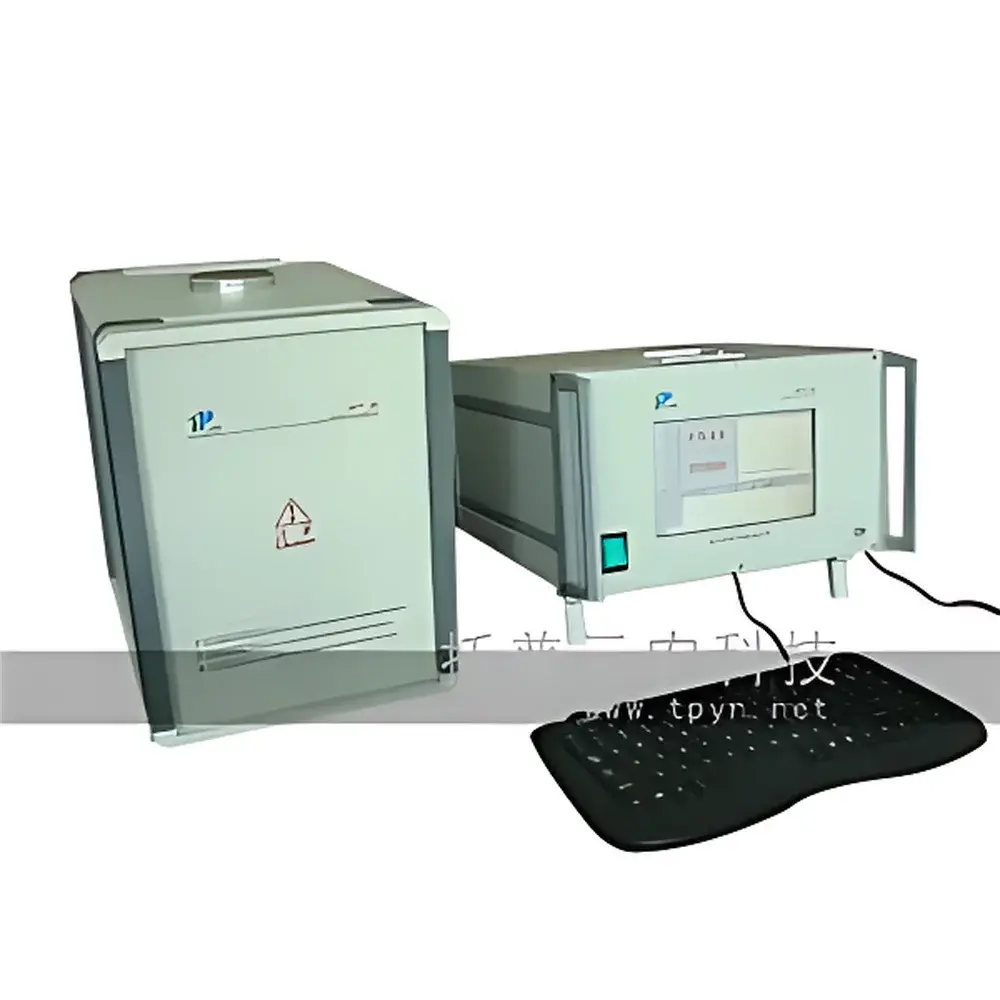
Top Cloud-agri HCY-20 Nuclear Magnetic Resonance Oil Content Analyzer
| Brand | Top Cloud-agri |
|---|---|
| Origin | Zhejiang, China |
| Manufacturer Type | Direct Manufacturer |
| Country of Origin | China |
| Model | HCY-20 |
| Power Supply | 220 V, 50 Hz |
| Rated Power | ≤40 W |
| Sample Volume | 40 mL |
| Oil Content Range | 0.1–100% (w/w) |
| Measurement Accuracy | ±0.2% (relative to reference gravimetric extraction) |
| Measurement Stability | ±0.1% (RSD over 24 h under controlled conditions) |
| Display | Color LCD with mouse & keyboard interface |
| Data Export | USB flash drive compatible |
| Firmware Update | USB-based software upgrade |
Overview
The Top Cloud-agri HCY-20 Nuclear Magnetic Resonance (NMR) Oil Content Analyzer is a benchtop, time-domain NMR instrument engineered for rapid, non-destructive quantification of total oil content in intact or ground oilseed samples. It operates on the principle of pulsed low-field NMR (typically 0.5–2 MHz proton resonance frequency), measuring the transverse relaxation decay (T2) of hydrogen nuclei predominantly associated with triglyceride-bound protons in oil. Unlike solvent-based extraction methods (e.g., Soxhlet or ASE), the HCY-20 requires no chemical reagents, sample digestion, or hazardous solvents—making it compliant with green analytical chemistry principles and aligned with ISO 10565 (oilseeds — determination of oil and/or fat content — reference method) and GB/T 15690–1995 (Chinese national standard for oil content determination in oilseeds by NMR). Designed for routine quality control and breeding program support, the system delivers quantitative results in ≤30 seconds per sample, with minimal operator training required.
Key Features
- Non-invasive measurement: Analyzes whole or homogenized seeds without grinding, drying, or solvent extraction—preserving sample integrity for downstream analysis or archival.
- Low-power operation: Rated at ≤40 W, enabling stable deployment in field laboratories, mobile testing units, or off-grid agricultural extension stations with limited power infrastructure.
- Automated frequency locking: Implements real-time RF frequency auto-tuning and magnetic field homogeneity compensation, eliminating manual shimming and reducing inter-operator variability.
- Integrated human-machine interface: Equipped with a high-resolution color LCD, full QWERTY keyboard, and optical mouse—supporting standalone operation without external PC dependency.
- Traceable calibration protocol: Factory-calibrated against NIST-traceable oilseed reference materials; supports user-defined calibration curves using certified standards (e.g., AOCS Ca 5a-40).
- Robust mechanical architecture: Shielded permanent magnet assembly with temperature-stabilized probe housing, ensuring consistent performance across ambient temperatures from 10–35 °C.
Sample Compatibility & Compliance
The HCY-20 is validated for use with major oilseed matrices including soybean, rapeseed (canola), sesame, peanut, sunflower, cottonseed, corn germ, wheat germ, and tung nut—as well as processed derivatives such as expeller cake and solvent-extracted meal. Sample preparation is limited to optional size reduction (e.g., coarse grinding to ≤2 mm particles) to ensure homogeneous packing within the 40 mL cylindrical sample tube. The method meets the repeatability requirements of GB/T 15690–1995 (RSD ≤1.5% for duplicate measurements) and is referenced in internal quality manuals of Chinese grain procurement agencies and edible oil refineries. While not FDA 21 CFR Part 11–compliant out-of-the-box, audit-ready data logs (timestamped measurement records, operator ID, calibration history) can be exported via USB for integration into GLP/GMP documentation workflows.
Software & Data Management
Built-in firmware provides real-time signal acquisition, exponential T2 decay fitting (mono- or bi-exponential models), and automatic oil content calculation using pre-loaded calibration coefficients. All measurement metadata—including pulse sequence parameters (90°–τ–180°–τ–echo), signal-to-noise ratio, and coil Q-factor—are stored with each result. Data export is supported in CSV format via USB 2.0 port for post-processing in Excel, MATLAB, or LIMS platforms. Firmware updates are delivered as signed binary packages distributed via secure USB transfer, ensuring version traceability and integrity verification. No cloud connectivity or remote telemetry is implemented—data residency remains fully under user control.
Applications
- Pre-harvest oil profiling in plant breeding programs to accelerate selection of high-oil cultivars.
- In-line quality screening at grain elevators and oilseed collection centers for contractual settlement based on oil yield potential.
- Process monitoring in oil mills to verify extraction efficiency and optimize screw press or solvent leaching parameters.
- Regulatory compliance testing for national grain grading standards (e.g., GB 1352–2009 for soybeans).
- Research applications in seed physiology, lipid oxidation kinetics, and post-harvest storage stability assessment.
FAQ
Does the HCY-20 require cryogens or radioisotopes?
No. It uses a permanent magnet and room-temperature RF electronics—no liquid helium, nitrogen, or radioactive sources are involved.
Can it measure moisture content simultaneously?
No. The HCY-20 is optimized exclusively for oil quantification. Moisture analysis requires separate instrumentation (e.g., halogen moisture analyzer or Karl Fischer titrator).
What maintenance is required?
Annual verification of magnet homogeneity and RF coil impedance; no consumables or scheduled part replacements are specified under normal operating conditions.
Is method validation support available?
Yes—Top Cloud-agri provides application notes documenting ICH Q2(R2)-aligned precision, accuracy, linearity, and robustness studies upon request for regulatory submission support.
How is measurement traceability established?
Each unit ships with a calibration certificate referencing NMR-determined oil content values of three certified reference materials (CRMs), traceable to China National Institute of Metrology (CNIM) standards.