
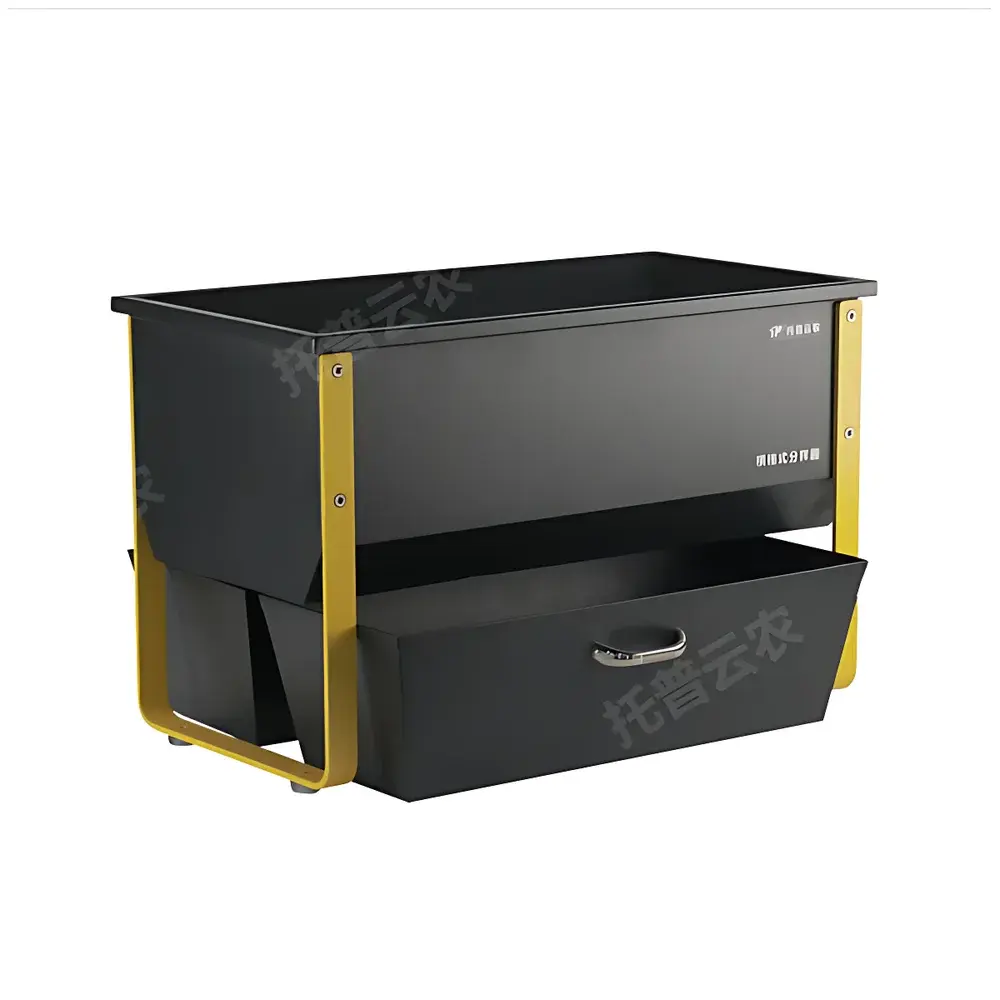
Top Cloud-agri HGG-I Horizontal Sample Divider
| Brand | Top Cloud-agri |
|---|---|
| Origin | Zhejiang, China |
| Manufacturer Type | Direct Manufacturer |
| Country of Origin | China |
| Model | HGG-I |
| Pricing | Upon Request |
| Material | Stainless Steel |
| Groove Count | 12 |
| Groove Width | 25.4 mm |
| Maximum Sample Capacity | 300–2000 g |
| External Dimensions | 420 × 240 × 280 mm |
| Applicable Seed Types | Medium-to-Large Grains (e.g., Soybean, Maize, Sorghum) |
| Compliance | Designed for ISO 5495:2005 and GB/T 5491–1985 compliant sampling procedures |
Overview
The Top Cloud-agri HGG-I Horizontal Sample Divider is a precision mechanical device engineered for reproducible, bias-free subdivision of granular agricultural samples—primarily cereal grains, oilseeds, and legumes. It operates on the principle of gravity-fed, alternating-channel splitting, where bulk material is introduced at the top inlet and guided through a series of parallel, opposing stainless-steel grooves arranged in a horizontal linear array. As the sample flows downward, each successive groove directs material into one of two symmetrical collection channels, ensuring equal mass distribution via geometric symmetry and consistent flow dynamics. This design eliminates operator-dependent variability inherent in manual quartering or coning-and-quartering methods, thereby satisfying the fundamental requirement of representative sampling as defined in international standards such as ISO 5495:2005 (“Cereals and pulses — Sampling”) and GB/T 5491–1985 (“Grain and Oilseed Sampling Methods”). The HGG-I is not an analytical instrument per se, but a critical pre-analytical tool essential for ensuring downstream test validity in moisture analysis, germination testing, mycotoxin screening, and compositional assays.
Key Features
- Stainless-steel construction: Entire groove plate and housing fabricated from corrosion-resistant 304 stainless steel to withstand repeated exposure to abrasive seeds, cleaning agents, and humid storage environments.
- 12-channel symmetric groove geometry: Precisely machined 25.4 mm wide grooves ensure uniform channel cross-sections and laminar flow partitioning—critical for maintaining mass balance across repeated splits.
- Scalable capacity range: Optimized for sample masses between 300 g and 2000 g, accommodating both routine quality-control batches and larger lot-sampling requirements typical in grain elevators and seed certification labs.
- Modular, tool-free assembly: Removable collection trays and adjustable base feet allow rapid reconfiguration for integration with downstream equipment (e.g., moisture analyzers, near-infrared spectrometers) or compliance with lab bench ergonomics.
- Traceable operation: No electrical components or software dependencies—fully mechanical function ensures operational consistency without calibration drift, firmware updates, or cybersecurity concerns.
Sample Compatibility & Compliance
The HGG-I is validated for use with medium-to-large particulate agricultural materials including maize (corn), soybean, sorghum, sunflower seeds, and dehulled barley. Its 25.4 mm groove width prevents bridging or jamming with particles up to ~12 mm in maximum dimension while maintaining sufficient surface contact for reliable trajectory control. It is explicitly excluded for fine powders (<100 µm), fibrous materials (e.g., cottonseed hulls), or highly irregular shapes (e.g., broken rice kernels), which may induce preferential channeling. For regulatory alignment, the device supports GLP-compliant sampling workflows when used in conjunction with documented SOPs (e.g., referencing ISO 6497:2022 for laboratory sample pretreatment) and integrated into audit-trail-enabled LIMS environments where split-event metadata (date, operator ID, lot number) is recorded alongside analytical results.
Software & Data Management
The HGG-I operates independently of software or digital interfaces. As a Class I mechanical sampling device under ISO/IEC 17025:2017 Annex A.3, it requires no embedded firmware, connectivity, or data logging capabilities. However, its use is fully compatible with electronic record-keeping systems: laboratories routinely log split events—including sample ID, gross weight pre-split, individual sub-sample weights post-split, and deviation tolerances (±2% recommended per ISO 5495)—within validated LIMS platforms or ELN modules. When deployed in FDA-regulated environments (e.g., feed safety testing under FSMA), operators may apply 21 CFR Part 11-compliant digital signatures to associated sampling records, provided the underlying hardware remains unchanged and maintenance logs are retained per manufacturer-recommended intervals (biannual visual inspection and groove wear assessment).
Applications
- Preparation of homogeneous subsamples for official grain grading and contract arbitration testing.
- Reduction of composite field samples prior to aflatoxin or DON quantification by HPLC or LC-MS/MS.
- Generation of replicate portions for inter-laboratory proficiency testing programs (e.g., FAPAS, GIPSA).
- Standardization of seed lots prior to accelerated aging or tetrazolium viability assays.
- Support of ISO/IEC 17025 accreditation for grain testing laboratories requiring documented chain-of-custody and sampling uncertainty evaluation.
FAQ
Is the HGG-I suitable for small-seed crops like rice or millet?
No—the 25.4 mm groove width is optimized for medium-to-large seeds. For rice, wheat, or millet, the HGT-I model (12.7 mm grooves, 16-channel configuration) is recommended.
Does the HGG-I require periodic calibration?
No calibration is required; however, annual verification of groove symmetry and tray alignment against manufacturer-provided templates is advised to maintain ≤±1.5% mass split deviation.
Can it be cleaned in an autoclave?
No—stainless-steel components are compatible with ethanol wipe-downs and alkaline detergent immersion, but thermal cycling above 80°C may compromise structural integrity of polymer seals and mounting gaskets.
What documentation accompanies shipment?
Each unit ships with a Declaration of Conformity, dimensional verification report, material certificate (EN 10204 3.1), and SOP template aligned with ISO 5495:2005 Clause 7.2.



