
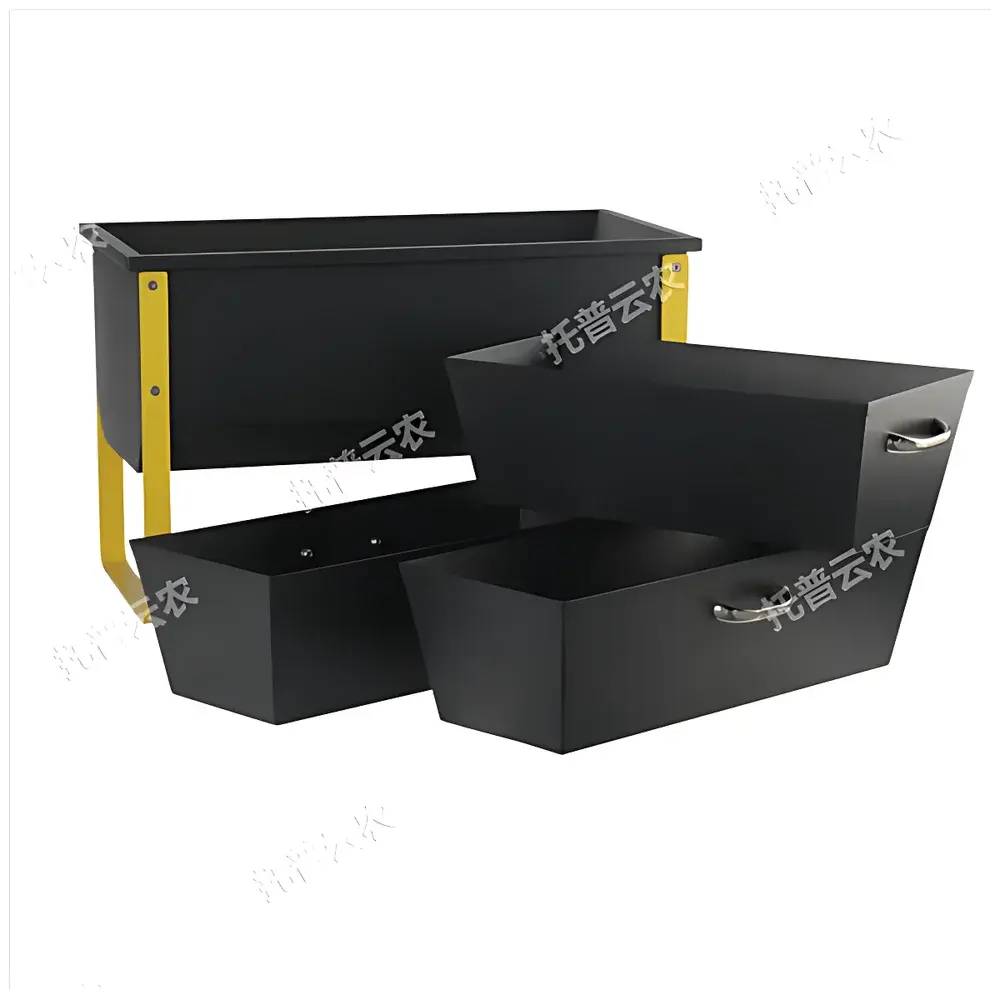
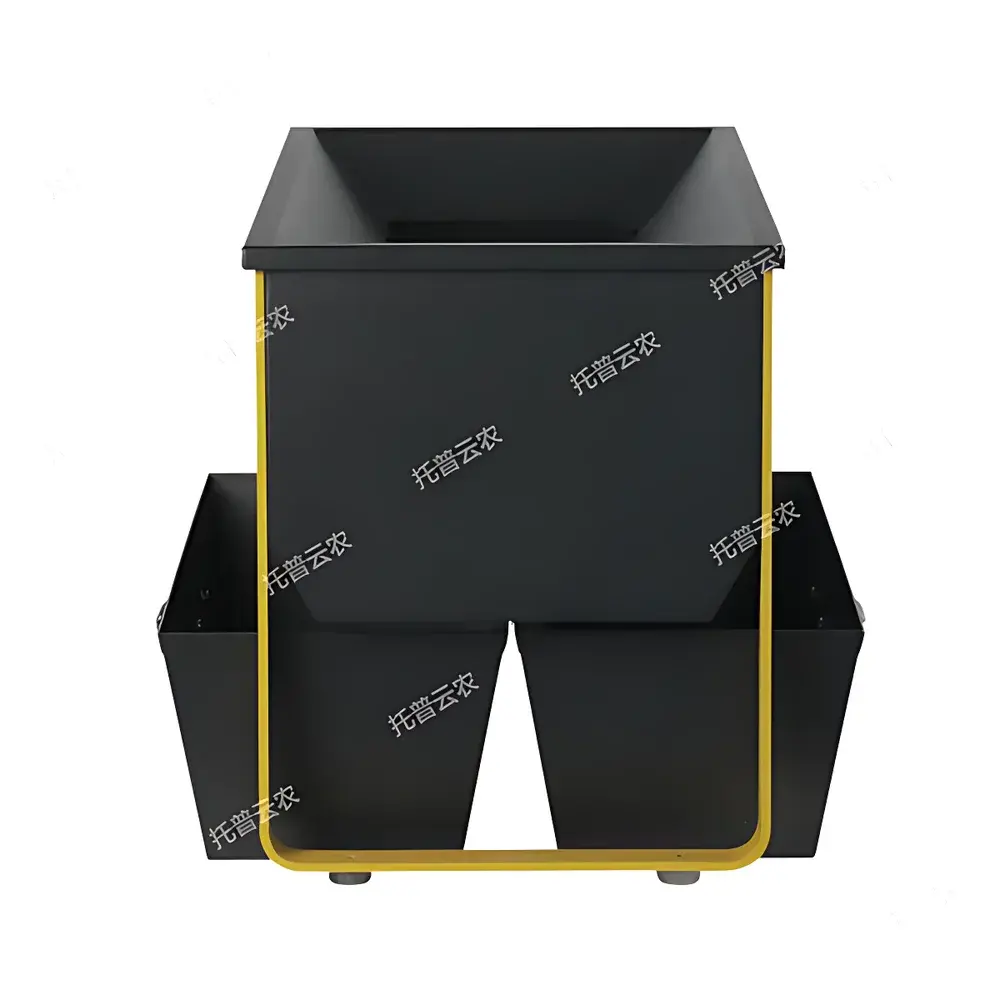
Top Cloud-agri HGG-II Stainless Steel Cross-Sectional Sample Divider
| Brand | Top Cloud-agri |
|---|---|
| Origin | Zhejiang, China |
| Manufacturer Type | Direct Manufacturer |
| Country of Origin | China |
| Model | HGG-II |
| Material | Full 304 Stainless Steel |
| Groove Configuration | 12 parallel rectangular channels |
| Channel Width | 25.4 mm |
| Maximum Sample Capacity | 300–2000 g |
| Overall Dimensions (L×W×H) | 420 × 240 × 280 mm |
| Compliance | Designed for ISO 565:2022 (Test sieves and sieving — Metal wire cloth, perforated metal plate and electroformed sheet — Nominal sizes of openings) and ASTM D6938–22 (Standard Test Method for In-Place Density and Water Content of Soil and Soil-Aggregate by Nuclear Methods) sample division protocols |
Overview
The Top Cloud-agri HGG-II Stainless Steel Cross-Sectional Sample Divider is a precision mechanical device engineered for the quantitative splitting of granular solid samples—particularly agricultural seeds, cereals, oilseeds, and bulk particulate materials—into two equal, representative sub-samples. It operates on the principle of gravitational flow combined with symmetrical channel bifurcation: when a bulk sample is introduced uniformly at the top inlet, it flows downward through a fixed array of parallel, evenly spaced stainless steel grooves. Each groove directs material toward alternating left- and right-side discharge outlets, ensuring statistically balanced mass distribution via geometric symmetry and consistent flow dynamics. This design eliminates operator bias and minimizes segregation effects common in manual or conical splitters, making it especially suitable for routine quality control, seed certification, grain grading, and regulatory sampling where reproducibility and traceability are critical.
Key Features
- Full-body construction from 304 stainless steel—resistant to corrosion, abrasion, and chemical exposure during repeated handling of oily, dusty, or humid agricultural samples;
- 12 precisely machined, parallel rectangular grooves (25.4 mm wide), arranged in a single linear row to ensure uniform cross-sectional flow distribution;
- Optimized chute geometry and surface finish (Ra ≤ 0.8 µm) to reduce particle adhesion and residual carryover between runs;
- Stable base footprint and low center of gravity (420 × 240 × 280 mm) for vibration-free operation on laboratory benches or field sampling stations;
- No moving parts or power requirements—fully passive, maintenance-free operation compliant with GLP and ISO/IEC 17025 environmental conditions;
- Calibration traceability supported via documented groove dimensional verification per ISO 565:2022 Annex B guidelines for divider validation.
Sample Compatibility & Compliance
The HGG-II accommodates a broad range of free-flowing, non-cohesive granular materials including but not limited to soybeans, paddy rice, wheat kernels, maize (corn), rapeseed, sunflower seeds, and processed feed pellets. It is validated for use with particles ranging from 2 mm to 12 mm in nominal diameter—within the scope defined by ISO 6425:2021 (Sampling of cereals and pulses) and GB/T 5491–2017 (Grain and oilseed sampling methods). The device meets structural and dimensional requirements for accredited laboratories performing sampling under ISO/IEC 17025:2017 Clause 7.6 (Sampling), and supports compliance with national seed testing regulations (e.g., ISTA Rules, Chapter 4 – Sampling) when used as part of a documented sampling procedure. All contact surfaces are food-grade compatible and suitable for GMP-aligned environments.
Software & Data Management
As a purely mechanical, non-electronic instrument, the HGG-II does not incorporate embedded firmware, data logging, or connectivity features. Its operation requires no software interface, eliminating cybersecurity concerns and ensuring uninterrupted functionality across diverse infrastructure settings—including remote field labs, mobile grain inspection units, and ISO-classified cleanrooms. However, its design facilitates full integration into digital quality management systems (QMS): each use can be recorded manually or via LIMS barcode scanning (e.g., linking divider ID, batch number, operator, date/time, and pre/post-division weights) to satisfy FDA 21 CFR Part 11 audit trail requirements when paired with certified analytical balances and standardized SOPs. Calibration records and groove wear assessments may be archived electronically per ISO/IEC 17025 documentation policies.
Applications
- Primary sample reduction in official seed certification laboratories (ISTA, AOSA, USDA-APHIS);
- Representative subsampling prior to moisture content (ISO 6540), germination (ISTA Rule 5), or purity analysis (ISO 6540);
- Preparation of test portions for near-infrared (NIR) spectroscopy calibration models;
- Field-based grain quality assessment during harvest monitoring and warehouse intake inspection;
- Reference material subdivision in proficiency testing schemes for inter-laboratory comparison studies;
- Supporting ISO 22000 and HACCP prerequisite programs through documented, repeatable sampling procedures.
FAQ
What is the recommended cleaning protocol between sample batches?
Wipe all groove surfaces and discharge chutes with lint-free, ethanol-moistened cloths; air-dry before reuse. For oily or sticky residues, ultrasonic cleaning in mild alkaline solution (pH 9–10) followed by deionized water rinse is permissible.
Can the HGG-II be used for powdered or fine-grained materials?
No—it is specifically designed for discrete, free-flowing particles ≥2 mm. Fine powders (<100 µm) will bridge across grooves and compromise splitting accuracy; use a rotary riffler or spinning cone divider instead.
Is third-party calibration certification available?
Yes—Top Cloud-agri provides optional factory-issued dimensional verification reports aligned with ISO 565:2022 groove tolerance classes, including groove width, depth, and parallelism measurements conducted using calibrated CMM equipment.
How often should groove wear be inspected?
Visual inspection before each use; dimensional re-verification annually or after 5,000 operational cycles, whichever occurs first—per ISO/IEC 17025 Clause 6.4.10 on equipment performance monitoring.
Does this model comply with international seed testing standards?
Yes—the HGG-II satisfies ISTA Rule 4.3.2 (Mechanical dividers) and AOSA Procedure 2.1 for “cross-slot type” dividers when operated per manufacturer instructions and included in a validated sampling SOP.



