
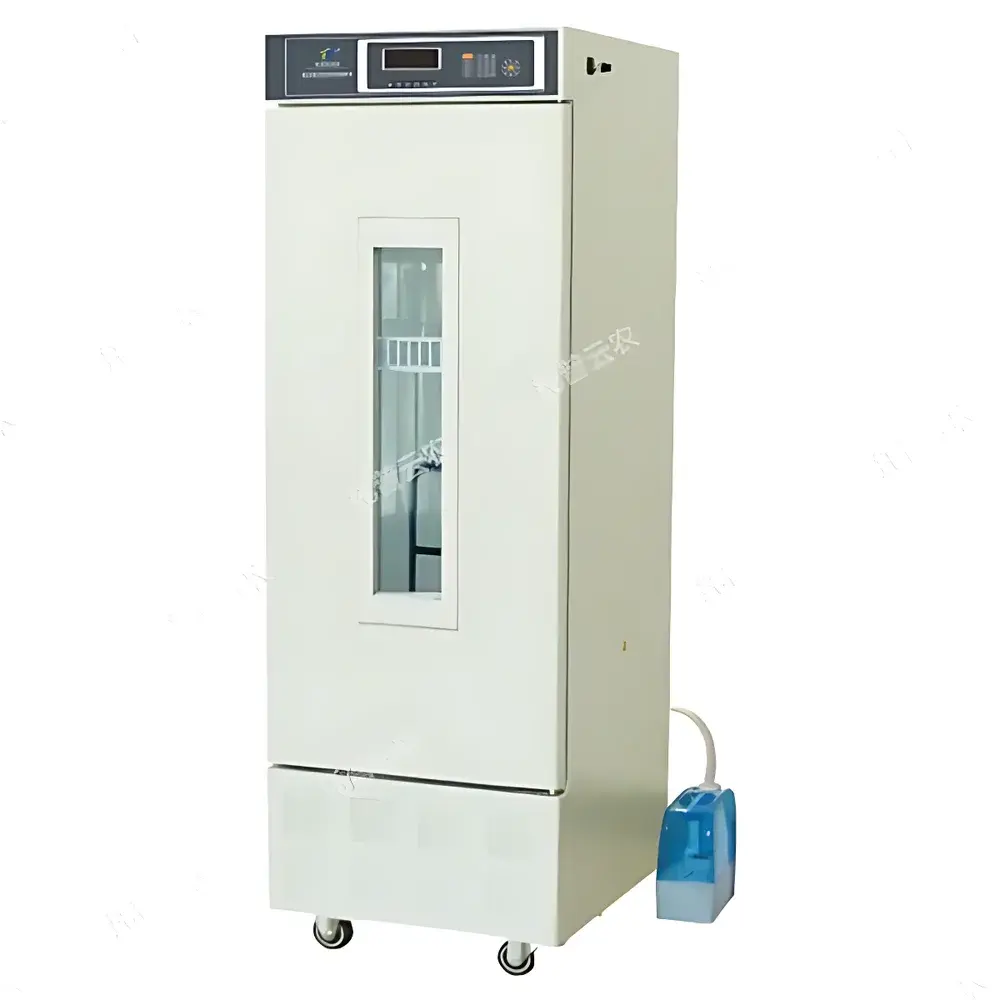
Top Cloud-agri HWS Series Temperature and Humidity Controlled Incubator
| Brand | Top Cloud-agri |
|---|---|
| Origin | Zhejiang, China |
| Manufacturer Type | Direct Manufacturer |
| Model | HWS Series |
| Temperature Range (with Humidification) | 0–50°C |
| Temperature Range (without Humidification) | 0–35°C (≤85% RH) |
| Temperature Fluctuation | ±0.5°C |
| Temperature Uniformity | ±1°C |
| Humidity Range | 50–95% RH |
| Humidity Fluctuation | ±7% RH |
| Capacity Options | 150 L to 1000 L |
| Water Reservoir | External Tank |
| Heating Power | 300–500 W |
| Cooling Power | 190–450 W |
| Compressor Delay Protection | ~3 min |
| Noise Level | <70 dB(A) |
| Operating Environment | 0–35°C, ≤85% RH, non-corrosive atmosphere |
| Power Supply | 220 ± 22 V, 50 ± 0.5 Hz |
Overview
The Top Cloud-agri HWS Series Temperature and Humidity Controlled Incubator is an engineered environmental chamber designed for precise, long-term maintenance of stable thermal and hygroscopic conditions in life science laboratories. It operates on a dual-mode thermoelectric control architecture—integrating resistive heating and vapor-compression refrigeration—to deliver accurate, independent regulation of temperature and relative humidity across defined operational envelopes. Unlike basic incubators, the HWS series incorporates active humidification via external water reservoirs and feedback-controlled ultrasonic or evaporative humidifiers, enabling reproducible moisture delivery without internal condensation risks. Its robust stainless-steel inner chamber, double-glazed observation door, and insulated perimeter construction minimize thermal bridging and ambient interference—critical for sensitive biological assays, seed germination studies, microbial culture stabilization, and stability testing of pharmaceutical intermediates per ICH Q1 guidelines.
Key Features
- Intelligent 99-segment programmable controller with real-time display of setpoints, actual chamber values (temperature/humidity), elapsed time, remaining cycle duration, and optional ambient temperature monitoring.
- Large backlit LCD interface with Chinese-language menu navigation—optimized for ease of use in academic and regional R&D facilities where multilingual operation is required.
- Dual-sensor redundancy: high-accuracy capacitive humidity sensors and PT100-grade temperature probes ensure traceable, drift-compensated measurements compliant with ISO/IEC 17025 calibration frameworks.
- Comprehensive safety architecture including over-temperature cutoff (configurable upper limit), sensor fault detection, compressor anti-short-cycling delay (~3 min), and automatic power recovery after grid interruption—with full state retention and resumption capability.
- Chamber protection logic prevents humidity control below 10°C to avoid condensation-induced corrosion or sample wetting—a design consideration aligned with USP & EP storage condition definitions for hygroscopic reference standards.
- Low-noise operation (<70 dB[A]) achieved through vibration-dampened compressor mounting and optimized airflow distribution, supporting placement in shared laboratory spaces without acoustic disruption.
Sample Compatibility & Compliance
The HWS incubator supports diverse biological and material specimens requiring controlled hygrothermal exposure—including plant tissue cultures, fungal spore viability assays, insect rearing (e.g., Drosophila melanogaster, Tribolium castaneum), small-mammal behavioral pre-acclimation, and accelerated aging of polymers per ASTM D3045. Its interior volume options (150–1000 L) accommodate standard ISO 8573-1 Class 4 cleanroom-compatible shelving configurations and stackable Petri dish racks. All models meet CE marking requirements for electrical safety (EN 61010-1) and electromagnetic compatibility (EN 61326-1). While not certified for GMP manufacturing environments, its logging-capable controller supports GLP-aligned documentation practices—including timestamped parameter records, alarm event logs, and user-accessible audit trails suitable for internal validation protocols.
Software & Data Management
Data integrity is maintained through built-in non-volatile memory that preserves all programmed cycles, sensor readings, and fault events during power loss. Optional RS485/Modbus RTU or USB data export enables integration with third-party LIMS or ELN platforms. The controller supports CSV-formatted log exports for post-hoc statistical analysis (e.g., ANOVA of RH stability across zones) and complies with basic 21 CFR Part 11 principles—user authentication, electronic signature placeholders, and immutable record timestamps are configurable. For regulatory submissions, raw data files can be archived alongside instrument qualification documents (IQ/OQ/PQ templates available upon request).
Applications
- Seed germination and plant phenotyping under standardized ICH Q5C temperature/humidity profiles.
- Microbial growth curve analysis for QC microbiology labs—especially for mesophilic fungi and psychrotolerant bacteria.
- Stability testing of diagnostic reagents, lyophilized vaccines, and excipient blends per ICH Q5C and WHO TRS 992 Annex 10.
- Environmental simulation for entomological research, including diapause induction and developmental rate modeling.
- Material science applications such as polymer hydration kinetics, desiccant performance evaluation, and corrosion susceptibility screening.
- Pre-conditioning of reference materials prior to gravimetric or spectroscopic analysis.
FAQ
What is the minimum operating temperature when humidity control is active?
Humidity regulation is disabled below 10°C to prevent condensation; temperature-only operation remains functional from 0°C upward.
Is remote monitoring supported out-of-the-box?
Standard units include local display and manual control only; RS485 Modbus or optional Wi-Fi modules enable remote supervision via custom SCADA or LabVIEW integration.
Can the incubator maintain 95% RH at 50°C?
Yes—the specified humidity range (50–95% RH) is fully achievable across the entire 0–50°C temperature span, subject to ambient dew point limitations.
How often should humidity sensors be recalibrated?
Capacitive RH sensors exhibit typical drift of ≤1% RH/year; annual verification against NIST-traceable hygrometers is recommended for GLP-compliant workflows.
Does the unit comply with FDA 21 CFR Part 11 for electronic records?
It provides foundational elements (audit trail, user roles, data immutability); full Part 11 compliance requires site-specific validation and supplementary procedural controls.





