
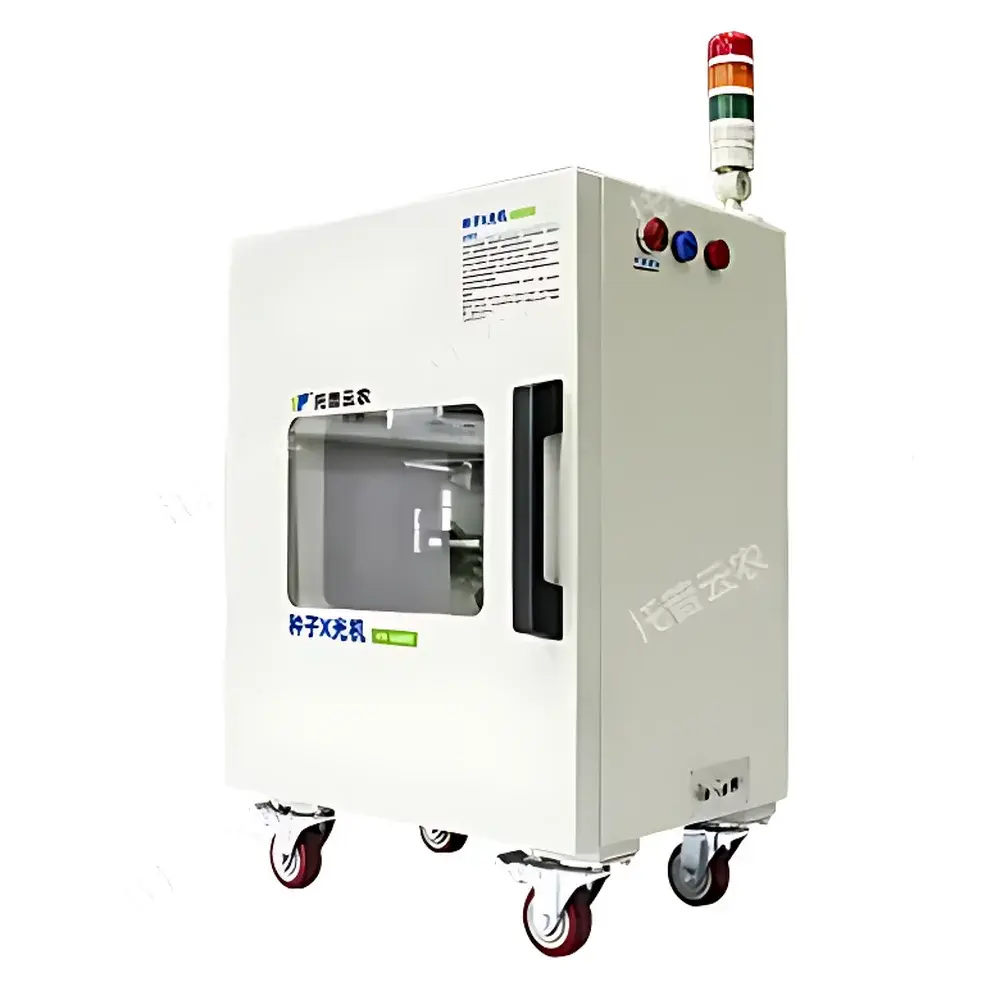
Top Cloud-agri HY-1600T Digital Radiographic Imaging System for Seed Quality Analysis
| Brand | Top Cloud-agri |
|---|---|
| Origin | Zhejiang, China |
| Manufacturer Type | Direct Manufacturer |
| Country of Origin | China |
| Model | HY-1600T |
| Instrument Category | Seed Radiography System |
| Pixel Pitch | 125 µm |
| A/D Conversion | 16-bit |
| Spatial Resolution | 4.0 LP/mm |
| Tube Voltage | 40–60 kV |
| Tube Current | 0.5–1.0 mA |
| Maximum Object Thickness Capacity | 300 mm |
| Digital Imaging Field of View | 130 × 160 mm (customizable) |
| External Dimensions | 710 × 530 × 350 mm |
| Weight | 110 kg |
Overview
The Top Cloud-agri HY-1600T Digital Radiographic Imaging System is a purpose-built, non-destructive X-ray inspection platform engineered for high-throughput seed quality assessment in agricultural research, breeding programs, and regulatory seed testing laboratories. Operating on the principle of transmission radiography, the system utilizes a microfocus X-ray source and a high-sensitivity flat-panel detector to generate high-contrast, real-time grayscale images of internal seed morphology. Unlike conventional film-based or low-resolution digital systems, the HY-1600T delivers consistent sub-millimeter structural resolution—enabling reliable differentiation among fully developed embryos, collapsed endosperm cavities (empty seeds), developmental abnormalities (e.g., fused cotyledons, missing radicles), insect infestation traces (larval tunnels, frass deposits), and physiological maturity indicators such as starch granule density distribution. Its design adheres to IEC 61331-1:2014 and GBZ 130–2020 radiation safety standards, integrating full lead shielding (≥2.0 mm Pb equivalent) to ensure operator dose compliance at the point of operation.
Key Features
- Real-time digital radiography without darkroom dependency: Integrated acquisition software captures and displays live X-ray images with latency under 150 ms, enabling immediate visual evaluation during sample positioning.
- Comprehensive image enhancement suite: Built-in tools support contrast stretching, edge sharpening via Sobel filtering, grayscale inversion, pseudo-color mapping (Jet, Hot, Viridis LUTs), localized histogram equalization, pixel-level measurement, region-of-interest cropping, and scalable zoom (up to 8× with interpolation preservation).
- Quantitative morphometric analysis: Automated and manual measurement modes calculate seed length, maximum width, projected area, perimeter, aspect ratio, and angular orientation relative to gravity vector—exportable in CSV format for statistical modeling (e.g., ANOVA, PCA).
- Dual-tier sample stage: Upper platform features micrometer-adjustable XYZ translation (±5 mm range, 0.01 mm resolution); lower platform provides extended field-of-view (130 × 160 mm) optimized for bulk screening of small-seed species (e.g., lettuce, carrot) or multi-sample trays.
- High-speed acquisition cycle: Full-image capture, reconstruction, and display completes within 3.2–3.8 seconds per sample—achievable through synchronized pulse-width modulation of the X-ray tube and zero-latency detector readout.
- Integrated reporting workflow: Includes native print driver support for direct thermal or laser printer output; all images retain embedded DICOM-compatible metadata (exposure parameters, timestamp, operator ID, calibration coefficients).
- Remote operational interface: Footswitch-triggered exposure initiation allows operators to remain outside the primary beam zone while maintaining full control over imaging sequence and parameter selection.
Sample Compatibility & Compliance
The HY-1600T accommodates intact, unprocessed seeds ranging from 0.5 mm (e.g., orchid) to 30 mm (e.g., coconut fragments) in maximum dimension. It supports both single-seed analysis and batch imaging of standardized Petri dishes or aluminum trays (up to 120 seeds per frame at 0.5 mm/pixel sampling). The system meets ISO 20292:2017 requirements for radiographic seed viability testing and aligns with national seed certification protocols under GB/T 3543.5–1995 (Rules for Seed Testing – Determination of Germination). Radiation shielding integrity is verified annually per CNAS-CL01:2018 accreditation criteria, with documented leakage tests performed at 5 cm from all surface points (measured dose ≤ 0.5 µSv/h).
Software & Data Management
The proprietary TopSeedView™ v3.2 software operates on Windows 10/11 x64 platforms and implements audit-trail functionality compliant with GLP principles: every image acquisition, annotation, measurement, and export event is timestamped and linked to user credentials. Data storage follows hierarchical folder structure (Project → Batch → Sample ID), with optional encryption (AES-256) and automatic backup to network-attached storage (NAS) via SMB protocol. Export formats include TIFF (uncompressed), PNG (lossless), and DICOM SR (structured reporting for interoperability with LIS/PACS environments). Software validation documentation—including IQ/OQ protocols—is available upon request for regulated environments subject to FDA 21 CFR Part 11 or EU Annex 11 requirements.
Applications
- Viability assessment of dormant or aged seed lots prior to sowing trials
- Detection of internal infestation by Bruchidae, Sitophilus, or Tineidae larvae in stored cereals and legumes
- Morphological phenotyping in crop breeding programs (e.g., maize kernel density mapping, rice embryo size quantification)
- Post-harvest quality control for certified seed producers (ISO 9001:2015 clause 8.5.2)
- Research into seed development disorders induced by abiotic stress (drought, heat) or phytohormone treatments
- Forensic botany applications requiring non-invasive internal structure verification
FAQ
Is the HY-1600T certified for use in GLP-compliant laboratories?
Yes—software audit trail, electronic signature support, and calibration traceability documentation are provided to meet OECD GLP Principles and national regulatory expectations.
Can the system be integrated with laboratory information management systems (LIMS)?
It supports HL7 v2.5.1 message exchange for sample ID synchronization and offers RESTful API endpoints for metadata ingestion (requires TopSeedView™ Enterprise license).
What maintenance intervals are recommended for the X-ray tube?
Annual preventive maintenance is advised; tube lifetime is rated at ≥5,000 operating hours under nominal 50 kV / 0.7 mA conditions.
Does the system require external cooling or dedicated power conditioning?
No—integrated thermoelectric cooling maintains detector temperature stability; standard 220 V ±10 %, 50 Hz single-phase input suffices.
Are custom FOV sizes supported beyond the standard 130 × 160 mm?
Yes—optical path reconfiguration allows field-of-view expansion up to 200 × 250 mm (lead time: 8–10 weeks; requires recalibration and shielding reinforcement).





