
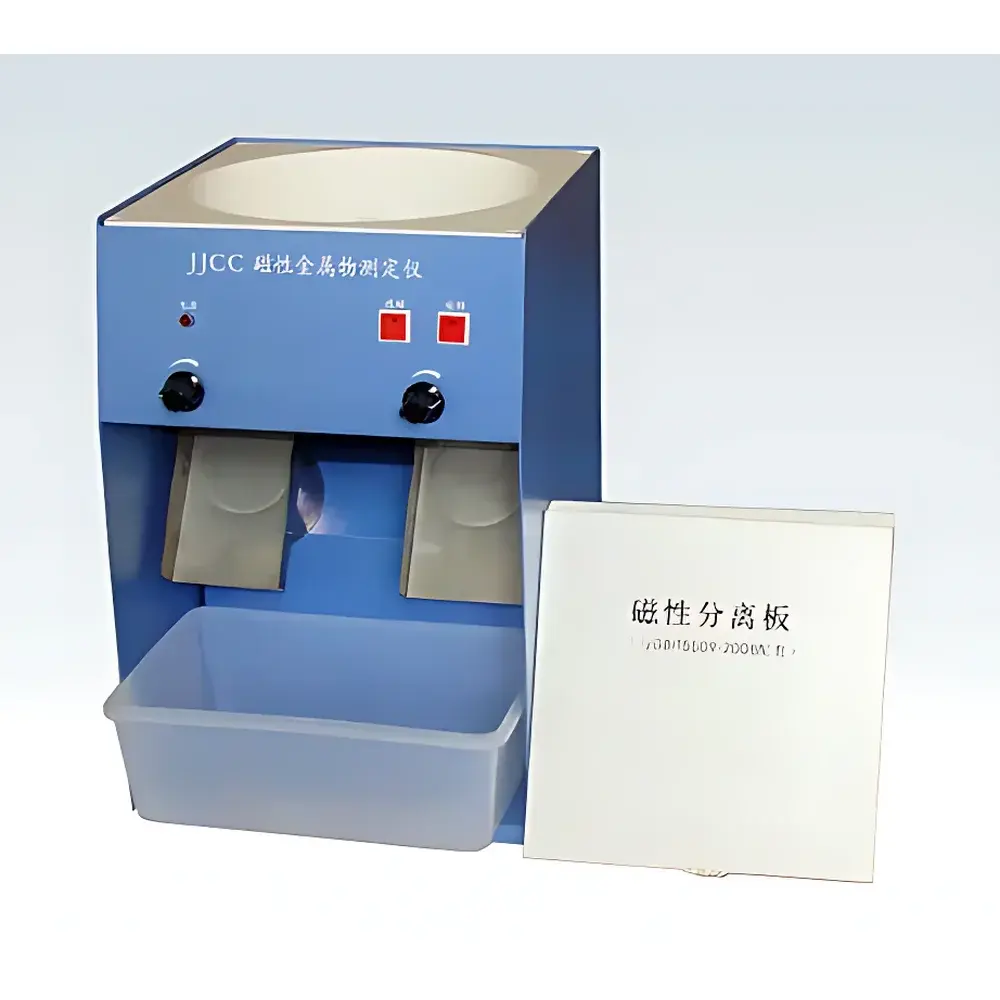
Top Cloud-agri JJCC Magnetic Metal Detector
| Brand | Top Cloud-agri |
|---|---|
| Origin | Zhejiang, China |
| Manufacturer Type | Direct Manufacturer |
| Country of Origin | China |
| Model | JJCC |
| Price Range | USD 370 – 470 (FOB) |
| Power Supply | AC (220 ± 22) V, 50 Hz, 1 A |
| Motor Speed | 50 rpm (dual-blade scraper) |
| Electromagnet Pull Force | ≥ 40 kg |
| Sample Mass | 1 kg |
| Recovery Rate | ≥ 95% |
| Dimensions (W × D × H) | 255 × 275 × 385 mm |
| Weight | 12 kg |
| Magnetic Field Strength | ≥ 120 mT |
| High-Field Zone Dimensions | 130 × 130 mm |
| Separation Plate Size | 210 × 210 × 6 mm |
Overview
The Top Cloud-agri JJCC Magnetic Metal Detector is a dedicated laboratory instrument engineered for the quantitative determination of ferromagnetic contaminants—primarily iron, steel, and nickel-based particles—in powdered cereal products, including wheat flour, rice flour, cornmeal, and other milled grain commodities. It operates on the principle of high-gradient magnetic separation (HGMS), utilizing a precisely controlled electromagnet generating a stable magnetic flux density of ≥120 mT across a defined active zone (130 mm × 130 mm). As the 1 kg test sample is uniformly spread and mechanically agitated via dual rotating scrapers at 50 rpm, ferromagnetic particles are selectively attracted and immobilized onto a stainless-steel separation plate (210 mm × 210 mm × 6 mm), enabling subsequent gravimetric quantification. Designed in strict compliance with GB/T 5509–2008 *Determination of Magnetic Metallic Substances in Cereal Flours*, this instrument replaces the hazardous carbon tetrachloride flotation method—eliminating operator exposure to toxic solvents and reducing environmental discharge risks while maintaining analytical integrity.
Key Features
- Electromagnetic separation system delivering ≥40 kg nominal pull force, ensuring robust capture of fine ferromagnetic particulates down to sub-millimeter scale.
- Dual-blade scraper mechanism with precise 50 rpm rotational control, guaranteeing uniform sample dispersion and consistent exposure to the magnetic field.
- Integrated separation plate fabricated from non-magnetic stainless steel (304 grade), dimensioned at 210 × 210 × 6 mm to maximize surface area and facilitate complete particle retention.
- Compact benchtop footprint (255 × 275 × 385 mm) and lightweight design (12 kg) suitable for QC laboratories, grain inspection stations, and mobile testing units.
- CE-compliant electrical architecture with built-in overcurrent protection and thermal cutoff, meeting IEC 61000-6-3 EMC emission standards.
- No consumables required; maintenance limited to periodic cleaning of the separation plate and calibration verification using certified reference iron powder standards.
Sample Compatibility & Compliance
The JJCC detector is validated for use with all dry, free-flowing cereal flours and milled grain products conforming to ISO 7305 (Cereals and cereal products — Sampling) and GB 5491 (General rules for sampling of cereals and cereal products). It supports routine analysis under national regulatory frameworks including China’s GB 1355 (Wheat Flour), GB/T 10463 (Corn Flour), and GB 2715 (National Food Safety Standard for Cereals). The methodology aligns with AOAC Official Method 981.11 (Magnetic Separation of Ferrous Particles) and provides traceable data suitable for GLP-compliant environments. While not intrinsically 21 CFR Part 11 compliant, its manual operation and physical record generation (weight data + visual confirmation) satisfy audit requirements for non-automated food safety testing in GMP-aligned facilities.
Software & Data Management
The JJCC is a hardware-only instrument with no embedded microprocessor or digital interface. All measurements are performed manually: post-separation, captured magnetic particles are transferred to an analytical balance (not included), and mass is recorded directly into laboratory notebooks or LIMS-compatible spreadsheets. This analog architecture eliminates software validation burdens and ensures full transparency in data lineage—critical for regulatory audits where chain-of-custody documentation must reflect direct operator intervention. Users may integrate results into enterprise systems via standardized CSV export from external balance interfaces or barcode-scanned entry workflows.
Applications
- Routine quality control in flour mills and cereal processing plants to verify compliance with maximum permissible magnetic metal limits (e.g., ≤0.003 g/kg per GB 1355).
- Raw material acceptance testing at grain elevators and procurement centers prior to milling.
- Research applications assessing wear debris from milling equipment (e.g., roller mill steel fragments) or contamination ingress during storage and transport.
- Method validation studies comparing magnetic separation efficacy against alternative techniques such as X-ray fluorescence screening or ferrography.
- Training laboratories teaching fundamental principles of magnetic susceptibility, particle separation physics, and food safety standard implementation.
FAQ
What standards does the JJCC Magnetic Metal Detector comply with?
It is fully aligned with GB/T 5509–2008 and functionally equivalent to AOAC 981.11. It supports verification against ISO 22000 and HACCP prerequisite programs for physical hazard control.
Is calibration required before each use?
Daily verification using a certified 10 mg iron reference standard is recommended; full calibration is performed annually by authorized service technicians using traceable NIST-equivalent weights and gaussmeter validation.
Can the instrument detect non-ferrous metals like aluminum or stainless steel?
No—it is specifically designed for ferromagnetic materials only. Austenitic stainless steels (e.g., 304, 316) and non-ferrous metals require complementary detection methods such as X-ray or eddy current systems.
What is the expected service life of the electromagnet assembly?
Rated for ≥50,000 operational cycles under continuous duty; coil insulation meets Class H (180°C) thermal endurance per IEC 60085.
Does the device require compressed air or external vacuum sources?
No—all mechanical motion is self-contained; only standard AC mains power is required.



