
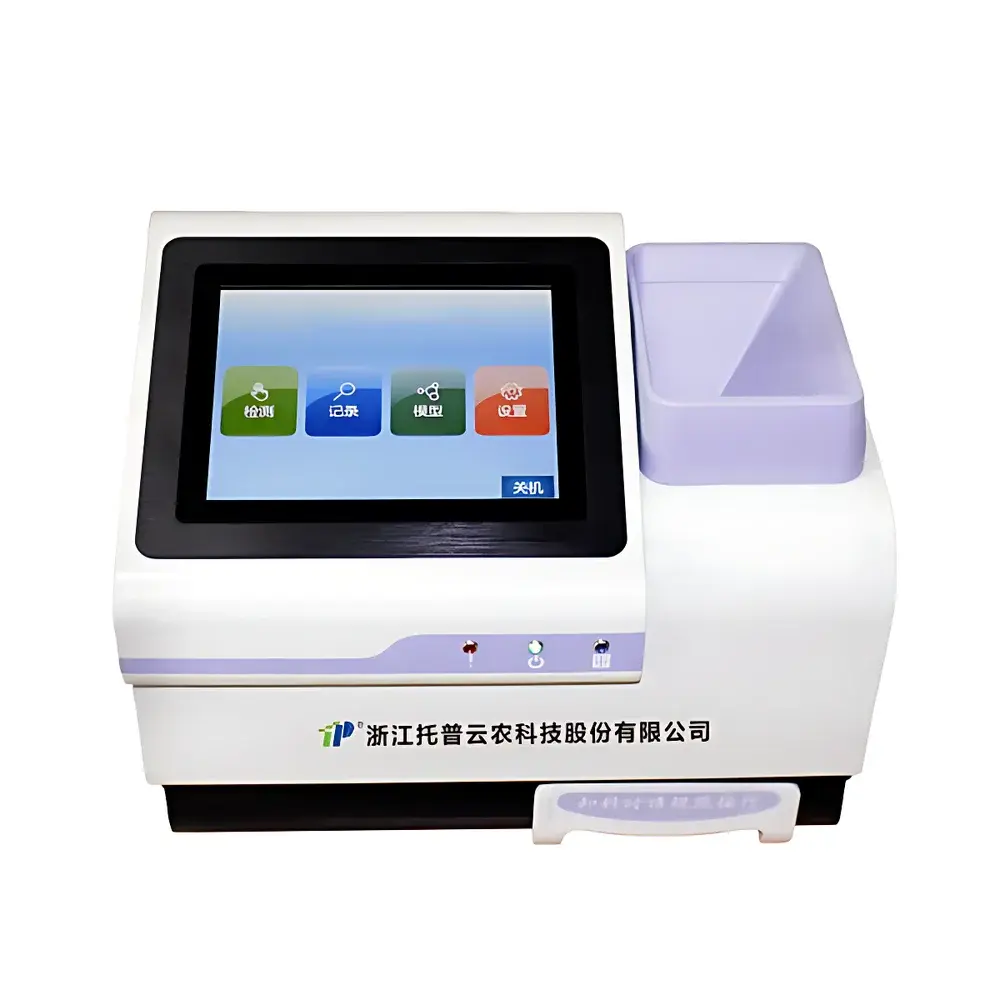
Top Cloud-agri JSWL-II Rice Taste Meter
| Brand | Top Cloud-agri |
|---|---|
| Origin | Zhejiang, China |
| Manufacturer Type | Manufacturer |
| Country of Origin | China |
| Model | JSWL-II |
| Price | USD 20,800 (FOB) |
| Detection Principle | Near-Infrared (NIR) Transmittance Spectroscopy |
| Wavelength Range | 700–1050 nm |
| Spectral Resolution | < 7 nm |
| Detector | 256-element Si photodiode array |
| Measurement Mode | Transmittance |
| Sample Form | Whole-grain brown rice and milled rice (indica & japonica) |
| Key Parameters Measured | Moisture, Protein, Amylose Content, Taste Score (Rice Taste Value) |
| Measurement Time | < 180 s |
| Operating Temperature | −10 °C to 40 °C |
| Relative Humidity Limit | ≤ 85 % RH |
| Weight | < 15 kg |
| Power Options | AC 110–220 V, DC 12–15 V (external battery), or internal Li-polymer battery (≥2 h runtime) |
| Display | 8-inch capacitive multi-touch TFT color screen |
| Storage | ≥16 GB SSD |
| Connectivity | Dual USB 2.0 ports, Ethernet, Wi-Fi |
| Software | Embedded OS with model management, audit-trail-capable data logging, GLP-compliant metadata tagging (date/time, operator ID, sample ID, calibration status) |
Overview
The Top Cloud-agri JSWL-II Rice Taste Meter is a dedicated near-infrared (NIR) transmittance spectrometer engineered for objective, non-destructive quantitative analysis of key quality parameters in paddy rice and milled rice. It operates on the principle of NIR transmittance spectroscopy—where broadband light (700–1050 nm) passes through intact whole grains, enabling deep-tissue spectral interrogation without grinding or chemical reagents. This optical configuration captures bulk compositional signatures related to moisture distribution, protein secondary structure, amylose–amylopectin ratio, and starch gelatinization behavior—all of which collectively determine the sensory and cooking properties quantified as the standardized “Rice Taste Value” (RTV). Designed for deployment across the rice value chain—from procurement centers and storage silos to milling facilities and QC laboratories—the instrument delivers field-deployable performance while maintaining laboratory-grade repeatability (CV < 1.2% for moisture; CV < 1.8% for amylose under controlled conditions).
Key Features
- Stable optical architecture: Fixed-grating monochromator with no moving parts ensures long-term wavelength fidelity and resistance to mechanical drift during transport or daily operation.
- High-fidelity signal acquisition: 256-element silicon photodiode array detector provides wide dynamic range (>4.5 OD), rapid response (<10 µs), and uniform sensitivity across the 700–1050 nm band—critical for resolving subtle spectral differences between indica and japonica cultivars.
- Transmittance-optimized sample interface: Precision-aligned optical path enables consistent light penetration through heterogeneous grain matrices, minimizing scattering artifacts and enhancing correlation between spectral response and reference wet-chemistry values (e.g., ISO 6647-1 for amylose, ISO 712 for moisture).
- Embedded industrial computing platform: Real-time Linux-based OS powers an 8-inch capacitive multi-touch display, local SSD storage (≥16 GB), dual USB 2.0 ports, and integrated Wi-Fi/Ethernet—supporting remote firmware updates, centralized model deployment, and secure data export in CSV/Excel-compatible formats.
- Multi-mode power architecture: Seamless switching among AC mains (110–220 V), external DC input (12–15 V), and internal rechargeable Li-polymer battery (≥2 h continuous operation) enables uninterrupted use in off-grid warehouses, mobile inspection vans, or harvest-side field stations.
Sample Compatibility & Compliance
The JSWL-II accepts whole, unbroken brown rice (unhulled) and milled rice (polished) from both Oryza sativa subspecies—indica (e.g., IR64, KDML105) and japonica (e.g., Koshihikari, Nipponbare)—without size sorting or pre-conditioning. Each measurement requires only 30–50 g of representative grain, loaded into a standardized quartz cuvette. The instrument’s calibration models are developed and validated against AOAC Official Methods (992.15 for moisture, 984.27 for protein) and national Chinese standards (GB/T 17891–2017 for rice quality grading, GB/T 21367–2008 for NIR analysis of cereal grains). Data logs include timestamp, operator ID, ambient temperature/humidity, instrument thermal stability status, and model version—ensuring traceability per GLP and internal QA requirements. While not FDA 21 CFR Part 11-certified out-of-box, the system supports configurable user authentication, electronic signature prompts, and immutable audit trails when deployed with validated IT infrastructure.
Software & Data Management
The embedded software suite implements a hierarchical model management framework compliant with ISO/IEC 17025:2017 Clause 7.7 (Sampling and Calibration). Users may import, validate, and activate region-specific PLS regression models for moisture, protein, amylose, and RTV—each accompanied by uncertainty estimates and residual error distributions. All measurements are automatically tagged with contextual metadata: sample type (brown/milled, indica/japonica), lot number, acquisition date/time, and environmental sensor readings. Historical records support multi-dimensional search (by date range, parameter, cultivar, or operator) and batch export to external LIMS via SFTP or USB drive. Firmware updates preserve historical calibration coefficients and retain user-defined model sets—eliminating revalidation overhead during routine maintenance cycles.
Applications
- Grain procurement: Rapid screening of incoming paddy lots against contractual moisture (<14.5%) and amylose thresholds (<20% for premium japonica) prior to silo entry.
- Milling process control: Monitoring real-time changes in protein content and taste score across polishing stages to optimize yield versus quality trade-offs.
- Storage monitoring: Detecting early-stage moisture migration or localized heating events via longitudinal RTV deviation trends in static stockpiles.
- Research & breeding programs: High-throughput phenotyping of segregating populations for taste-related QTLs using standardized spectral fingerprints.
- Regulatory compliance: Generating auditable reports for national rice grading authorities (e.g., China National Grain and Oils Information Center) and export certification bodies.
FAQ
What rice varieties are supported by factory-calibrated models?
The JSWL-II includes pre-loaded PLS models for 12 major commercial indica and japonica cultivars grown in China’s Yangtze River and Northeast regions. Custom models for other varieties can be developed using ≥200 reference samples analyzed by AOAC-approved wet chemistry methods.
Is sample grinding required before measurement?
No. The transmittance design requires only intact, unbroken kernels—preserving structural integrity and eliminating preparation bias associated with milling heterogeneity.
How often must the instrument be recalibrated?
Optical alignment and wavelength verification are performed at factory shipment. Routine performance verification uses a certified NIR transmission standard (NIST-traceable quartz slide); recommended frequency is biweekly for high-volume labs and monthly for field units.
Can the device connect to enterprise LIMS systems?
Yes—via Ethernet or Wi-Fi using configurable RESTful API endpoints or flat-file synchronization protocols (CSV/JSON). Integration documentation and test scripts are provided upon request.
Does the system meet international food safety documentation standards?
It supports GLP-aligned data governance (user roles, audit logs, electronic signatures) and aligns with ISO 22000 clause 8.4.2 for analytical method validation; formal GMP/21 CFR Part 11 validation is customer-responsibility and requires site-specific IQ/OQ/PQ protocols.






