
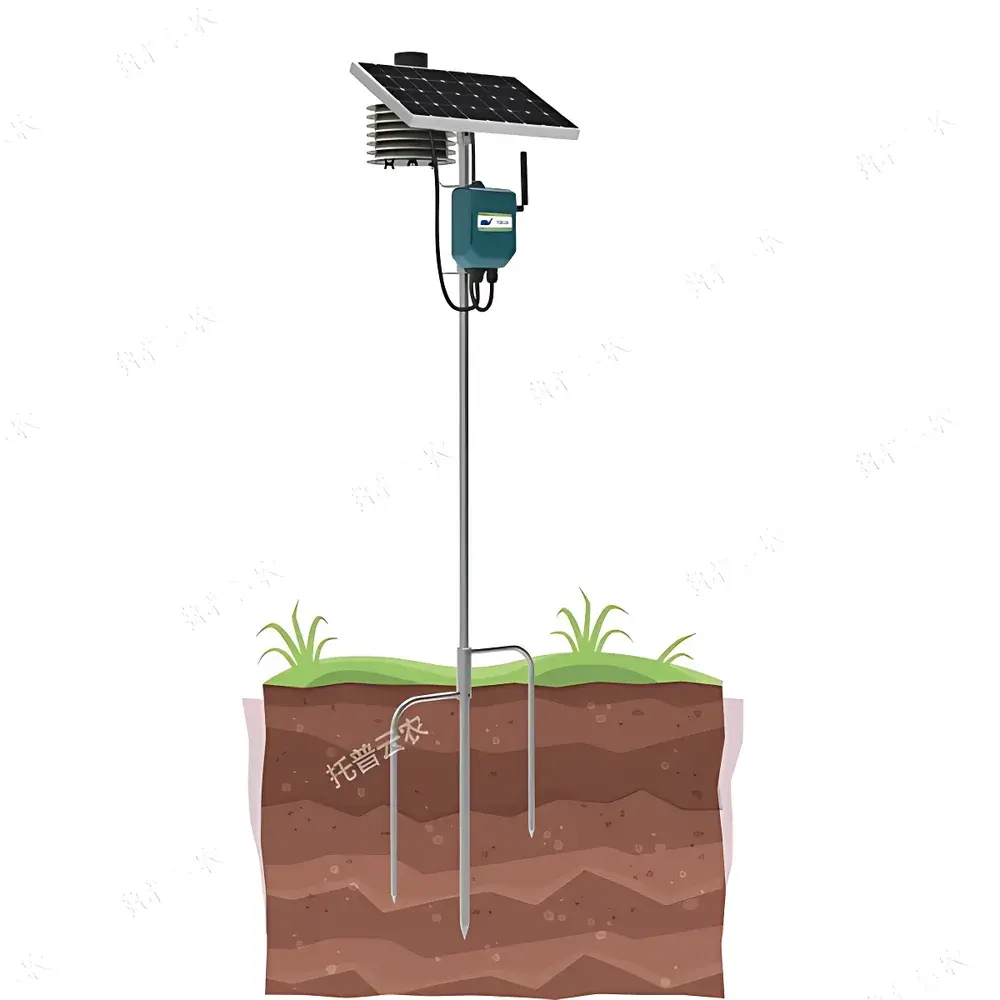
Top Cloud-agri JWY-III-C Accumulated Temperature and Photosynthetic Photon Flux Density (PPFD) Recorder
| Brand | Top Cloud-agri |
|---|---|
| Origin | Zhejiang, China |
| Manufacturer Type | OEM Manufacturer |
| Country of Origin | China |
| Model | JWY-III-C |
| Power Supply | Solar Panel with Rechargeable Battery |
| Operating Temperature | -10°C to 70°C |
| Air Temperature Range | -40°C to 120°C |
| Temp. Accuracy | ±0.4°C |
| Temp. Resolution | 0.1°C |
| PPFD Spectral Response | 400–700 nm |
| PPFD Range | 0–2700 μmol·s⁻¹·m⁻² |
| PPFD Resolution | 1 μmol·s⁻¹·m⁻² |
| PPFD Accuracy | ±0.5% of reading ±1 μmol·s⁻¹·m⁻² |
| PPFD Linearity | ±1% full scale |
| PPFD Long-term Drift | <±2% per year |
| Temp. Sampling Interval | 5 min – 12 h (configurable) |
| PPFD Sampling Interval | 1–60 min (configurable) |
| Data Storage | MicroSD card (up to 32 GB) |
| Communication | GPRS + Web-based Cloud Platform + Mobile App (iOS/Android) |
| Compliance | Designed for agricultural microclimate monitoring in accordance with FAO-56 guidelines for reference evapotranspiration (ET₀), ISO 9060:2018 Class C spectral responsivity, and GLP-aligned data integrity practices |
Overview
The Top Cloud-agri JWY-III-C Accumulated Temperature and Photosynthetic Photon Flux Density (PPFD) Recorder is an autonomous, solar-powered environmental monitoring instrument engineered for long-term deployment in unattended field conditions. It implements dual-parameter bioclimatic measurement based on two fundamental agronomic indices: accumulated temperature (degree-days) and photosynthetically active radiation (PAR) integral—expressed as cumulative PPFD (μmol·s⁻¹·m⁻²·day⁻¹). The device employs a high-stability thermistor for air temperature sensing and a calibrated silicon photodiode sensor with cosine-corrected optical diffuser to capture incident PAR irradiance across the 400–700 nm photosynthetic band. All measurements are time-stamped, logged locally to removable microSD storage, and transmitted remotely via embedded GPRS module to a secure, browser-accessible cloud platform. Its architecture supports continuous operation under variable solar insolation, making it suitable for remote orchards, experimental farms, seed breeding stations, and ecological observatories where grid power is unavailable.
Key Features
- Solar-rechargeable power system with intelligent charge management ensures uninterrupted operation for >12 months without maintenance in mid-latitude temperate zones.
- Configurable sampling intervals: temperature acquisition from 5 minutes to 12 hours; PPFD sampling from 1 to 60 minutes—enabling optimization between temporal resolution and battery longevity.
- On-device voice播报 (via integrated speaker) delivers real-time audible readouts of accumulated temperature (°C·day) and PPFD integral (mol·m⁻²·day⁻¹), facilitating rapid field verification without mobile interface.
- Customizable biological thresholds: users define base temperature (Tb) per crop species, enabling automated calculation of active accumulation (T > Tb) and effective accumulation (Tmin ≤ T ≤ Tmax), aligned with phenological modeling standards.
- Integrated ET₀ engine computes daily reference evapotranspiration using the FAO-56 Penman-Monteith equation, requiring only measured temperature, PPFD-derived net radiation estimation, and user-input elevation and latitude.
- Robust IP65-rated enclosure with UV-stabilized polycarbonate housing withstands prolonged exposure to rain, dust, and solar ultraviolet degradation.
Sample Compatibility & Compliance
The JWY-III-C is designed for outdoor atmospheric microclimate monitoring in open-field agriculture, greenhouse perimeter zones, and agroforestry transects. It does not require sample preparation or consumables. Sensor calibration traceability follows manufacturer’s internal SOPs aligned with ISO/IEC 17025 principles. While not certified to IEC 61215 or UL 1703, its solar panel and battery subsystem comply with RoHS Directive 2011/65/EU. Data integrity mechanisms—including timestamped logs, cyclic redundancy check (CRC) validation on SD writes, and immutable cloud-side audit trails—support documentation requirements under Good Agricultural Practice (GAP) and national crop insurance verification protocols. The system meets spectral responsivity criteria specified in ISO 9060:2018 for “Class C” pyranometers when used for relative PAR assessment.
Software & Data Management
The instrument interfaces with the Top Cloud-agri Instrument Cloud Platform—a B/S architecture SaaS environment accessible via HTTPS. The platform provides role-based access control, TLS 1.2 encryption, and automatic daily backup to geo-redundant cloud storage. Users configure alert rules (e.g., accumulated temperature exceeding 850 °C·day for rice heading stage), assign SMS notifications to up to three designated phone numbers, and schedule firmware updates over-the-air. Raw time-series data export is supported in CSV and NetCDF 4.0 formats. All calculations—including daily mean/max/min temperature, diurnal PPFD integral, ET₀, and deviation from historical baselines—are performed server-side using deterministic algorithms compliant with FAO and WMO metadata conventions. Audit logs record all user actions (login, parameter change, calibration event) with ISO 8601 timestamps, satisfying basic GLP data traceability expectations.
Applications
- Phenological stage prediction for cereal crops (wheat, rice, maize) using thermal time models calibrated to local cultivars.
- Light-use efficiency (LUE) analysis in canopy-level carbon assimilation studies.
- Validation of satellite-derived PAR products (e.g., MOD08_M3, ERA5-Land) at ground-truth sites.
- Regulatory compliance reporting for protected designation of origin (PDO) vineyards requiring documented growing-degree-day accumulation.
- Climate resilience trials assessing varietal responses to altered heat-unit accumulation patterns under climate change scenarios.
- Extension service dashboards delivering localized planting/harvest advisories to farmer cooperatives via mobile push notifications.
FAQ
What base temperature values are preloaded for common crops?
The device ships with default Tb settings for 12 major species (e.g., 10°C for wheat, 12°C for rice, 8°C for potato), editable via web interface or mobile app.
Can the unit operate during extended cloudy periods?
Yes—the lithium-iron-phosphate battery sustains >14 days of continuous logging without solar recharge, assuming nominal sampling intervals and ambient temperatures above 0°C.
Is sensor calibration certificate included?
A factory calibration report (including serial-numbered sensor ID, date, and deviation values against NIST-traceable references) is provided with each unit; field recalibration is recommended every 24 months.
How is PPFD converted to daily light integral (DLI)?
The platform automatically integrates PPFD readings (μmol·s⁻¹·m⁻²) over time to compute DLI in mol·m⁻²·day⁻¹, applying trapezoidal numerical integration with sub-minute interpolation where gaps occur.
Does the system support integration with third-party farm management software?
Yes—RESTful API endpoints are available for authorized partners, supporting OAuth2 authentication and JSON-formatted data exchange compatible with ISO 11783-10 (ISOBUS) telemetry schemas.
Related Products







