
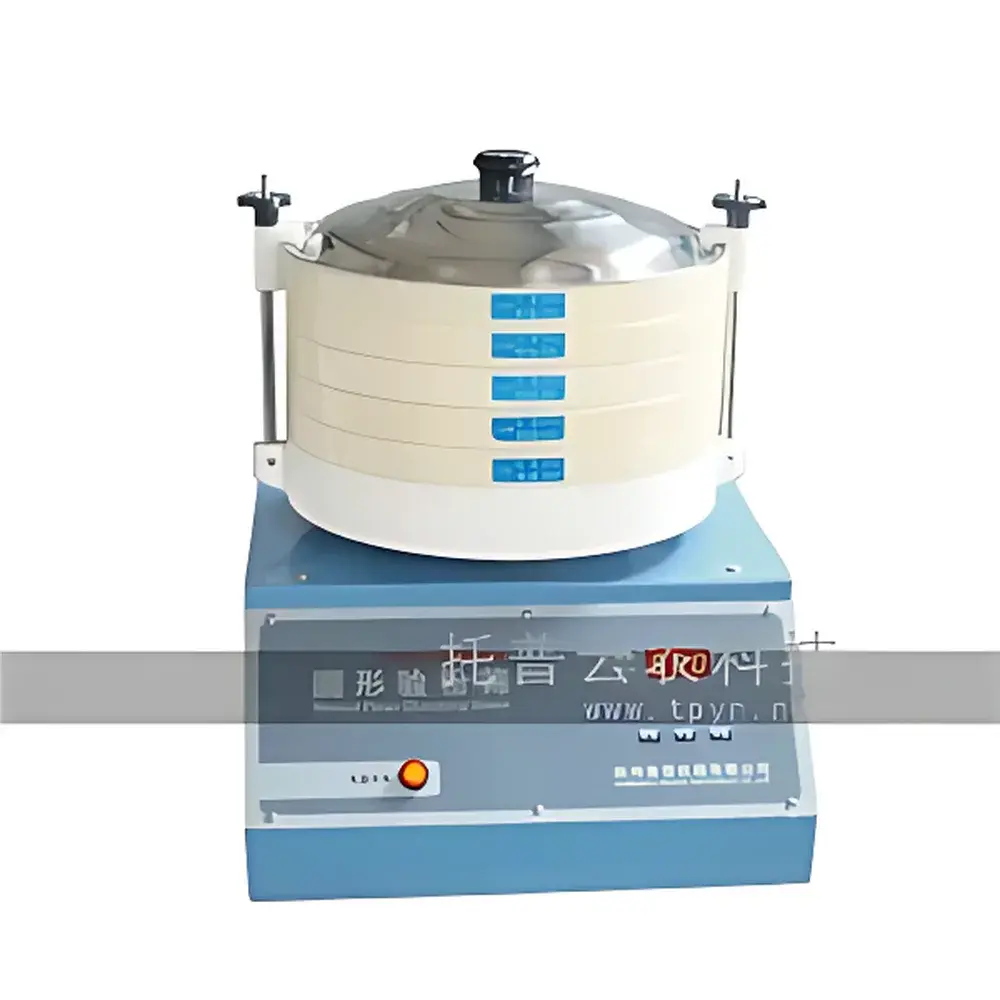
Top Cloud-agri JYSY30×8 Electric Circular Sieve Shaker for Flour Particle Size Analysis
| Brand | Top Cloud-agri |
|---|---|
| Origin | Zhejiang, China |
| Manufacturer Type | Direct Manufacturer |
| Country of Origin | China |
| Model | JYSY30×8 |
| Price | USD 920 (approx.) |
| Sieve Diameter | 300 mm |
| Sieve Height | 30 mm |
| Orbit Diameter | 50 mm |
| Rotational Speed | 260 rpm |
| Sample Mass | 50.0 g |
| Timer Range | 0–999 s |
| Motor Power | 60 W |
| Standard Sieve Set | CQ10 (25 mesh), CQ16 (41 mesh), CQ20 (51 mesh), CQ27 (69 mesh), CB30 (76 mesh), CB36 (91 mesh), CB42 (107 mesh) |
Overview
The Top Cloud-agri JYSY30×8 Electric Circular Sieve Shaker is a precision laboratory instrument engineered for standardized particle size distribution analysis of milled cereal flours and related powdered food commodities. It operates on the principle of horizontal circular motion—also known as planar orbital sieving—where a sample is subjected to controlled, uniform oscillation across stacked, nested sieve frames of defined mesh apertures. This mechanical separation method complies strictly with GB/T 5507–2008, the People’s Republic of China National Standard for “Grain and Oil Inspection – Determination of Coarseness in Flour.” Unlike vertical tapping or vibratory shakers, the JYSY30×8 employs a low-center-of-gravity worm gear reduction drive coupled with an eccentric connecting rod mechanism to generate stable, repeatable 50 mm orbit diameter motion at 260 rpm. This architecture minimizes dynamic imbalance, reduces mechanical wear, and ensures high reproducibility in residue quantification across replicate analyses—critical for QC laboratories performing routine flour grading, mill process validation, or raw material acceptance testing.
Key Features
- Compliant mechanical design validated against GB/T 5507–2008 for flour coarseness determination
- Worm gear transmission system with optimized inertia profile for smooth, low-vibration orbital motion
- Microcontroller-based digital timer with ±1 s accuracy over 0–999 s range, supporting programmable run cycles and emergency stop functionality
- Integrated balance-weighted chassis and coaxial pressure rod assembly ensuring uniform clamping force across all 300 mm diameter sieve frames
- Modular sieve stack configuration accommodating up to seven nested standard sieves (25–107 mesh) without realignment
- 60 W brush-type motor with thermal overload protection, rated for continuous operation under ISO 50001-aligned energy efficiency parameters
Sample Compatibility & Compliance
The JYSY30×8 is specifically calibrated for dry, free-flowing particulate matrices including wheat flour, rice flour, cornmeal, soybean meal, and other milled cereal derivatives. It is not intended for agglomerated, hygroscopic, or electrostatically charged powders without prior conditioning. All operational parameters—including 50.0 g nominal sample mass, 300 mm sieve diameter, and 260 rpm orbital frequency—are harmonized with the procedural requirements of GB/T 5507–2008. While this standard is nationally binding in China, its methodology aligns conceptually with ASTM E11 (Specification for Woven Wire Test Sieve Cloth and Test Sieves) and ISO 3310-1 (Test sieves — Technical requirements and testing — Part 1: Test sieves of metal wire cloth). The instrument supports traceable sieve calibration via certified reference sieves (e.g., ISO/IEC 17025-accredited providers) and may be incorporated into GLP-compliant workflows when paired with documented SOPs and maintenance logs.
Software & Data Management
The JYSY30×8 operates as a standalone electromechanical system with no embedded firmware or network interface. Timer settings and run status are displayed via LED indicators; no data logging, USB export, or PC connectivity is provided. Users must manually record sieve residue masses using analytical balances (e.g., METTLER TOLEDO XP series) and compute coarseness indices per GB/T 5507–2008 Annex A. For laboratories requiring audit-ready documentation, integration with LIMS platforms is achieved externally via standardized electronic lab notebook (ELN) entries or CSV-formatted spreadsheets generated from balance output. Though lacking FDA 21 CFR Part 11-compliant electronic signatures, the device satisfies basic GMP documentation prerequisites when used within validated analytical procedures supported by change-controlled SOPs and equipment qualification records (IQ/OQ).
Applications
- Routine quality control of flour fineness in milling facilities and grain processing plants
- Verification of compliance with contractual specifications for bakery-grade, noodle-grade, or industrial-use flours
- Process optimization studies correlating roller mill gap settings, tempering moisture, and final particle size distribution
- Raw material incoming inspection for wheat, barley, rye, and alternative cereal sources
- Educational use in food science curricula for teaching standardized sieving principles and statistical grain size analysis
- Supporting R&D activities in gluten-free product development where starch granule size influences hydration kinetics and dough rheology
FAQ
Does the JYSY30×8 meet international standards such as ISO or ASTM?
It is explicitly designed and verified for GB/T 5507–2008. Its mechanical operation is compatible with the physical principles referenced in ISO 3310-1 and ASTM E11, but formal certification to those standards requires third-party verification.
Can I use non-standard sieve meshes with this shaker?
Yes—any 300 mm diameter, 30 mm height stainless steel sieve frame conforming to ISO 3310-1 dimensional tolerances may be mounted, though GB/T 5507–2008 compliance requires the specified CQ/CB series.
Is preventive maintenance required, and what does it involve?
Monthly inspection of worm gear lubrication, eccentric rod fasteners, and sieve frame gasket integrity is recommended. Full service intervals are specified at 500 operating hours or annually, whichever occurs first.
What power supply is required for operation?
Standard 220 V AC ±10%, 50 Hz single-phase input; no voltage converter needed for operation in mainland China.
How is measurement uncertainty addressed in regulatory reporting?
Uncertainty contributions arise primarily from balance repeatability (±0.001 g), sieve mesh calibration tolerance (±2% aperture deviation per ISO 3310-1), and operator-dependent sieve cleaning consistency—these must be quantified per ISO/IEC 17025 during method validation.





