
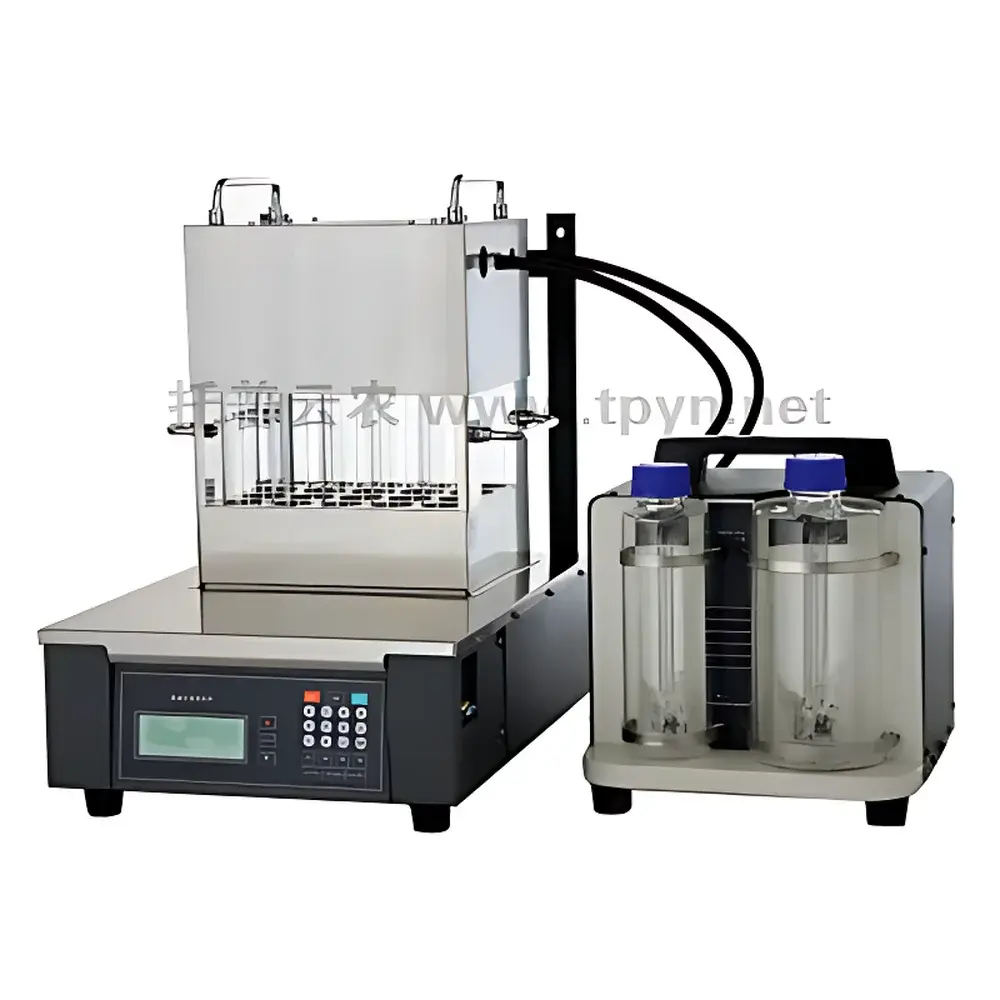
Top Cloud-agri KDN-10D Graphite Block Digestion System with Programmable Ramp Heating
| Brand | Top Cloud-agri |
|---|---|
| Origin | Zhejiang, China |
| Manufacturer Type | Direct Manufacturer |
| Country of Origin | China |
| Model Variants | KDN-10D / KDN-15D / KDN-20D / KDN-15S / KDN-20S |
| Pricing | Upon Request |
Overview
The Top Cloud-agri KDN-10D is a laboratory-grade graphite block digestion system engineered for controlled, reproducible sample mineralization in Kjeldahl nitrogen analysis workflows. It operates on the principle of conductive heating via a high-purity graphite thermal block, enabling precise ramp-and-hold temperature programming across up to 60 user-defined segments. Unlike conventional ceramic or metal-block digesters, the KDN-10D’s monolithic graphite architecture delivers exceptional thermal uniformity (±1.5 °C typical inter-hole variation at 400 °C), minimal thermal lag, and stable operation up to 650 °C — critical for complete oxidation of refractory organic matrices in food, feed, soil, and environmental samples. The system integrates a built-in fume management interface compatible with external vacuum-assisted scrubbing systems, ensuring SO₂, NOₓ, and HBr vapors generated during sulfuric acid digestion are efficiently captured and neutralized in aqueous traps before discharge to standard lab drainage infrastructure.
Key Features
- Monolithic high-density graphite heating block with optimized thermal mass and low emissivity surface finish for rapid heat transfer and long-term dimensional stability under repeated thermal cycling.
- Programmable multi-segment ramp heating (1–60 steps) with independent slope control (°C/min), soak duration (0.1–999.9 min), and target temperature (room temp to 650 °C) per segment.
- Individual digital PID control per digestion position, maintaining inter-hole temperature deviation ≤ ±2.0 °C across full operating range (verified per ASTM D5133-22 Annex A1).
- Ten pre-configurable digestion protocols stored in non-volatile memory; selectable via front-panel interface with one-touch activation and audit-trail timestamping.
- Integrated cooling stand with ceramic-coated aluminum support grid and forced-air ventilation channels, enabling safe post-digestion handling without manual intervention or secondary cooling baths.
- Front-accessible corrosion-resistant stainless-steel fume exhaust port (19 mm ID) designed for direct coupling to laboratory vacuum manifolds and wet scrubbers meeting EN 14181 requirements.
Sample Compatibility & Compliance
The KDN-10D accommodates standard 16 mm × 150 mm or 20 mm × 200 mm borosilicate digestion tubes (e.g., Pyrex® or equivalent), supporting batch sizes of 10–20 samples depending on configuration (KDN-10D: 10-position; KDN-20D: 20-position). It complies with core methodological prerequisites for AOAC 984.27, ISO 5983-1:2009, and USP <467> residual solvent preparation protocols requiring controlled thermal decomposition prior to distillation. All electrical components meet IEC 61010-1:2010 safety standards for laboratory equipment, and firmware supports GLP-compliant data integrity through operator ID logging, parameter change history, and tamper-evident event timestamps.
Software & Data Management
While the KDN-10D operates as a standalone instrument with intuitive membrane keypad interface, optional RS-485/Modbus RTU communication enables integration into centralized LIMS or ELN platforms. Logged parameters—including actual block temperature per zone, elapsed time per segment, total cycle duration, and alarm events—are exportable as CSV files via USB flash drive. Firmware adheres to FDA 21 CFR Part 11 principles for electronic records: all user actions trigger immutable audit trails with date/time stamps, operator identifiers, and reason-for-change fields where applicable.
Applications
This digestion system is routinely deployed in accredited food safety laboratories for protein quantification in cereals, dairy, and meat products; in agricultural research centers for total nitrogen assessment in compost and biofertilizers; and in environmental testing labs for heavy metal speciation prep (e.g., EPA Method 3050B adaptation). Its thermal precision and fume containment make it suitable for high-sulfur samples (e.g., coal ash, marine sediments) where aggressive H₂SO₄/H₂O₂ mixtures demand strict temperature ramping to prevent violent foaming or tube rupture.
FAQ
What is the maximum recommended operating temperature for continuous use?
The graphite block is rated for sustained operation at 600 °C; 650 °C is permissible for short-duration (<30 min) ramp phases only.
Can the KDN-10D be used with perchloric acid digestion protocols?
No. Perchloric acid is incompatible due to explosion risk under confined heating conditions; only sulfuric- or nitric-based oxidizing mixtures are supported.
Is calibration traceable to NIST standards?
Yes—factory calibration uses NIST-traceable PT100 sensors; users may perform in-house verification using Class A glass thermometers per ISO/IEC 17025 clause 6.4.10.
How often does the graphite block require maintenance or replacement?
Under normal usage (≤8 hrs/day, 5 days/week), the block retains functional integrity for ≥5 years; visual inspection for micro-cracking or surface pitting is recommended quarterly.
Does the system support remote monitoring via Ethernet or Wi-Fi?
Not natively; however, third-party Modbus-to-Ethernet gateways (e.g., Moxa EDS-205A) enable networked status polling and alarm forwarding via SNMP traps.




