
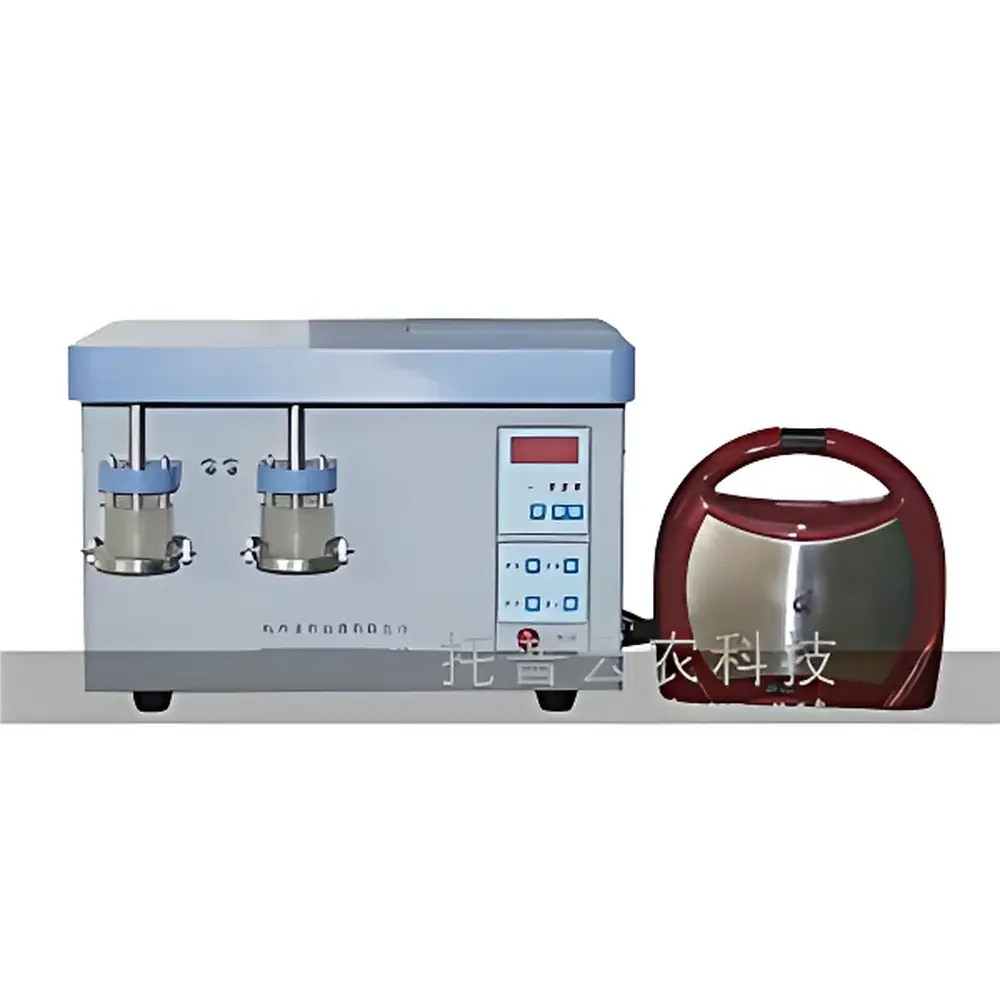
Top Cloud-agri MJ-IIIA Dual-Head Gluten Determinator
| Brand | Top Cloud-agri |
|---|---|
| Origin | Zhejiang, China |
| Manufacturer Type | Direct Manufacturer |
| Country of Origin | China |
| Model | MJ-IIIA |
| Price | USD 1,750 (approx.) |
| Compliance | GB/T 5506–2008, SB/T 10248–1995 |
| Power Supply | AC 220 V ±5%, 50 Hz |
| Wet Gluten Recovery Precision | ≤5% RSD between duplicate tests |
| Gluten Index Accuracy | ±11 units (index 70–100), ±15 units (index <70) |
| Washing Flow Rate | 50–56 mL/min |
| Stirring Speed | 120 rpm ±2 rpm |
| Fine Sieve | 80 µm (200 mesh) stainless steel |
| Coarse Sieve | 800 µm (26 mesh) stainless steel |
| Centrifugation Speeds | 3,000 rpm & 6,000 rpm ±5 rpm |
| Centrifuge Sieve Aperture | 500 µm (centrifuge basket), 600 µm (gluten index sieve) |
| Kneading Time Range | 1–59 s (1-s increments) |
| Washing Time Range | 1–59 s or 1–9 min (digital display) |
| Centrifugation Time Range | 1–59 s or 1–9 min (digital display) |
| Drying Temperature Range | 150–200 °C |
| Operating Humidity | <90% RH |
Overview
The Top Cloud-agri MJ-IIIA Dual-Head Gluten Determinator is a precision laboratory instrument engineered for standardized quantitative analysis of gluten content and functional quality in wheat flour and whole wheat flour. It operates on the principle of wet gluten isolation via controlled aqueous saline extraction—following the internationally aligned methodology defined in GB/T 5506–2008 (equivalent to ISO 21415-1:2006 for wet gluten determination) and SB/T 10248–1995 (for gluten index evaluation). The system integrates three functionally synchronized modules: automated dough formation and saline washing, high-precision centrifugal separation, and thermal drying—all designed to deliver reproducible, audit-ready results compliant with grain quality assurance protocols used in commercial milling, food R&D, and national grain inspection laboratories.
Key Features
- Dual-head architecture enables parallel processing of two 10 g flour samples—doubling throughput without compromising inter-assay consistency or operator workload.
- Programmable kneading and washing cycles (1–59 s kneading; 1 s–9 min washing) ensure strict adherence to standardized hydration and mechanical stress profiles per GB/T 5506–2008.
- Two-tier stainless-steel sieve assembly: coarse 800 µm (26 mesh) for initial bran removal and fine 80 µm (200 mesh) for gluten retention—both laser-cut for dimensional stability and long-term calibration integrity.
- Regulated saline flow delivery (50–56 mL/min) maintains consistent wash efficiency across batches, minimizing matrix-induced variability in gluten recovery.
- Centrifuge module offers dual selectable speeds (3,000 rpm and 6,000 rpm ±5 rpm) with mechanical safety interlock and lid-activated motor cutoff—ensuring operator protection and rotor balance integrity during high-G separation.
- Digital time-display controls for all critical phases (kneading, washing, centrifugation) support GLP-compliant documentation and method traceability.
- Integrated drying unit operates at precisely controllable temperatures (150–200 °C), enabling accurate dry gluten mass determination per ASTM D4292–16 (standard test method for dry gluten content).
Sample Compatibility & Compliance
The MJ-IIIA is validated for use with refined wheat flour, durum semolina, and whole wheat flour matrices. It conforms to national and international standards governing cereal protein characterization—including GB/T 5506–2008 (Chinese National Standard for Wet Gluten Content), SB/T 10248–1995 (Gluten Index Method), and technical equivalencies to ISO 21415-1:2006 and AACC Method 38–12. Its design supports routine verification against certified reference materials (CRMs) for gluten quantification, and its operational parameters are fully documentable for internal QA audits or third-party accreditation (e.g., CNAS, ISO/IEC 17025). All electrical components meet IEC 61010-1 safety requirements for laboratory equipment.
Software & Data Management
While the MJ-IIIA operates via embedded digital controls (no PC dependency), its parameter settings—including kneading duration, washing interval, centrifugation speed/time, and drying temperature—are fully recordable in lab notebooks or LIMS-integrated workflows. Time-stamped manual logs satisfy FDA 21 CFR Part 11 requirements when paired with institutional SOPs for electronic record retention. Optional external data capture (e.g., via USB-connected timers or calibrated thermocouple loggers) enables full traceability for GMP-regulated environments such as contract testing labs serving food ingredient suppliers.
Applications
- Quality control in flour mills: real-time monitoring of gluten yield and index to adjust blending ratios and optimize baking performance.
- R&D screening of wheat breeding lines: correlation of wet/dry gluten content and gluten index with dough rheology (e.g., farinograph stability, alveograph P/L ratio).
- Grain procurement verification: objective assessment of supplier flour specifications prior to bulk intake.
- Academic and regulatory research: generation of reference-grade gluten metrics for nutritional labeling, allergen threshold studies, and gluten-free compliance validation (e.g., AOAC 2011.01).
- Storage stability studies: longitudinal tracking of gluten degradation kinetics under controlled humidity/temperature conditions.
FAQ
What standards does the MJ-IIIA comply with?
It is fully aligned with GB/T 5506–2008 (wet gluten), SB/T 10248–1995 (gluten index), and technically equivalent to ISO 21415-1:2006 and AACC 38–12.
Can it process whole wheat flour?
Yes—the dual-sieve configuration and optimized washing protocol accommodate bran interference typical of whole wheat matrices without compromising gluten recovery accuracy.
Is calibration verification supported?
Yes—users may perform routine verification using NIST-traceable reference flours or certified gluten CRMs; all mechanical and thermal parameters are adjustable within documented tolerances.
Does the unit require external software or a computer?
No—it functions autonomously with front-panel digital controls; however, parameter logs can be exported manually for LIMS or QA archival.
What maintenance is required for long-term accuracy?
Routine cleaning of sieves and washing cups with deionized water, periodic verification of centrifuge speed via tachometer, and annual verification of drying chamber temperature uniformity using calibrated PT100 probes.




