
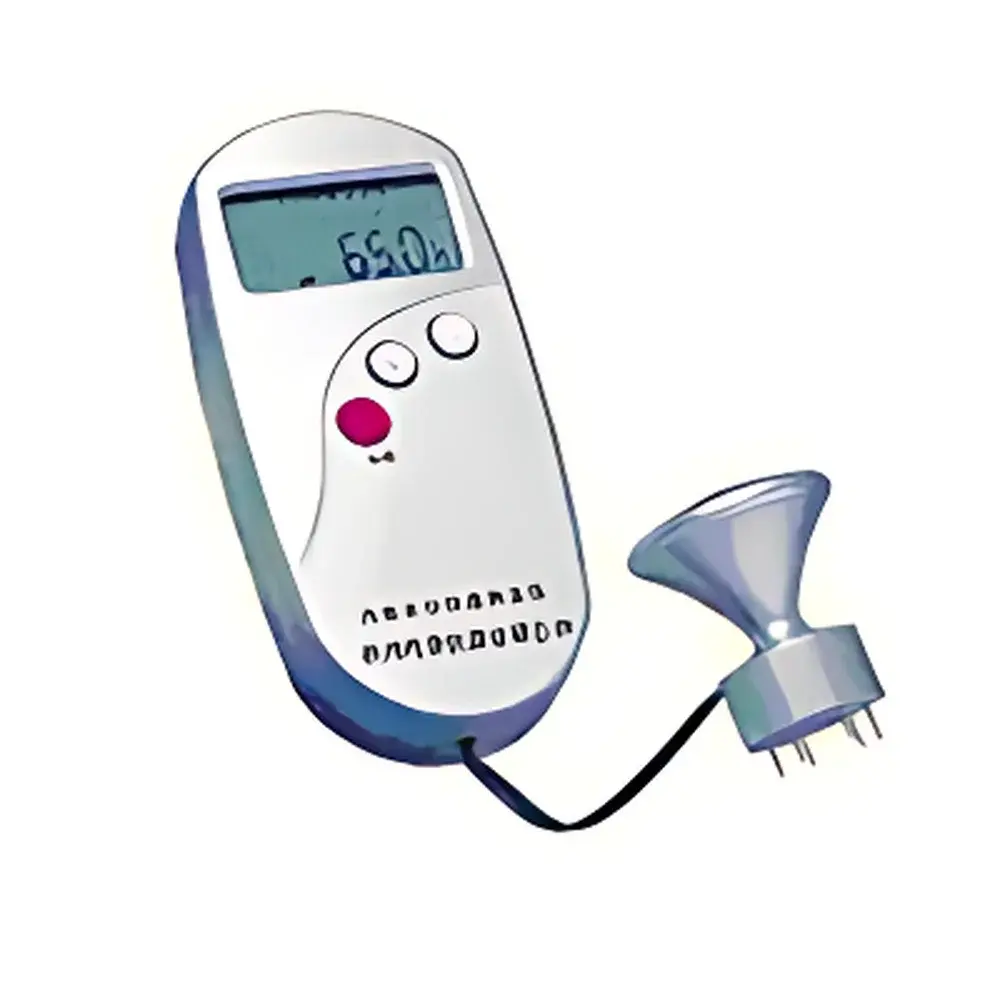
Top Cloud-agri RLS-2 Rapid Meat Moisture Analyzer
| Brand | Top Cloud-agri |
|---|---|
| Origin | Zhejiang, China |
| Manufacturer Type | OEM Manufacturer |
| Country of Origin | China |
| Model | RLS-2 |
| Measurement Range | 65–85% (w/w) |
| Sampling Time | <2 s per measurement |
| Measurement Output | Single-shot or averaged over 10 consecutive samplings |
| Accuracy | ≤ ±1.0% (within 70–78% range) |
| Repeatability | ≤ ±0.5% (within 70–78% range) |
| Power Supply | 9 V DC (1 × 6F22 battery) |
| Power Consumption | ~45 mW |
| Dimensions | 180 × 50 × 28 mm |
| Display | 3-digit LCD with Chinese character support |
| Operating Temperature | 0–40 °C |
| Relative Humidity Range | 20–90 % RH |
| Audible/Visual Alarm | Enabled for out-of-spec results and low-battery condition |
| Customizable Thresholds | Per-meat-type moisture acceptance limits |
| Baseline Calibration Function | Auto-calculates species-specific baseline from up to 20 reference gravimetric (oven-dry) measurements |
| Deviation Alert | Flashing display when single reading deviates >2.0% from recent moving average |
Overview
The Top Cloud-agri RLS-2 Rapid Meat Moisture Analyzer is a handheld, non-destructive near-infrared (NIR) reflectance instrument engineered for on-site, real-time quantification of moisture content in raw and processed meat products. Unlike traditional oven-drying (gravimetric) methods governed by AOAC 950.46 and ISO 1442, the RLS-2 employs calibrated NIR spectral response at fixed wavelengths optimized for water absorption bands in muscle tissue—enabling rapid assessment without sample preparation, grinding, or solvent use. Its design targets regulatory compliance workflows in slaughterhouses, cold-chain distribution hubs, retail inspection points, and municipal food safety laboratories across China and emerging markets where portable, operator-independent verification of moisture adulteration is required under GB 18394–2020 (Livestock and Poultry Meat Hygiene Standard) and related market surveillance protocols.
Key Features
- Sub-2-second single-point measurement cycle with optional 10-sample averaging for enhanced statistical robustness
- Embedded baseline calibration algorithm that derives species- and breed-specific reference offsets using up to 20 user-supplied oven-dry validation points (ASTM E1655-compliant data ingestion)
- Configurable pass/fail thresholds per meat category (e.g., pork loin, beef chuck, chicken breast), supporting traceable audit trails
- Dual-stage alarm system: visual + audible alert for moisture exceedance and real-time deviation monitoring (>2.0% shift from rolling mean)
- Low-power architecture with battery voltage monitoring (under-voltage warning at <7.5 V) ensuring field-deployable longevity
- Compact ergonomic form factor (180 × 50 × 28 mm) with IP54-rated enclosure for operation in humid, temperature-variable environments (0–40 °C)
- On-device LCD interface with bilingual character support—designed for frontline inspectors with minimal technical training
Sample Compatibility & Compliance
The RLS-2 is validated for intact surface measurement of chilled, frozen-thawed, and cured meat cuts—including porcine, bovine, ovine, and avian tissues—with nominal fat content <30% and surface temperature stability within ±2 °C during acquisition. It does not require homogenization or standardized geometry, though consistent probe-to-surface contact pressure and ambient light shielding are recommended per manufacturer SOPs. The device meets electromagnetic compatibility requirements per GB/T 18268.1–2010 (IEC 61326-1) and conforms to national metrological verification regulation JJG 1047–2009 for portable moisture analyzers used in food supervision. While not FDA 21 CFR Part 11–compliant (due to lack of electronic signature and audit trail export), its measurement logs satisfy GLP-aligned record-keeping when paired with manual entry into LIMS systems.
Software & Data Management
The RLS-2 operates as a standalone embedded system with no external software dependency. All calibration parameters, threshold settings, and measurement history are stored in non-volatile memory. Device-level data export is not supported; however, each measurement includes timestamped numeric output (three-digit % w/w), status flags (alarm active / baseline valid / low battery), and a unique session ID for manual transcription. For integration into centralized quality management systems, users may log entries into Excel-based templates aligned with ISO 22000 Clause 8.4 (Control of Monitoring and Measuring Resources) or map results to HACCP critical control points via paper-based or QR-coded reporting workflows.
Applications
- Regulatory field inspections for water injection fraud detection in fresh meat supply chains
- In-plant QC screening prior to packaging or freezing to prevent drip loss and microbial proliferation
- Verification of moisture retention claims in value-added marinated or injected products
- Educational use in food science curricula demonstrating NIR principles and statistical process control fundamentals
- Border inspection agencies conducting rapid triage of imported meat consignments under bilateral SPS agreements
FAQ
What measurement principle does the RLS-2 employ?
It utilizes near-infrared reflectance spectroscopy at discrete wavelengths sensitive to O–H bond vibrations in water molecules, with factory calibration anchored to gravimetric reference standards.
Can the RLS-2 measure ground or minced meat?
No—it is designed exclusively for intact muscle surfaces; ground samples introduce scattering artifacts that degrade NIR signal fidelity and invalidate calibration.
Is third-party certification available for this instrument?
Yes—calibration certificates traceable to CNAS-accredited labs (e.g., Zhejiang Institute of Metrology) can be issued upon request for annual verification cycles.
Does the device support firmware updates?
No—firmware is固化 (hard-coded) at production; functional enhancements require hardware revision (e.g., RLS-2A).
How often must the baseline be recalculated?
Baseline recalibration is recommended after seasonal livestock feed changes, introduction of new breeds, or relocation to geographically distinct abattoirs—typically every 3–6 months under stable operational conditions.
Related Products






