
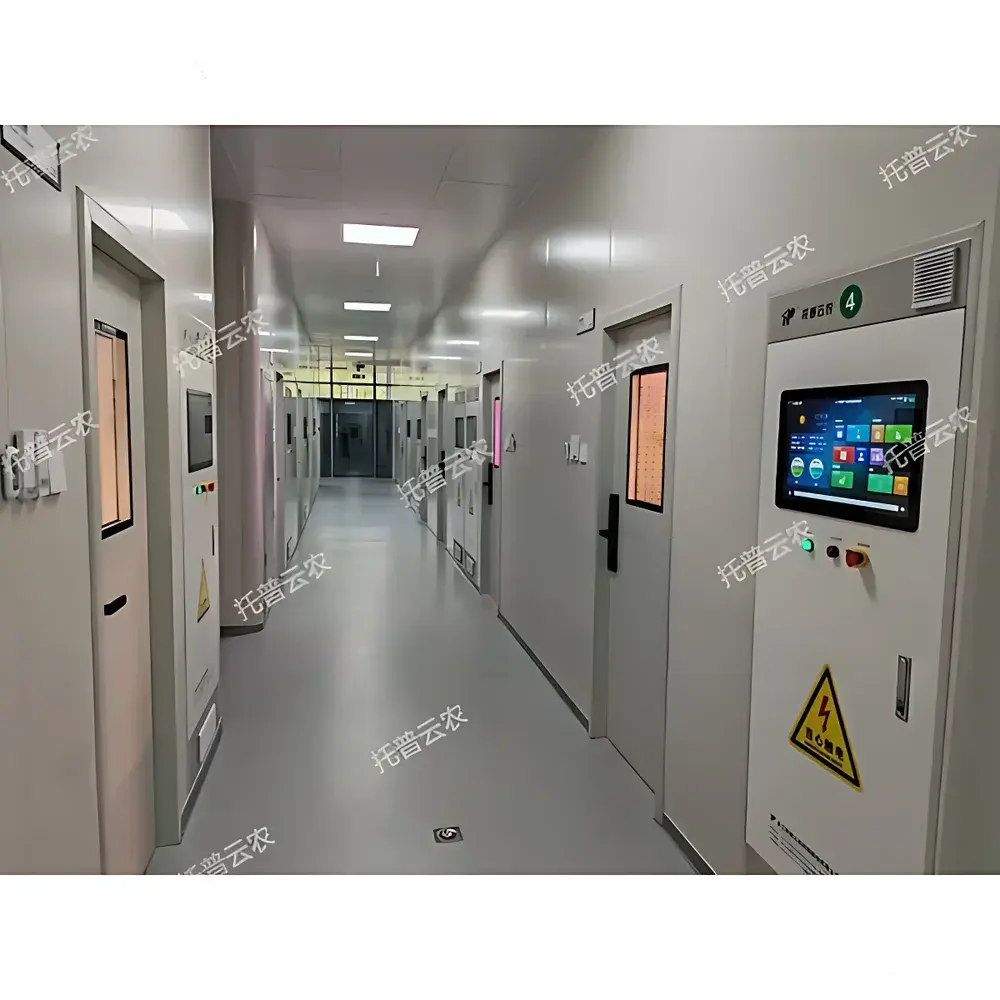
Top Cloud-agri RTOP-A / RTOP-B Intelligent Plant Growth Chamber
| Brand | Top Cloud-agri |
|---|---|
| Origin | Zhejiang, China |
| Manufacturer Type | Direct Manufacturer |
| Model | RTOP-A / RTOP-B |
| Spectral Range | Visible Light (400–700 nm) |
| Temperature Control Range | 5–40 °C |
| Temperature Uniformity | Customizable (Typical ±0.5 °C @ 25 °C, 1 m³ test volume) |
| Temperature Stability | Customizable (Typical ±0.3 °C over 24 h) |
| Humidity Range | Customizable (Typical 30–90 %RH) |
| Illumination Intensity | Customizable (0–30,000 lx, LED-based) |
| Light Control | Stepless dimming & programmable photoperiod scheduling |
| Internal Volume | Customizable (Standard configurations: 1.2–20 m³) |
| External Dimensions | Custom-engineered per installation site |
| Compliance | Designed to support GLP-compliant experimental workflows |
Overview
The Top Cloud-agri RTOP-A and RTOP-B Intelligent Plant Growth Chambers are precision-engineered environmental simulation systems designed for reproducible, long-term plant phenotyping, physiological research, and controlled-environment agriculture studies. Built upon a dual-layer insulated enclosure architecture and integrated with closed-loop PID-controlled thermohygrometric regulation, these chambers utilize advanced air handling dynamics—including stratified airflow distribution, laminar recirculation, and intelligent fresh-air exchange—to maintain spatially uniform microclimates across the entire growth volume. Unlike conventional incubators, the RTOP series implements a modular climate control paradigm: temperature, relative humidity, and photosynthetically active radiation (PAR) are independently regulated and synchronized via time-programmable profiles—enabling precise replication of diurnal cycles, seasonal transitions, or stress-induction protocols (e.g., drought, heat shock, low-light acclimation). The system’s core measurement and actuation infrastructure complies with ISO 17025 traceability principles for environmental parameter validation, supporting audit-ready data integrity in academic, regulatory, and industrial R&D settings.
Key Features
- Programmable multi-zone climate control: Independent real-time adjustment of temperature (5–40 °C), RH (30–90 %RH), and PAR intensity (0–30,000 lx) with <1.5 s response latency to setpoint changes.
- Dual-redundant control architecture: Primary PLC-based controller with 10-inch capacitive touchscreen HMI + secondary failover controller; both retain full parameter memory and operational state after power interruption.
- Energy-optimized air management: Bottom-inlet / top-exhaust ventilation with programmable duty cycle (1–120 min intervals); integrated air curtain barrier minimizes thermal leakage at access portals.
- High-fidelity LED lighting system: Full-spectrum white + red/blue supplemental LEDs (660 nm / 450 nm peaks), calibrated to PAR (µmol/m²/s) output; dimming resolution ≤0.1 %, lifetime >50,000 h L70.
- Structural integrity: Six-sided sandwich panels with B1-rated polyurethane insulation (≥30 mm thickness), stainless steel or double-skinned galvanized steel cladding, non-toxic anti-mold flooring compliant with GB/T 21089–2007.
- Remote operability: Native Wi-Fi/4G/5G connectivity; web-based dashboard and iOS/Android app for live monitoring, historical curve analysis, alarm acknowledgment, emergency shutdown, and video feed (optional IP camera integration).
- Data governance: On-device SD card logging + cloud backup (AES-256 encrypted); supports CSV export, time-synchronized multi-chamber comparison, and configurable alarm thresholds with email/SMS notification.
Sample Compatibility & Compliance
The RTOP series accommodates diverse biological specimens—from Arabidopsis thaliana seedlings and rice tillers to entomological cultures (Drosophila, aphids, parasitoid wasps) and fungal inoculum plates—within fully customizable interior layouts. Shelving, hanging rails, and vertical grow towers are engineered for structural load distribution and airflow clearance (≥10 cm clearance around all surfaces). Each chamber configuration undergoes factory calibration using NIST-traceable reference sensors (Rotronic Hygromer® IN-1, PT100 Class A). System documentation includes IQ/OQ templates aligned with ISO 14644-1 (cleanroom classification), ASTM E145-22 (laboratory oven/chamber performance), and FDA 21 CFR Part 11 requirements for electronic records and signatures—facilitating GxP-aligned validation in pharmaceutical botany, crop biotechnology, and biosafety level 1 (BSL-1) containment applications.
Software & Data Management
The embedded control firmware (v3.2+) features an open RESTful API and supports MODBUS TCP integration for third-party LIMS or SCADA environments. All logged parameters—including chamber ambient T/RH, light intensity (lx and µmol/m²/s), fan speed (%), compressor duty cycle, and door-open events—are timestamped with UTC synchronization and stored with millisecond precision. Audit trails record user login/logout, parameter modification history, alarm triggers/resolutions, and firmware update logs—retained for ≥18 months on device and indefinitely in encrypted cloud storage. Data visualization tools include overlay-capable multi-curve plots, statistical summaries (mean, SD, CV%), and automated report generation (PDF/Excel) compliant with GLP Annex 11 and OECD TG 208 guidelines.
Applications
- Plant phenomics: High-throughput screening of genotype-by-environment interactions under standardized photoperiods, VPD gradients, or combined abiotic stresses.
- Seed science: Controlled germination assays (ISTA-compliant protocols), vigor testing, and dormancy-breaking studies across Brassicaceae, Poaceae, and Solanaceae species.
- Crop breeding acceleration: Indoor speed-breeding cycles (e.g., wheat, barley, soybean) with extended photoperiods and optimized thermal setpoints to reduce generational turnover by 30–50 %.
- Insect rearing & biocontrol research: Maintenance of parasitoid colonies (Trichogramma spp.), herbivore feeding trials, and host–pathogen interaction modeling under ecologically relevant microclimates.
- Pathology & resistance screening: Inoculation chambers for Fusarium, Phytophthora, and rust fungi; quantification of lesion development kinetics under controlled humidity ramps.
- Tissue culture support: Low-temperature (4–12 °C), low-light (0–2000 lx) modules for meristem preservation, cryoprotectant equilibration, and callus induction consistency.
FAQ
What standards does the RTOP series comply with for laboratory validation?
The system supports IQ/OQ documentation per ISO/IEC 17025, ASTM E145-22, and EU GMP Annex 15. Calibration certificates reference NIST-traceable standards, and software meets FDA 21 CFR Part 11 requirements for audit trails and electronic signatures.
Can the RTOP-B cloud platform integrate with existing institutional IT infrastructure?
Yes—via configurable HTTPS endpoints, LDAP/Active Directory authentication, and SAML 2.0 single sign-on. Firewall-friendly port configuration (default TLS 443) and VLAN segmentation support enterprise-grade network deployment.
Is remote firmware update supported without on-site technician intervention?
Firmware updates are delivered over-the-air (OTA) with rollback capability, SHA-256 signature verification, and pre-update compatibility checks. Updates require manual approval via admin dashboard but execute autonomously post-approval.
How is temperature uniformity validated across the working volume?
Uniformity mapping follows ISO 14644-3 Annex B methodology: 9-point sensor grid (center + 8 corners at mid-height), 24-hour stabilization, and reporting of max deviation from setpoint per ICH Q5C guidance.
Does the system support dynamic VPD (Vapor Pressure Deficit) control as a derived parameter?
VPD is calculated in real time from concurrent T/RH measurements and displayed alongside primary variables. While not directly actuated, VPD trends inform manual or script-driven adjustments to temperature/humidity setpoints for transpiration-focused experiments.





