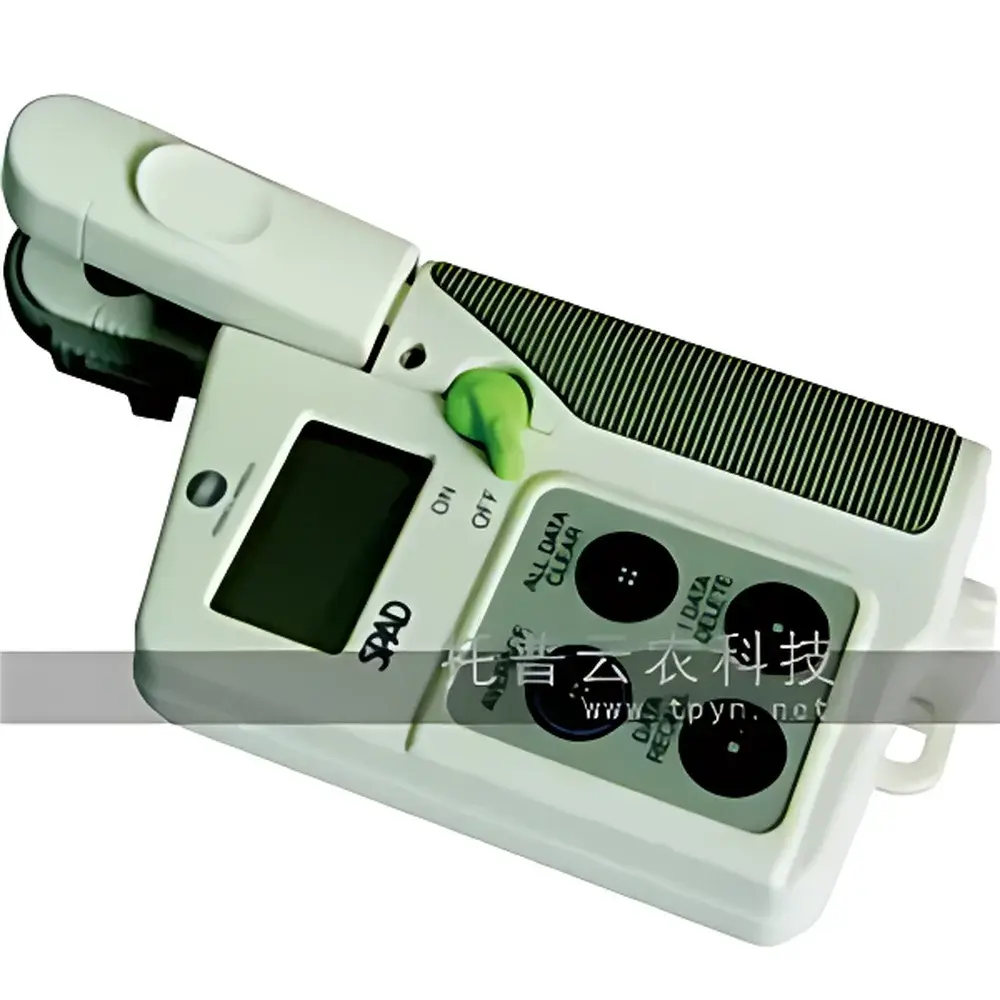
Top Cloud-agri SPAD-502PLUS Handheld Chlorophyll Meter
| Brand | Top Cloud-agri |
|---|---|
| Origin | Zhejiang, China |
| Manufacturer Type | Direct Manufacturer |
| Country of Origin | China |
| Model | SPAD-502PLUS |
| Measurement Principle | Dual-wavelength optical absorbance differential method (650 nm & 940 nm) |
| Measurement Area | 2 mm × 3 mm |
| Sensor | Silicon photodiode |
| Display | LCD with 4-decimal resolution and real-time trend graph |
| Range | –9.9 to 199.9 SPAD units |
| Memory Capacity | 30 measurements with auto-calculated mean |
| Power | Two AA batteries (1.5 V) |
| Battery Life | >20,000 measurements |
| Measurement Interval | 2 seconds |
| Accuracy | ±1.0 SPAD units (at 0–50 SPAD, 25 °C) |
| Repeatability | ±0.3 SPAD units (0–50 SPAD) |
| Reproducibility | ±0.5 SPAD units (0–50 SPAD) |
| Dimensions | 164 × 78 × 49 mm (L × W × H) |
| Weight | 225 g |
| Operating Temperature | 0–50 °C |
| Additional Functions | Audible alert, on-device calibration, GLP-compliant data logging |
Overview
The Top Cloud-agri SPAD-502PLUS Handheld Chlorophyll Meter is a field-deployable, non-destructive optical instrument engineered for rapid, in situ quantification of relative chlorophyll content in plant leaves. It operates on the dual-wavelength absorbance differential principle—measuring light attenuation at 650 nm (peak chlorophyll-a absorption band) and 940 nm (reference wavelength minimally absorbed by chlorophyll but sensitive to leaf thickness and water content). The resulting SPAD (Soil-Plant Analysis Development) index is a dimensionless, empirically calibrated value correlated with chlorophyll concentration per unit leaf area (µg/cm²), enabling standardized cross-study comparisons without tissue extraction or solvent-based spectrophotometry. Designed for agronomic decision support and physiological phenotyping, the SPAD-502PLUS supports nitrogen status assessment, photosynthetic capacity screening, stress response monitoring, and precision nutrient management protocols across diverse crop species and ecological field conditions.
Key Features
- Non-invasive measurement: No leaf excision or chemical reagents required—preserves sample integrity for longitudinal tracking.
- Dual-wavelength LED optical system: Optimized 650 nm and 940 nm emitters ensure robustness against inter-sample variability in leaf thickness and hydration state.
- Integrated silicon photodiode sensor with 2 mm × 3 mm measurement aperture: Delivers spatially consistent readings aligned with standard leaf sampling protocols (e.g., ISO 10212, ASTM D6708).
- Real-time trend visualization: On-device LCD displays up to 30 sequential SPAD values as a dynamic line graph, facilitating immediate outlier identification and intra-leaf or inter-plant comparative analysis.
- On-board statistical processing: Automatic calculation and display of mean, min, max, and count for each session—critical for field data validation prior to export.
- GLP-aligned operational safeguards: Built-in calibration verification mode, audible measurement confirmation, and timestamped memory storage comply with basic Good Laboratory Practice documentation requirements.
- Extended field endurance: >20,000 measurements per battery set (2 × AA) with low-power circuit architecture—validated under ISO 9241-307 ambient temperature profiles (0–50 °C).
Sample Compatibility & Compliance
The SPAD-502PLUS is validated for use on intact, mature leaves of dicotyledonous and monocotyledonous species—including rice, wheat, maize, soybean, tomato, and Arabidopsis thaliana—with leaf thickness ≤0.5 mm and surface reflectance 0.92) with laboratory-quantified values when calibrated against species-specific regression models. The device meets CE marking requirements for electromagnetic compatibility (EN 61326-1) and environmental robustness (IP54 ingress protection), and its measurement methodology aligns with FAO/IAEA guidelines for nitrogen use efficiency (NUE) field assessment.
Software & Data Management
Data are stored locally in non-volatile memory with automatic time stamping (YYYY-MM-DD HH:MM format). Each session retains 30 readings with calculated mean, supporting manual transcription into LIMS or Excel-based QA/QC workflows. Although no proprietary PC software or Bluetooth interface is included, the structured numeric output (SPAD value, timestamp, sequence ID) is compatible with third-party data aggregation platforms compliant with ISO/IEC 17025 traceability frameworks. Audit trails—including calibration events and battery status logs—are retained in firmware and accessible via diagnostic mode. For regulated environments (e.g., GMP-compliant agronomic trials), users may implement external metadata tagging (e.g., plot ID, cultivar, treatment group) using standardized CSV templates that integrate seamlessly with R or Python-based analysis pipelines.
Applications
- Nitrogen status monitoring in cereal crops during critical growth stages (tillering, booting, grain filling) to optimize top-dressing timing and dosage.
- High-throughput phenotyping of chlorophyll-related QTLs in breeding programs—enabling selection under controlled-environment or field-based nurseries.
- Evaluation of abiotic stress responses (drought, salinity, heavy metal exposure) via longitudinal SPAD decline kinetics.
- Validation of remote sensing indices (e.g., NDVI, EVI) using ground-truth SPAD measurements for satellite or UAV-based canopy modeling.
- Teaching laboratories in plant physiology courses—demonstrating structure-function relationships between leaf anatomy, pigment composition, and photosynthetic performance.
- Ecological field surveys assessing chlorophyll dynamics across elevation gradients, soil fertility gradients, or post-disturbance recovery trajectories.
FAQ
How does the SPAD-502PLUS differ from laboratory-based chlorophyll extraction methods?
It provides rapid, non-destructive relative quantification—not absolute concentration. Extraction methods yield µg/cm² values but require destructive sampling, solvent handling, and spectrophotometric calibration; SPAD offers field scalability and temporal resolution at the cost of species-specific calibration dependency.
Can SPAD values be converted to absolute chlorophyll content?
Yes—but only through empirical, species- and cultivar-specific regression equations derived from concurrent SPAD readings and lab-quantified chlorophyll (e.g., Arnon’s method). Universal conversion factors are not scientifically valid.
Is the device suitable for conifer needles or mosses?
No. Its optical design assumes planar, translucent leaf architecture with minimal internal light scattering. Conifer needles, bryophytes, and aquatic macrophytes exhibit structural interference that invalidates the 650/940 nm ratio assumption.
What maintenance is required to ensure long-term accuracy?
Monthly verification using the included ceramic calibration standard; annual sensor alignment check by authorized service centers; avoidance of direct sunlight exposure during storage to prevent LED spectral drift.
Does the SPAD-502PLUS comply with FDA 21 CFR Part 11 for electronic records?
No—it lacks electronic signature capability, audit trail export, or user access controls. However, raw SPAD data exported manually meet ALCOA+ principles (Attributable, Legible, Contemporaneous, Original, Accurate) when paired with procedural SOPs and handwritten field notebooks.