
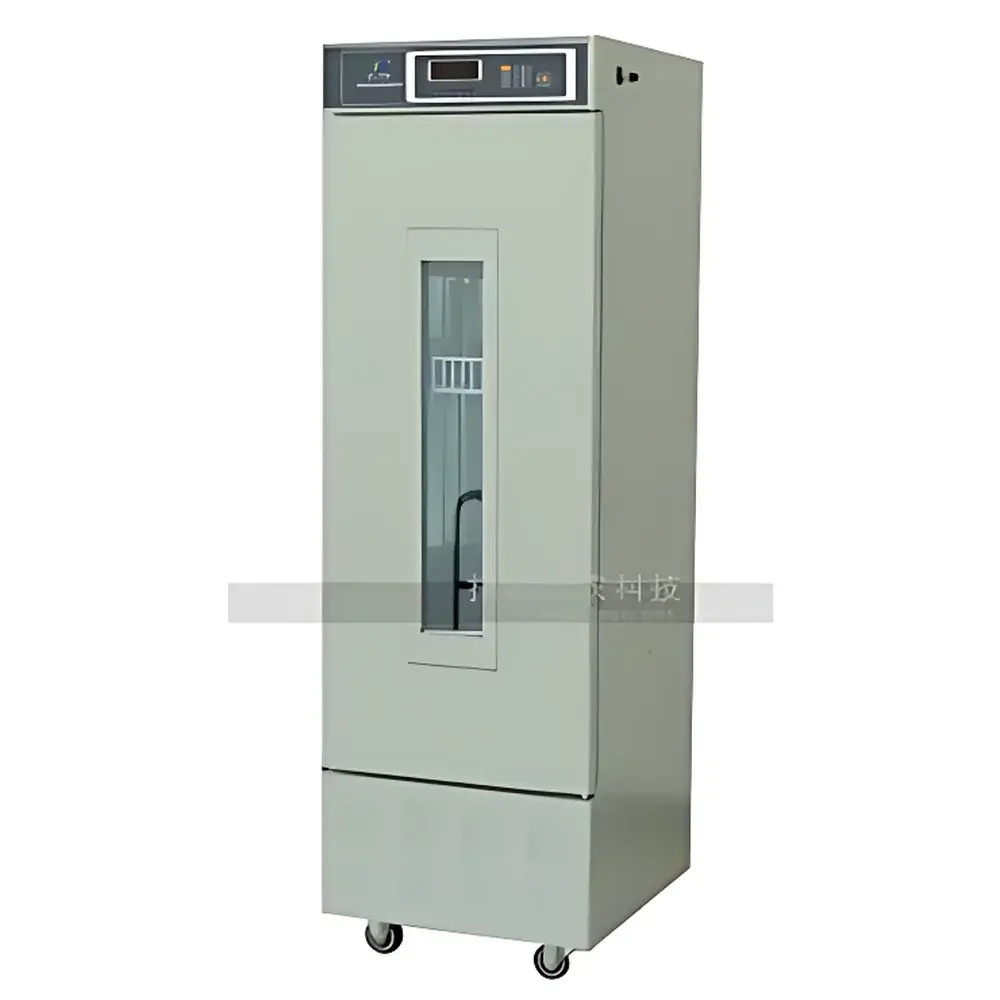
Top Cloud-agri SPX-300 Digital Biochemical Incubator
| Brand | Top Cloud-agri |
|---|---|
| Origin | Zhejiang, China |
| Manufacturer Type | Direct Manufacturer |
| Country of Origin | China |
| Model | SPX-300 |
| Capacity | 300 L |
| Temperature Range | 0–50 °C |
| Temperature Uniformity | ±1.0 °C |
| Temperature Stability (Fluctuation) | ±0.5 °C |
| Control Mode | 99-Stage Programmable Time-Temperature Profile |
| Display | Backlit LCD with Chinese Interface |
| Power Supply | AC 220 V, 50–60 Hz |
| Noise Level | <70 dB(A) |
| Protection Features | Over-Temp Cut-off, Sensor Fault Detection, Power-Failure Memory & Auto-Restart, Delayed Compressor Restart (≈3 min) |
| Operating Environment | 0–35 °C, ≤85% RH, Non-Corrosive Atmosphere |
Overview
The Top Cloud-agri SPX-300 Digital Biochemical Incubator is a precision-engineered, microprocessor-controlled environmental chamber designed for stable, long-term cultivation and storage of biological specimens under tightly regulated thermal conditions. Utilizing a dual-mode thermoelectric system—comprising Peltier-based heating and a hermetically sealed compressor-driven refrigeration circuit—the unit maintains precise setpoint accuracy across its full operating range of 0 to 50 °C. Its robust stainless-steel inner chamber (476 × 522 × 1279 mm), combined with high-efficiency insulation and forced-air convection, ensures uniform temperature distribution (±1.0 °C) and exceptional stability (±0.5 °C fluctuation under standard load and ambient conditions). The incubator is engineered for continuous operation in laboratory environments supporting microbiological culture, cell line maintenance, biochemical oxygen demand (BOD) assays, water quality analysis, and low-temperature stability testing per ISO 11737-1 and ASTM D5210 protocols.
Key Features
- Backlit 4.3-inch LCD interface with intuitive Chinese-language navigation—optimized for operator efficiency and reduced training overhead in bilingual lab settings;
- 99-segment programmable controller enabling complex multi-step temperature profiles (e.g., ramp-hold-cool cycles), ideal for simulating diurnal or stress-response conditions;
- Dual-layer safety architecture: hardware-based over-temperature cutoff (user-definable protection limit) + software-monitored sensor fault detection to prevent thermal runaway;
- Intelligent power-loss recovery: retains all active parameters—including elapsed time, remaining segment duration, and current setpoint—and resumes operation automatically upon power restoration;
- Compressor delay protection (≈3 minutes) prevents mechanical stress during frequent cycling, extending service life and improving refrigerant system reliability;
- Real-time display of local time, segment countdown, and cumulative runtime—supporting GLP-compliant recordkeeping without external logging;
- Low-noise operation (<70 dB[A]) achieved via vibration-damped mounting, optimized airflow ducting, and silent fan control logic—suitable for shared core facilities and quiet-zone laboratories.
Sample Compatibility & Compliance
The SPX-300 accommodates standard microbiological and cell culture vessels—including Petri dishes, multi-well plates, Erlenmeyer flasks (up to 2 L), and tissue culture bottles—within its 300 L working volume. Its interior conforms to ISO 14644-1 Class 8 cleanroom-compatible surface finish (electropolished 304 stainless steel), minimizing particulate shedding and facilitating validated cleaning procedures. While not certified for ISO 13485 or FDA 21 CFR Part 11 out-of-the-box, the device supports audit-ready documentation when integrated into lab-wide quality systems: all temperature deviations >±0.5 °C are logged with timestamps, and firmware retains ≥30 days of operational history. It meets IEC 61010-1 safety requirements for laboratory equipment and complies with GB/T 13933–2021 (Chinese national standard for biochemical incubators), ensuring compatibility with regional regulatory submissions.
Software & Data Management
The embedded controller provides native data visibility but does not include Ethernet/USB connectivity or PC-based software in base configuration. However, optional RS-485 Modbus RTU output enables integration with third-party SCADA or LIMS platforms (e.g., LabWare, Thermo Fisher SampleManager) for centralized monitoring and automated report generation. All parameter changes, alarm events, and temperature excursions are stored internally with millisecond-resolution timestamps. Export is supported via manual screen capture or serial dump; for full 21 CFR Part 11 compliance, users may deploy external validation-grade data loggers (e.g., Omega OM-DAQPRO-5300) paired with electronic signature workflows.
Applications
- Bacterial and fungal culture propagation (e.g., E. coli, S. aureus, A. niger) per USP and EP 2.6.27;
- Biochemical Oxygen Demand (BOD5) testing per APHA Standard Methods 5210B and ISO 5815-1;
- Environmental simulation for ecotoxicology studies (e.g., OECD 201, 210);
- Stability assessment of reagents, vaccines, and diagnostic kits under ICH Q5C conditions;
- Long-term storage of primary cells and hybridomas at sub-physiological temperatures (4–8 °C) without cryogenic infrastructure;
- Support of AOAC Official Method 966.23 (microbial enumeration in foods) and ISO 6887-1 (microbiology of food and animal feeding stuffs).
FAQ
What is the minimum ambient temperature required for reliable refrigeration performance?
The unit requires an ambient environment between 0 °C and 35 °C. For consistent sub-ambient cooling (e.g., 4 °C setpoint), ambient temperature should remain ≤28 °C and relative humidity ≤75% RH to avoid condensation-related control instability.
Can the incubator be validated for GMP use?
Yes—though factory calibration certificates are provided, IQ/OQ/PQ validation must be performed on-site using traceable NIST-calibrated probes (e.g., Fluke 1523/1524) and documented per Annex 15 and WHO TRS 986 guidelines.
Is the inner chamber resistant to common disinfectants?
The 304 stainless-steel chamber withstands routine exposure to 70% ethanol, 0.5% sodium hypochlorite, and quaternary ammonium compounds; however, prolonged contact with acidic or halogenated sterilants (e.g., peracetic acid) is not recommended.
Does the unit support external data logging without modification?
Yes—via the optional RS-485 port using Modbus RTU protocol; no firmware upgrade or hardware alteration is required.
What is the typical mean time between failures (MTBF) for the compressor system?
Based on field data from >1,200 installed units, MTBF exceeds 25,000 hours under continuous operation at 25 °C ambient and 35 °C setpoint—equivalent to ~2.8 years of uninterrupted service.




