
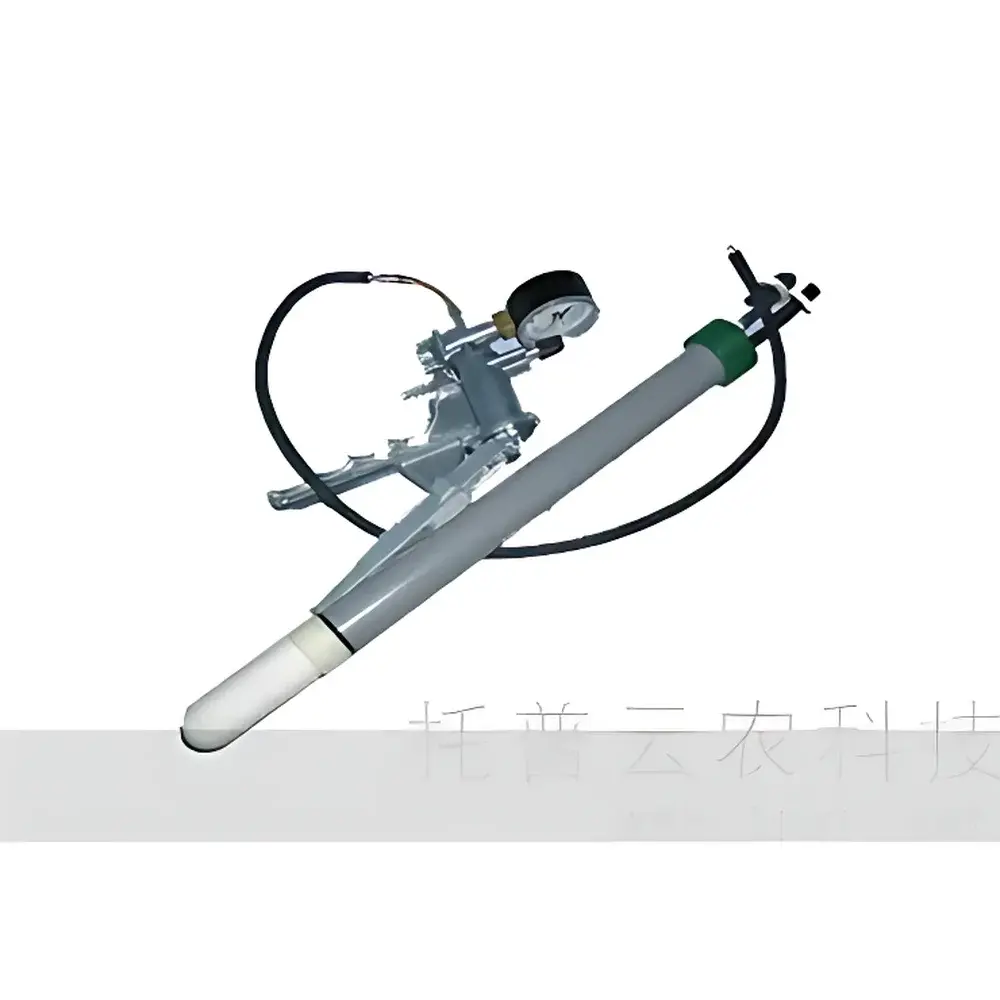
Top Cloud-agri SW Series Suction-Lysimeter for In-Situ Soil Solution Sampling
| Brand | Top Cloud-agri |
|---|---|
| Origin | Zhejiang, China |
| Manufacturer Type | Direct Manufacturer |
| Country of Origin | China |
| Model | SW Series |
| Price | USD 570 (approx. ¥4,000) |
Overview
The Top Cloud-agri SW Series Suction-Lysimeter is an engineered field-deployable device designed for in-situ extraction and collection of soil pore water across defined depth intervals. Operating on the principle of controlled suction (negative pressure) applied across a porous ceramic interface, it enables non-destructive, time-resolved sampling of soil solution without soil excavation or structural disturbance. This methodology aligns with established lysimetric protocols referenced in ISO 11269-2 (soil quality — effects of pollutants on soil microflora) and ASTM D5088–22 (standard practice for lysimeter installation and operation). The SW Series is optimized for long-term monitoring applications in agricultural research, vadose zone hydrology, contaminant leaching studies, and groundwater vulnerability assessments—particularly where preservation of undisturbed soil hydraulic continuity is critical.
Key Features
- 31 mm diameter high-porosity ceramic suction cup (length ≈ 70 mm), sintered for consistent hydraulic conductivity and mechanical durability under field burial conditions
- Modular stainless steel or PVC sampling tube assembly, available in standardized lengths: 15 cm, 30 cm, 45 cm, 60 cm, 90 cm, and 120 cm—enabling precise vertical resolution of solute transport dynamics
- Dual-mode operation: vacuum-driven (–80 to –100 kPa) for passive solution equilibration; positive-pressure purging (up to +100 kPa) for efficient elution and sample recovery
- Depth-rated design supporting installation up to 15 m below surface—compatible with standard soil augers (32 mm bore diameter)
- Integrated gas-tight sealing system using reusable elastomeric stopper rings and reinforced rubber tubing to maintain stable negative pressure during equilibration
- No chemical conditioning or pre-wetting required for most mineral soils; optional pre-hydration protocol included for low-moisture or highly structured clay profiles
Sample Compatibility & Compliance
The SW Series is validated for use in a broad spectrum of soil textures—including sandy loam, silty clay, and volcanic ash-derived Andisols—provided the matric potential remains within the operational range of the ceramic matrix (typically –10 to –100 kPa). It complies with field sampling requirements outlined in EPA Method 9060A (soil pore water extraction) and supports data integrity frameworks aligned with GLP (Good Laboratory Practice) and ISO/IEC 17025 traceability standards. All wetted components are inert (ceramic, stainless steel, food-grade EPDM rubber), ensuring minimal analyte adsorption or leaching—critical for trace metal, nitrate, pesticide residue, and dissolved organic carbon (DOC) analyses.
Software & Data Management
As a passive field instrument, the SW Series operates without embedded electronics or firmware. However, it integrates seamlessly into digital environmental monitoring workflows via companion documentation templates and metadata schemas compliant with the OGC SensorML standard. Users are provided with a structured Excel-based logbook (ISO 17025 Annex A3 compatible) for recording installation coordinates, depth, date/time of vacuum application, equilibration duration, pressure values, and sample volume—supporting audit-ready data packages for regulatory reporting (e.g., EU Water Framework Directive WFD monitoring programs or US EPA RCRA groundwater assessment reports).
Applications
- Long-term nutrient leaching studies (e.g., NO₃⁻, PO₄³⁻, K⁺) in fertilized agroecosystems
- Field-scale validation of reactive transport models (e.g., HYDRUS-1D, PFLOTRAN)
- Monitoring of emerging contaminants (pharmaceuticals, PFAS, microplastics) in the unsaturated zone
- Salinity profiling and irrigation-induced solute displacement in arid-zone agriculture
- Soil–plant–atmosphere continuum (SPAC) research requiring minimally disturbed pore water chemistry
- Baseline characterization prior to land-use change or remediation interventions
FAQ
What is the maximum recommended burial depth for the SW Series lysimeter?
Up to 15 meters—provided appropriate casing and backfill protocols are followed to prevent lateral soil intrusion and ensure vertical hydraulic isolation.
Can the ceramic cup be cleaned and reused after sampling?
Yes. Ceramic elements may be regenerated via ultrasonic cleaning in dilute HCl (0.1 M), followed by thorough deionized water rinsing and oven drying at 60°C—validated per ASTM D5088 Annex B.
Is the SW Series suitable for saturated zone (groundwater) sampling?
No. It is specifically designed for unsaturated (vadose) zone pore water extraction. For saturated aquifer sampling, dedicated drive-point or multilevel groundwater monitoring systems are required.
How does soil texture affect equilibration time?
Equilibration ranges from 2–6 hours in coarse sands to 48–96 hours in dense clays; repeated vacuum cycling may be employed in low-permeability media per ISO 11269-2 Section 7.3.
Does the system require calibration before deployment?
No factory calibration is needed; however, users must verify vacuum integrity (< –80 kPa hold for ≥30 min) and confirm ceramic cup permeability via distilled water flux test prior to field installation.







