
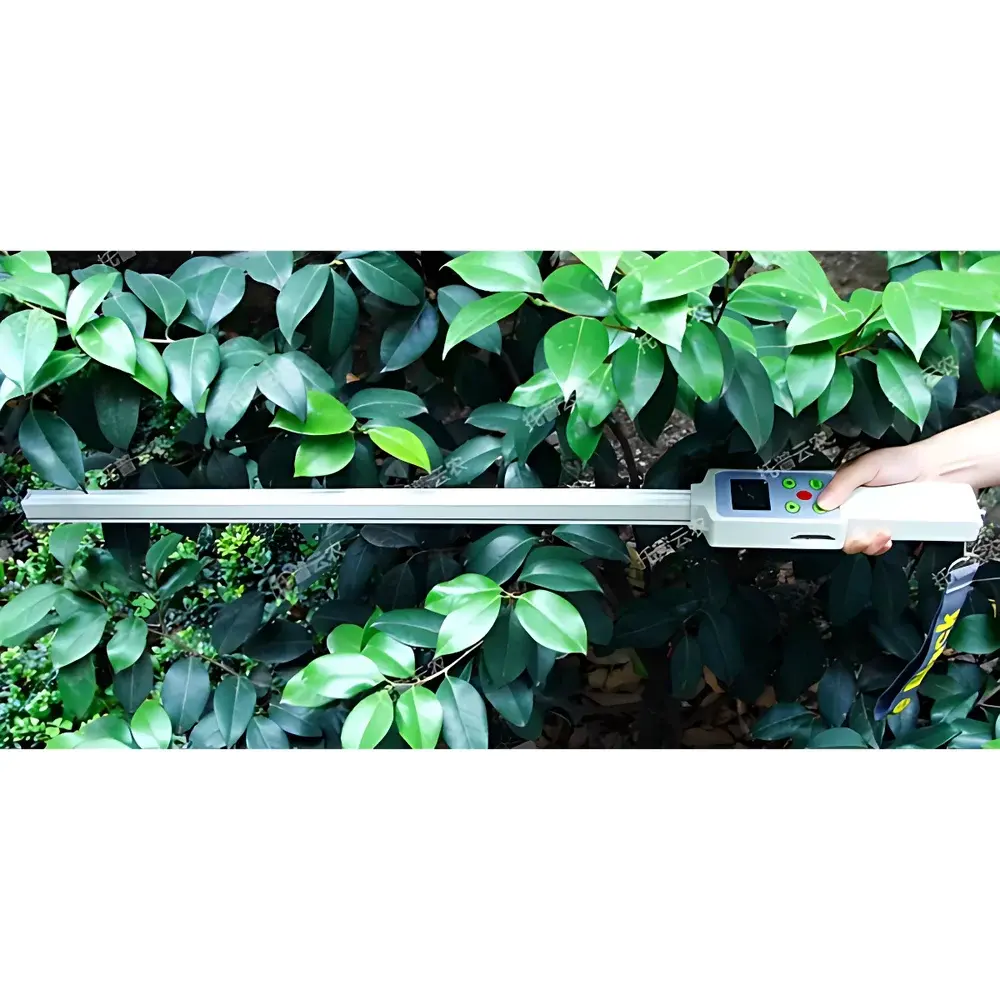
Top Cloud-agri TOP-1000 Portable Canopy Analyzer for Photosynthetically Active Radiation (PAR) Measurement
| Brand | Top Cloud-agri |
|---|---|
| Origin | Zhejiang, China |
| Manufacturer Type | Direct Manufacturer |
| Country of Origin | China |
| Model | TOP-1000 |
| Instrument Principle | Effective Radiation Measurement Method |
| Instrument Type | Portable |
| Spectral Range | 400–700 nm (PAR band) |
| Measurement Range | 0–2700 µmol·m⁻²·s⁻¹ |
| Resolution | 1 µmol·m⁻²·s⁻¹ |
| Spectral Response Error (vs. Canopy) | <10% |
| Accuracy | ±5% ±1 digit (relative to NIM standard) |
| Precision | ±0.5% ±1 digit |
| Long-term Stability | <±2% over 12 months |
| Data Logging Interval | 1–99 minutes (configurable) |
| Max Auto Measurements | 99 |
| Manual/Continuous Mode | Supported |
| Storage | 2 GB SD card (removable) |
| Probe Length | 50 cm |
| Total Unit Length | 75 cm |
| Power Supply | 2 × AA batteries |
| Operating Environment | 0–60 °C, 0–100% RH |
Overview
The Top Cloud-agri TOP-1000 Portable Canopy Analyzer is a field-deployable optical instrument engineered for quantitative assessment of photosynthetically active radiation (PAR) interception within plant canopies. It operates on the principle of effective radiation measurement—specifically calibrated to quantify photon flux density in the 400–700 nm spectral band, corresponding to the biologically active PAR range essential for photosynthesis. Unlike indirect estimation methods (e.g., hemispherical photography or LAI modeling), the TOP-1000 delivers direct, real-time PAR measurements above and below the canopy, enabling calculation of light extinction coefficients, fractional interception, and canopy transmission ratios. Its design prioritizes operational robustness in variable outdoor conditions—supporting longitudinal field trials, phenotyping studies, and agronomic monitoring where spatial and temporal resolution of light environment dynamics are critical to understanding crop physiological responses.
Key Features
- Integrated handheld architecture: All core components—including LCD display, tactile control buttons, SD card slot, and extendable 50 cm measurement probe—are co-located within a single 75 cm unit, eliminating external cabling and minimizing setup time.
- Configurable data acquisition: Supports both manual point sampling and automated logging with user-defined intervals (1–99 minutes) and session lengths (up to 99 consecutive measurements), facilitating unattended diurnal or multi-day light profiling.
- Low-power embedded system: Powered by two standard AA batteries with automatic sleep mode activation after 2 minutes of inactivity, extending field operation beyond 100 hours per battery set under typical usage.
- High-fidelity optical sensor: Features a cosine-corrected silicon photodiode with spectral responsivity optimized for PAR, validated against national metrological standards (NIM traceable calibration).
- Field-ready environmental tolerance: Rated for continuous operation across 0–60 °C and 0–100% relative humidity, including condensing conditions common in early-morning canopy microclimates.
Sample Compatibility & Compliance
The TOP-1000 is compatible with diverse vegetation structures—from low-stature herbaceous crops (e.g., wheat, rice, soybean) to orchard systems and managed grasslands. Its 50 cm probe enables consistent vertical profiling at standardized heights (e.g., above-canopy reference, mid-canopy, and ground-level), supporting protocols aligned with ISO 11737-1 (radiation measurement in plant science) and ASTM E2853-12 (standard practice for PAR quantification in agricultural research). While not certified for regulatory submission under FDA 21 CFR Part 11, its data integrity features—including timestamped SD card logging, non-volatile memory retention, and linear output scaling—meet GLP-aligned documentation requirements for academic and contract research organizations conducting ecological or agronomic field trials.
Software & Data Management
Data are stored in plain-text CSV format on removable SD cards, ensuring universal compatibility with spreadsheet applications, R, Python (pandas), and MATLAB for downstream analysis. Each record includes UTC timestamp, measurement mode (auto/manual), sequence number, and raw PAR value (µmol·m⁻²·s⁻¹). No proprietary software is required; however, optional Excel-based templates (provided upon request) support rapid calculation of canopy light interception ratio (LIR = 1 − [below-canopy PAR / above-canopy PAR]) and daily integral PAR accumulation. Firmware updates are delivered via SD card image files, maintaining full field-serviceability without connectivity dependencies.
Applications
- Quantifying PAR distribution gradients across canopy layers to parameterize radiative transfer models (e.g., SAIL, 3D ray-tracing simulations).
- Evaluating varietal differences in light capture efficiency and shading tolerance during breeding programs.
- Validating remote-sensing-derived LAI and fPAR products using ground-truth PAR profiles.
- Assessing impacts of planting density, row orientation, and pruning regimes on intra-canopy light availability.
- Monitoring diurnal and seasonal shifts in canopy transmittance linked to phenological stage (e.g., vegetative vs. reproductive growth).
- Supporting carbon assimilation modeling by coupling measured PAR with concurrent leaf gas exchange data.
FAQ
What spectral range does the TOP-1000 measure, and how is it calibrated?
The instrument measures photon flux density exclusively within the 400–700 nm photosynthetically active radiation (PAR) band. Calibration is traceable to the National Institute of Metrology (NIM) China, with spectral response error <10% relative to typical plant canopy reflectance/absorption profiles.
Can the TOP-1000 be used for underwater or greenhouse plastic-covered environments?
It is designed for open-air terrestrial use. Transmission characteristics of greenhouse films or water surfaces introduce unquantified spectral distortion; users should validate performance with in situ reference sensors if deploying in such modified light environments.
How is measurement reproducibility ensured across multiple operators?
The integrated probe design eliminates inter-unit alignment variability. Cosine correction and fixed geometry reduce operator-dependent positioning errors. Field validation studies report inter-operator coefficient of variation (CV) <2.3% under controlled lighting conditions.
Is the SD card data format compliant with FAIR data principles?
Yes—CSV output includes machine-readable headers, UTC timestamps, SI units, and no encryption or obfuscation, satisfying Findability, Accessibility, Interoperability, and Reusability (FAIR) baseline requirements for ecological datasets.
Does the device support Bluetooth or USB data export?
No. Data retrieval is SD card–based only, prioritizing reliability, power efficiency, and compatibility with offline field workflows.





