
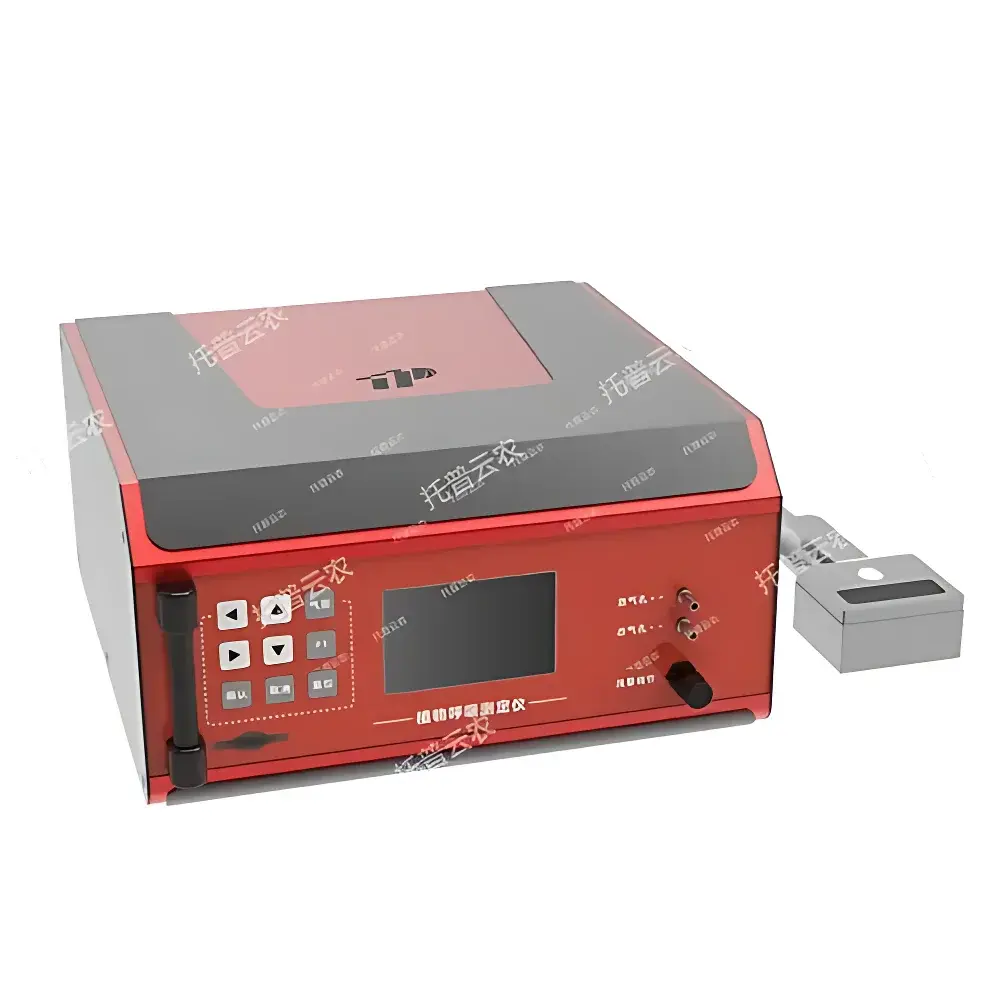
Top Cloud-agri TP-3051A Plant Respiration Rate Analyzer
| Brand | Top Cloud-agri |
|---|---|
| Origin | Zhejiang, China |
| Manufacturer Type | Direct Manufacturer |
| Country of Origin | China |
| Model | TP-3051A |
| CO₂ Range | 0–1000–2000 ppm |
| Resolution | 1 ppm |
| Accuracy | ±1% F.S. |
| Zero Drift | ≤±3% F.S./4 h |
| Span Drift | ≤±3% F.S./4 h |
| Linearity | ≤±2% F.S. |
| Repeatability | ≤±1% F.S. |
| Display | 256×160 LCD |
| Measurement Modes | Open-path & Closed-path |
| Flow Control | Integrated Electronic Mass Flow Meter |
| Environmental Sensors | Ambient Humidity Measurement |
| Interface Layout | Front-mounted data port and gas tubing connectors |
| Power Control | Dedicated mechanical power switch |
Overview
The Top Cloud-agri TP-3051A Plant Respiration Rate Analyzer is a dedicated, portable gas exchange instrument engineered for quantitative measurement of carbon dioxide (CO₂) evolution during plant respiratory metabolism. It operates on the principle of non-dispersive infrared (NDIR) spectroscopy to detect real-time CO₂ concentration changes in air streams passing through or around biological samples—enabling direct calculation of respiration rate (µmol CO₂ m⁻² s⁻¹ or µmol CO₂ g⁻¹ DW s⁻¹, depending on normalization). Designed for pedagogical clarity and field-deployable robustness, the system supports both open-path (ambient air reference) and closed-path (recirculating chamber) configurations, making it suitable for controlled lab experiments as well as greenhouse or nursery-based physiological assessments. Its architecture prioritizes signal stability over extended measurement intervals (up to 4 hours), with drift specifications aligned to ISO 17025-compliant environmental monitoring practices for short-term physiological assays.
Key Features
- NDIR-based CO₂ detection with dual-range capability (0–1000 ppm and 0–2000 ppm), optimized for low-flux respiratory emissions from leaves, roots, seeds, and postharvest tissues.
- Electronic mass flow meter integrated into the gas circuit ensures precise volumetric control (±2% full-scale accuracy), critical for stoichiometric conversion of CO₂ concentration to molar flux rates.
- Front-panel accessibility for all physical interfaces—including USB data output, silicone gas tubing ports, and tactile power switch—reduces setup time and minimizes handling errors during repeated measurements.
- Onboard ambient humidity sensing (non-compensated capacitive sensor) provides contextual environmental metadata, supporting basic correction of CO₂ partial pressure under variable vapor pressure deficits.
- Monochrome graphic LCD (256 × 160 pixels) delivers legible real-time trace plots, numeric readouts, and menu navigation without reliance on external computing hardware.
- Calibration-ready design: accommodates two-point NDIR zero/span verification using certified CO₂ standard gases (e.g., 0 ppm N₂ and 1000 ppm CO₂ in synthetic air), traceable to NIST SRMs.
Sample Compatibility & Compliance
The TP-3051A is validated for use with detached leaves, excised root segments, germinating seeds, whole fruits, tubers, and cut flowers—provided sample dimensions conform to the internal volume constraints of the supplied handheld leaf chamber (standard chamber volume: ~12 cm³; optional root/seed chambers available). It complies with fundamental instrumentation requirements outlined in ASTM E2912–21 (Standard Guide for In Situ Monitoring of Plant Gas Exchange) and supports experimental protocols referenced in USDA ARS postharvest physiology handbooks. While not certified for GLP or GMP-regulated environments, its repeatability (≤±1% F.S.) and documented drift performance meet minimum thresholds for academic teaching labs and preliminary agronomic screening per ISO/IEC 17025 Clause 7.7 (Uncertainty of Measurement).
Software & Data Management
Data acquisition occurs via direct serial communication (USB CDC virtual COM port) to Windows-compatible host software (provided free of charge). The application enables time-synchronized logging of CO₂ concentration, flow rate, relative humidity, and user-defined timestamps. Export formats include CSV and Excel-compatible .xlsx, facilitating downstream analysis in MATLAB, R, or Python (Pandas). Audit trail functionality includes operator ID tagging, session start/stop markers, and automatic firmware version stamping—supporting basic 21 CFR Part 11 readiness when paired with institutional electronic signature policies. Raw sensor outputs are unprocessed; all derived respiration rates require manual application of chamber geometry, sample biomass, and temperature-corrected ideal gas law constants by the end user.
Applications
- Undergraduate and graduate plant physiology laboratories: quantifying dark respiration kinetics across species under standardized light/dark transitions.
- Postharvest physiology studies: evaluating respiratory climacteric patterns in tomatoes, apples, and kiwifruit during cold storage trials.
- Seed viability assessment: correlating CO₂ emission rates from aged versus freshly harvested cereal grains with tetrazolium staining outcomes.
- Root-zone stress phenotyping: measuring oxygen-limited root respiration in flooded rice genotypes or saline-tolerant barley lines.
- Controlled-environment agriculture (CEA) optimization: validating ventilation setpoints in vertical farms by monitoring crop canopy-level CO₂ accumulation during nocturnal periods.
FAQ
What sample types can be measured with the TP-3051A?
Detached leaves, excised roots, intact fruits, seeds, tubers, and cut flowers—when placed inside compatible chambers that maintain laminar airflow and thermal equilibrium.
Does the instrument compensate for temperature or pressure variations?
No built-in compensation; users must apply post-acquisition corrections using recorded ambient temperature and barometric pressure values.
Is factory calibration traceable to international standards?
Yes—initial calibration is performed using NIST-traceable CO₂ reference gases; certificate of conformance is included with each unit.
Can multiple sensors be daisy-chained for parallel measurements?
No; the TP-3051A is a single-channel analyzer. Synchronized multi-chamber studies require separate units and external time alignment.
What maintenance is required for long-term reliability?
Annual NDIR optical path inspection and zero/span recalibration recommended; particulate filter replacement every 6 months under continuous use.




