
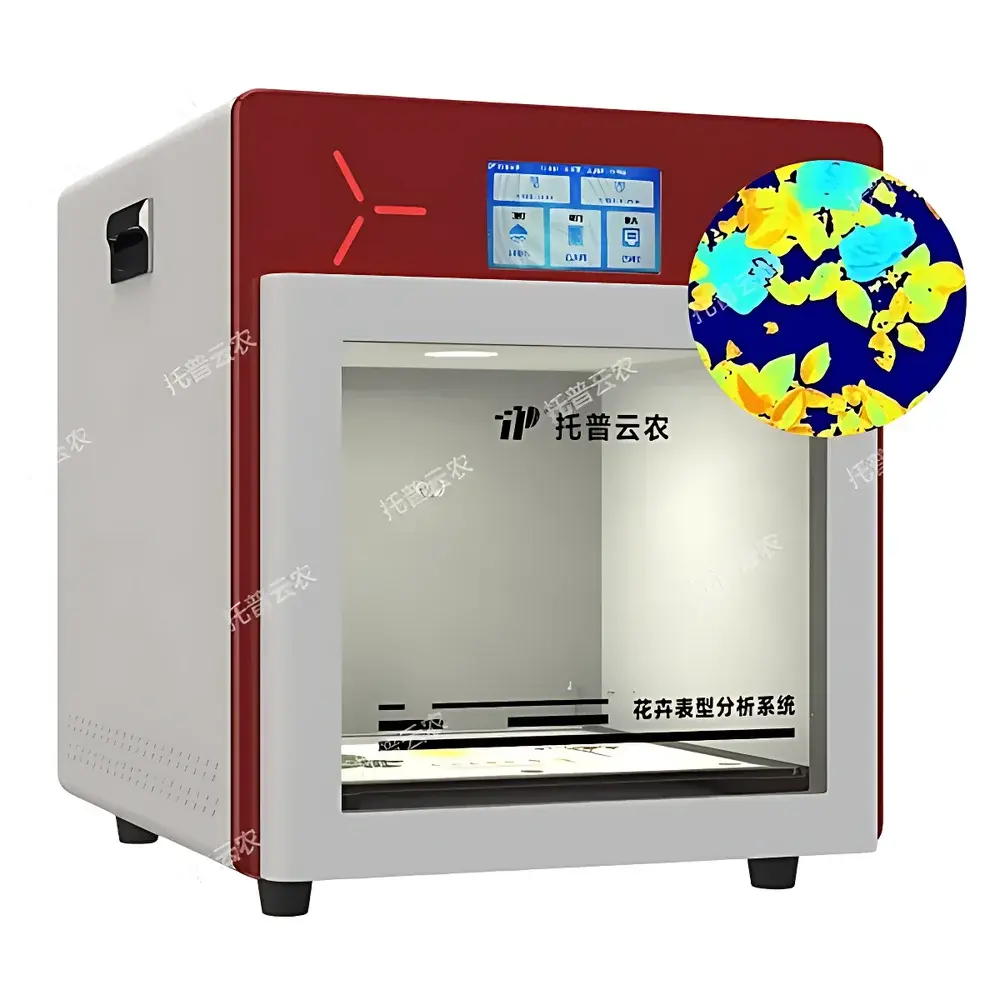
Top Cloud-agri TP-GP-BH Plant Pathology Phenotyping System
| Brand | Top Cloud-agri |
|---|---|
| Origin | Zhejiang, China |
| Manufacturer Type | OEM Manufacturer |
| Country of Origin | China |
| Model | TP-GP-BH |
| Imaging Sensors | 26 MP RGB camera + Hyperspectral imager (400–1000 nm) |
| Enclosure Dimensions | 450 mm × 450 mm background plate |
| IP Rating | IP53 |
| Power Supply | AC 220 V, 50 Hz |
| Max Power Consumption | <100 W |
| Operating Temperature | 0–40 °C |
| Relative Humidity | ≤90% RH |
Overview
The Top Cloud-agri TP-GP-BH Plant Pathology Phenotyping System is a modular, non-invasive imaging platform engineered for quantitative assessment of plant disease responses under controlled or semi-controlled environments. It integrates synchronized visible-light (RGB) and hyperspectral imaging within a single enclosed cabinet, enabling spectral-spatial characterization of pathological symptoms—including chlorosis, necrosis, lesion expansion, and tissue discoloration—across leaves, stems, fruits, and seedlings. The system operates on the principle of reflectance spectroscopy combined with high-resolution morphometric segmentation: by capturing spectral signatures across the 400–1000 nm range and correlating them with spatial features from a 26-megapixel RGB sensor, it supports objective, operator-independent quantification of symptom severity, progression kinetics, and anatomical distribution. Designed for reproducible phenotypic data acquisition, the TP-GP-BH meets core requirements for experimental rigor in phytopathology research, resistance screening, quarantine diagnostics, and agrochemical efficacy trials.
Key Features
- Multi-modal optical acquisition: Simultaneous RGB and hyperspectral imaging ensures complementary data layers—high-fidelity color morphology and biochemical-sensitive spectral fingerprints—for robust symptom classification.
- Standardized illumination environment: Uniform diffused LED lighting eliminates specular artifacts and shadowing, ensuring consistent radiometric calibration across samples and sessions.
- Integrated sample handling: Sliding-stage carrier enables rapid, repeatable positioning of detached organs or potted plants; background plate (450 × 450 mm) provides geometric reference and minimizes edge distortion.
- Automated image annotation & metadata embedding: Each acquired frame is timestamped, assigned a unique alphanumeric ID, and tagged with user-defined sample identifiers—enabling full traceability in GLP-aligned workflows.
- Onboard spectral processing engine: Pre-loaded pathogen response models leverage spectral indices (e.g., NDVI, PRI, SIPI) and machine learning classifiers to segment lesions, quantify affected area (%), classify symptom type (e.g., anthracnose vs. powdery mildew), and estimate severity grade.
- Batch-processing capability: Supports parallel analysis of hundreds of images via scriptable workflow templates, reducing manual intervention while preserving analytical consistency.
Sample Compatibility & Compliance
The TP-GP-BH accommodates a broad spectrum of plant materials—including dicot and monocot leaves, herbaceous stems, immature and mature fruits, and seedling rosettes—without requiring destructive sampling or chemical staining. Its enclosed design (IP53-rated) permits stable operation in variable ambient conditions typical of growth chambers, phytotrons, greenhouses, and biosafety-level 1 laboratories. While not certified to ISO/IEC 17025 or FDA 21 CFR Part 11 out-of-the-box, the system’s audit-ready data structure—comprising raw image files, processed outputs, parameter logs, and versioned analysis scripts—supports integration into validated laboratory information management systems (LIMS) compliant with ISO 15189, OECD GLP principles, and national phytosanitary protocols (e.g., EPPO PM 7/106).
Software & Data Management
The proprietary acquisition and analysis suite provides a deterministic, version-controlled pipeline: image capture → radiometric correction → region-of-interest (ROI) definition → spectral unmixing → feature extraction → statistical summarization. All intermediate and final datasets are stored in open, non-proprietary formats (TIFF, CSV, JSON). Metadata fields adhere to MIAPPE v1.1 standards where applicable. Cloud synchronization is implemented via TLS-encrypted HTTPS endpoints; local storage utilizes SQLite-backed relational indexing for fast querying by experiment ID, genotype, treatment, or date range. Export options include publication-ready PNG/SVG visualizations, Excel-compatible trait tables, and Word-formatted diagnostic reports containing annotated images, quantitative metrics, and confidence intervals derived from intra-sample replicates.
Applications
- High-throughput screening of host resistance against fungal, bacterial, and viral pathogens
- Time-series monitoring of disease progression in controlled-environment studies
- Quantitative evaluation of fungicide/biocontrol agent efficacy under standardized exposure regimes
- Phenotypic validation of gene-editing or QTL-mapping outcomes in breeding programs
- Supporting national and regional plant quarantine services through objective, evidence-based symptom documentation
- Integration with digital twin frameworks for predictive modeling of crop health trajectories
FAQ
Does the system require external calibration standards for hyperspectral data?
No—factory-calibrated using NIST-traceable reflectance panels; optional user recalibration is supported via included Spectralon® reference tiles.
Can the software interface with third-party statistical packages such as R or Python?
Yes—CSV and HDF5 export formats are natively compatible with pandas, scikit-learn, and plantCV; API documentation is provided for programmatic control.
Is remote operation possible over LAN or VPN?
Yes—the acquisition module supports headless mode via SSH; real-time preview and parameter adjustment are accessible through browser-based GUI.
What file formats are generated during batch analysis?
Raw images (.tiff), processed masks (.png), trait matrices (.csv), spectral libraries (.json), and report documents (.docx).
How is data integrity ensured during cloud upload?
Each upload session includes SHA-256 checksum verification; failed transfers auto-resume from last valid block without data duplication or corruption.





