
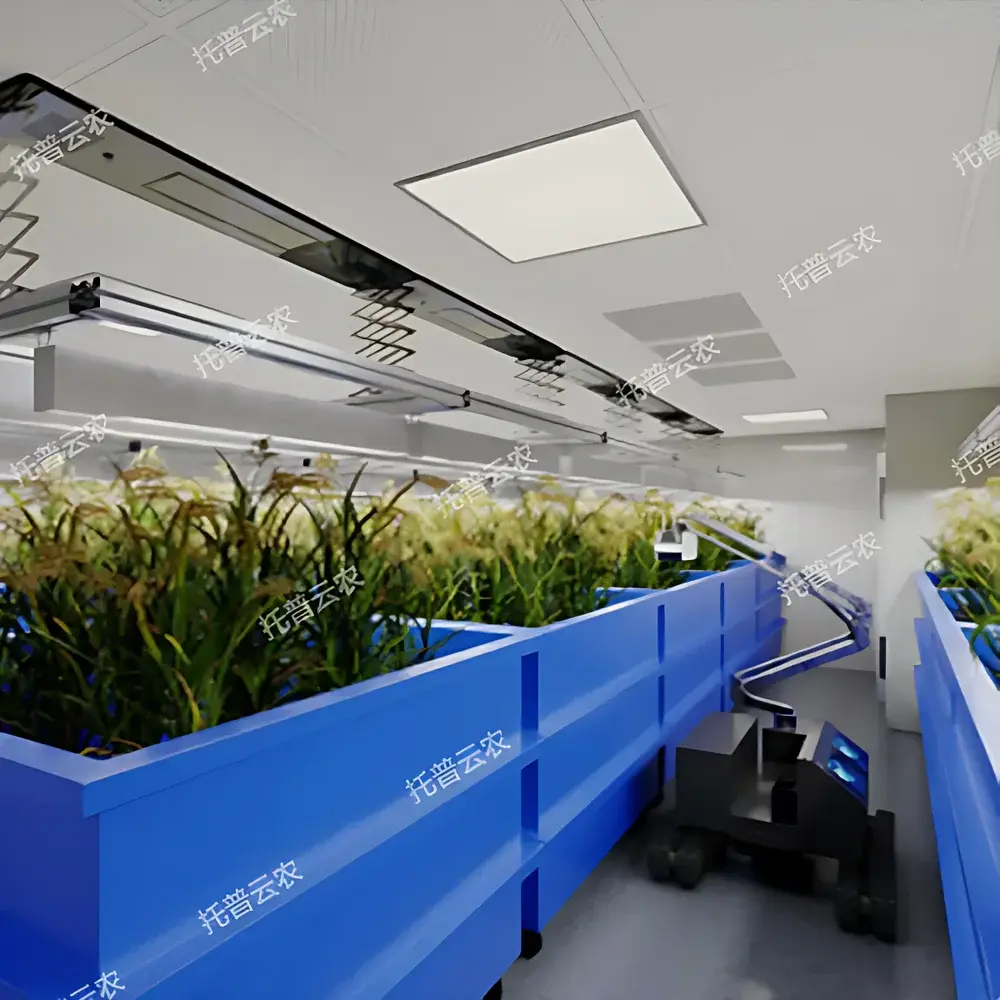
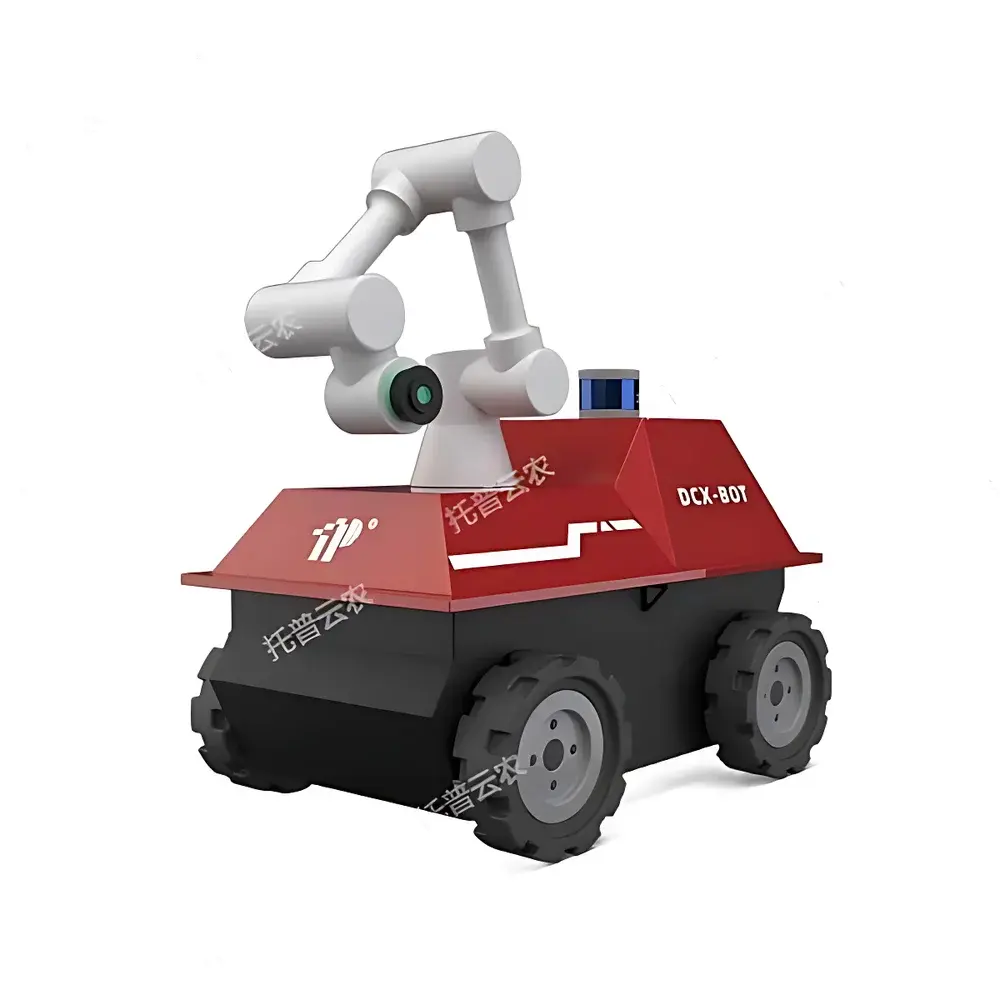
Top Cloud-agri TP-GTL-ARC Series Autonomous AGV-Based High-Throughput Plant Phenotyping Platform (Side-Lift Configuration)
| Brand | Top Cloud-agri |
|---|---|
| Origin | Zhejiang, China |
| Manufacturer Type | Manufacturer |
| Region of Origin | Domestic (China) |
| Model | TP-GTL-ARC Series |
| Pricing | Upon Request |
| Mobility Power | DC 51.2 V, 80 Ah battery (8 h field operation, ≤2 h charge time) |
| Operating Temp | −10–45 °C |
| Operating Humidity | 5–95% RH (non-condensing) |
| Visible & Depth Camera | 3840 × 2160 @ 5/15/25/30 fps MJPEG, 850 nm laser illumination |
| Hyperspectral Light Source | Low-flicker, high-CRI halogen lamp |
| Thermal IR Spectral Range | 7.5–14 µm |
| IR Resolution | 640 × 512 |
| Thermal Range | −20–150 °C and 0–650 °C |
| Thermal Accuracy | ±2 °C or ±2% of reading |
Overview
The Top Cloud-agri TP-GTL-ARC Series is an autonomous, AGV-based high-throughput plant phenotyping platform engineered for controlled-environment research facilities—including greenhouses, climate chambers, and vertical farming systems. Designed around a side-lift modular architecture, the system integrates mobile robotics, multi-axis robotic manipulation, and synchronized multimodal imaging to acquire spatially registered morphological, structural, and physiological data from potted and soil-grown plants without manual intervention. Its measurement foundation combines passive optical imaging (visible RGB), active structured-light depth mapping, reflectance-based hyperspectral analysis (400–1000 nm), and emissivity-corrected thermal infrared radiometry—enabling quantitative assessment of canopy architecture, growth dynamics, water status, nutrient distribution, and abiotic/biotic stress responses. Unlike stationary gantry or conveyor-based platforms, the TP-GTL-ARC’s compact footprint and omnidirectional mobility allow flexible deployment in constrained or reconfigurable experimental layouts, supporting longitudinal studies across diverse genotypes and treatment conditions.
Key Features
- Autonomous Navigation & Obstacle Avoidance: Equipped with LiDAR-based SLAM (Simultaneous Localization and Mapping), ultrasonic proximity sensors, and real-time path planning algorithms, the AGV executes repeatable, centimeter-accurate trajectories while dynamically rerouting around static or moving obstacles.
- Omnidirectional Mobility: Four-wheel independent drive and steering enable forward/backward translation, lateral strafing, and zero-radius rotation—critical for precise positioning beneath canopies and navigation through narrow aisles.
- Modular Sensor Payload Integration: A six-degree-of-freedom robotic arm supports hot-swappable sensor modules (RGB, RGB-D, hyperspectral, thermal IR), each calibrated to a common coordinate frame for geometric and radiometric consistency across modalities.
- Dual-Mode Control Architecture: Supports both remote manual operation via ergonomic handheld controller and fully automated mission scheduling through a web-accessible task management interface with georeferenced waypoint definition and batch job queuing.
- Real-Time Onboard Processing: Embedded edge computing unit performs preliminary image registration, background subtraction, and ROI segmentation prior to data offloading—reducing storage overhead and enabling rapid feedback during acquisition.
Sample Compatibility & Compliance
The TP-GTL-ARC accommodates standard growth containers (10–50 cm diameter pots), hydroponic trays, and bench-mounted soil mesocosms up to 1.2 m in height. Its side-lift mechanism lifts sensor payloads laterally—avoiding vertical intrusion into sensitive canopies—making it suitable for fragile or tall-stemmed species including maize, tomato, wheat, and Arabidopsis. All imaging modules comply with IEC 62471 (photobiological safety) and EN 61326-1 (EMC for laboratory equipment). Thermal IR measurements adhere to ASTM E1933-19 standards for infrared thermography in agricultural applications. Data handling workflows support GLP-compliant audit trails, including user authentication logs, timestamped acquisition metadata, and immutable raw-data archiving—facilitating alignment with ISO/IEC 17025 and FDA 21 CFR Part 11 requirements when deployed in regulated breeding or preclinical agronomic trials.
Software & Data Management
The proprietary PhenotypeStudio software suite provides end-to-end data lifecycle management—from mission configuration and sensor calibration to feature extraction, statistical modeling, and visualization. It includes validated analytical pipelines for: (1) 3D point-cloud reconstruction and volumetric trait derivation (e.g., projected leaf area, convex hull volume, fractal dimension); (2) spectral index computation (NDVI, GNDVI, PRI, MCARI, etc.) and partial least squares regression (PLSR)-based prediction of chlorophyll, nitrogen, and anthocyanin content; (3) thermal heterogeneity quantification (canopy temperature variance, Tmax/Tmin differentials, stomatal conductance proxies). All outputs are exportable in FAIR-compliant formats (NetCDF, TIFF, CSV) and integrate natively with Crop Ontology (CO) and Plant Trait Ontology (TO) identifiers. Optional API access enables integration with LIMS, Breeding Management Systems (BMS), and cloud-based analytics platforms such as RAPID or BreedBase.
Applications
- Genetic Mapping & QTL Analysis: High-temporal-resolution trait capture across biparental populations or association panels under controlled drought, heat, or nutrient limitation regimes.
- Phenotypic Screening in Mutation Libraries: Rapid identification of morphological outliers (e.g., altered tillering, leaf angle, senescence timing) in TILLING or CRISPR-edited lines.
- Physiological Stress Monitoring: Quantitative assessment of transpirational cooling deficits via thermal heterogeneity metrics and early detection of pathogen-induced stomatal closure using time-series NDVI decay kinetics.
- Crop Modeling Input Generation: Provision of spatially explicit, time-resolved inputs (LAI, canopy height, surface temperature) for process-based models such as APSIM or DSSAT.
- Vertical Farm Optimization: Evaluation of light-use efficiency, vertical light penetration, and microclimate gradients across stacked tiers in controlled-environment agriculture (CEA) settings.
FAQ
What environmental conditions can the TP-GTL-ARC operate in?
The platform is rated for operation in controlled environments at −10 °C to 45 °C and 5–95% relative humidity (non-condensing), making it suitable for most greenhouse and climate chamber configurations.
Can the system be integrated with existing greenhouse control systems?
Yes—via Modbus TCP or MQTT protocols, the platform supports bidirectional communication with HVAC, irrigation, and lighting controllers to synchronize phenotyping events with environmental perturbations.
Is raw sensor data accessible for custom algorithm development?
All unprocessed sensor outputs—including radiometrically corrected hyperspectral cubes, registered depth maps, and calibrated thermal radiance frames—are available in vendor-neutral formats for third-party analysis.
How is geometric calibration maintained across sensor modules?
A factory-applied, multi-step calibration procedure establishes extrinsic and intrinsic parameters for each module; routine verification is performed using NIST-traceable checkerboard and blackbody targets included with the system.
Does the platform support multi-year longitudinal studies?
Yes—the system maintains persistent device identity, time-synchronized acquisition timestamps, and version-controlled software/firmware—ensuring reproducibility and traceability across multi-season deployments.





