Top Cloud-agri TP-GTL-W High-Throughput Hyperspectral Plant Phenotyping Imaging System
| Brand | Top Cloud-agri |
|---|---|
| Origin | Zhejiang, China |
| Manufacturer Type | Original Equipment Manufacturer (OEM) |
| Product Origin | Domestic (China) |
| Model | TP-GTL-W |
| Pricing | Upon Request |
Overview
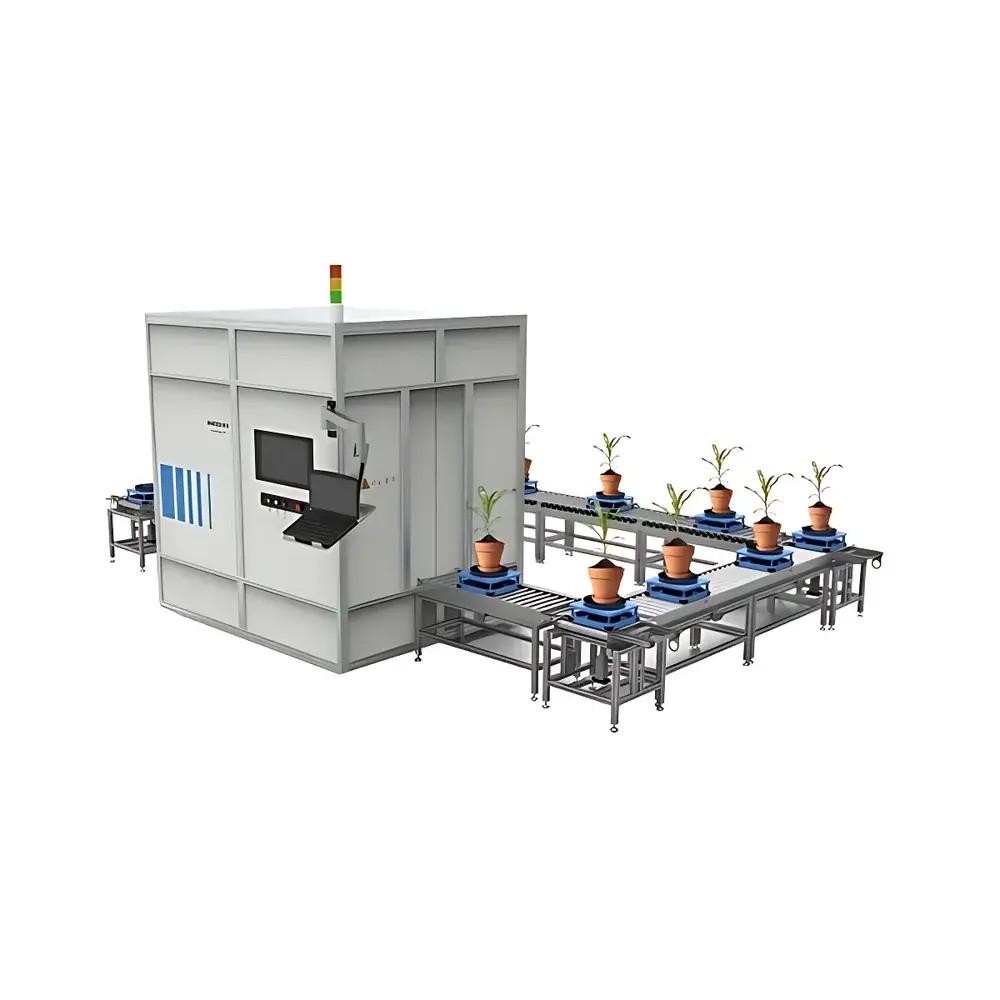
The Top Cloud-agri TP-GTL-W High-Throughput Hyperspectral Plant Phenotyping Imaging System is an integrated, automated platform engineered for non-destructive, quantitative phenotypic characterization of potted plants under controlled greenhouse environments. It operates on a conveyor-based acquisition architecture, sequentially transporting individual plant units into a light-controlled imaging chamber where synchronized multi-modal sensor data are acquired. The system implements a closed-loop workflow—plant positioning → multi-sensor image capture → edge-based feature extraction → centralized data ingestion—enabling reproducible, high-temporal-resolution phenotyping across hundreds of genotypes per day. Its core measurement principles include visible-light photogrammetry (2D/3D), hyperspectral reflectance spectroscopy (400–1000 nm), and structured-light-assisted 3D reconstruction. Designed for scalability and operational robustness, the TP-GTL-W supports longitudinal monitoring of morphological, textural, chromatic, and biochemical traits under abiotic (e.g., drought, salinity, heat) and biotic (e.g., pathogen infection, herbivory) stress regimes—making it suitable for translational research in crop improvement, functional genomics, and climate-resilient agriculture.
Key Features
- Modular multimodal imaging architecture: Integrates RGB 2D imaging, visible-light 3D photogrammetry, and push-broom hyperspectral imaging (HSI) within a single pass-through acquisition cycle.
- Automated conveyor subsystem: Precision belt-driven transport with ±2 mm positional repeatability and RFID-based plant identification; adjustable speed up to 13 m/min.
- 360° rotating imaging platform: Enables multi-angle, occlusion-minimized 2D/3D data capture without manual repositioning or calibration.
- Edge-computing analytics module: On-device execution of validated phenotypic algorithms—including canopy area, height, volume, leaf count, chlorophyll index (NDVI, RVI, GVI), and spectral unmixing—reducing latency and network dependency.
- Integrated weighing option: High-accuracy load cell module synchronized with conveyor position for real-time biomass estimation during transit.
- Secure, scalable data pipeline: Supports both LAN-deployed and cloud-integrated architectures with TLS-encrypted transmission, audit-trail logging, and extensible storage via NAS or object-based repositories.
- Standardized metadata embedding: Each image set is automatically tagged with timestamp, plant ID (RFID), sensor configuration, illumination parameters, and environmental metadata (if external sensors are interfaced).
Sample Compatibility & Compliance
The TP-GTL-W accommodates standard horticultural containers (7–20 cm diameter pots) and supports upright growth forms of dicot and monocot species—including Arabidopsis, tomato, rice, wheat, maize, and Brassica. Sample throughput is optimized for greenhouse-grown plants at vegetative to early reproductive stages (V3–R1). All optical components comply with IEC 62471:2006 (photobiological safety), and electrical subsystems meet CE and RoHS directives. While not FDA-cleared (as it is a research-grade instrument), the system’s data management framework aligns with GLP/GMP-aligned practices: full traceability of raw images, processing logs, algorithm versions, and user actions; configurable retention policies; and export-ready formats (TIFF, HDF5, CSV) compatible with FAIR data principles. Integration with LIMS or ELN systems is supported via RESTful API and ODBC drivers.
Software & Data Management
The system ships with TopCloud Phenotype Suite v3.x—a cross-platform application built on Qt and Python (PyTorch, OpenCV, scikit-image). It provides a unified interface for acquisition scheduling, sensor orchestration, real-time preview, batch analysis, and interactive visualization. Analytical modules are modular and version-controlled; users may import custom segmentation or regression models via ONNX. Raw hyperspectral cubes are stored in ENVI-compatible format with embedded wavelength calibration vectors. All processed metrics are exported in MIAPPE-compliant JSON-LD schemas. Audit trails record operator login, parameter changes, analysis triggers, and export events—supporting 21 CFR Part 11 readiness when deployed with optional digital signature and role-based access control (RBAC) add-ons. Data backups follow a 3-2-1 strategy (three copies, two media types, one offsite).
Applications
- Genetic mapping & QTL analysis: High-throughput screening of mutant populations or biparental mapping panels for architectural, pigmentary, or stress-response traits.
- Molecular breeding support: Correlating spectral signatures (e.g., chlorophyll absorption depth at 680 nm) with marker-trait associations to accelerate selection cycles.
- Abiotic stress physiology: Quantifying dynamic shifts in NDVI, anthocyanin index, and thermal dissipation proxies under controlled drought or salinity treatments.
- Plant–pathogen interaction studies: Detecting pre-symptomatic spectral anomalies in infected leaf tissue using supervised classification (e.g., SVM, Random Forest) trained on labeled HSI datasets.
- Phenomic model development: Generating ground-truth 3D biomass estimates and spectral libraries for training digital twin frameworks and remote sensing downscaling algorithms.
- Eco-physiological modeling: Parameterizing canopy radiation transfer models using measured LAI, clumping index, and spectral albedo derived from multi-angle acquisitions.
FAQ
What plant sizes and growth stages are compatible with the TP-GTL-W?
Plants must fit within standard 20 cm-diameter pots and maintain upright posture; optimal performance is achieved from rosette stage (Arabidopsis) through tillering (cereals) or branching (tomato), typically 2–8 weeks post-germination.
Can the system operate in ambient greenhouse lighting?
No—it requires integration into a dedicated darkroom or light-shielded enclosure to eliminate spectral contamination and ensure radiometric consistency across acquisitions.
Is third-party software integration supported?
Yes—via documented APIs, Python SDK, and standardized file exports (GeoTIFF, ENVI HDR, CSV), enabling interoperability with R/Bioconductor, MATLAB, ArcGIS, and commercial phenotyping platforms.
How is calibration maintained across long-term deployments?
The system includes automated daily dark-current and white-reference routines; spectral calibration is traceable to NIST-traceable standards, with drift correction applied during HSI cube reconstruction.
Does the system meet ISO/ASTM standards for phenotypic measurement?
While no single ISO standard governs high-throughput phenotyping, the TP-GTL-W adheres to metrological principles outlined in ISO/IEC 17025 (for lab-based validation), ASTM E2936 (hyperspectral imaging terminology), and the MIAPPE 1.1 metadata specification for reproducibility.
Related Products