
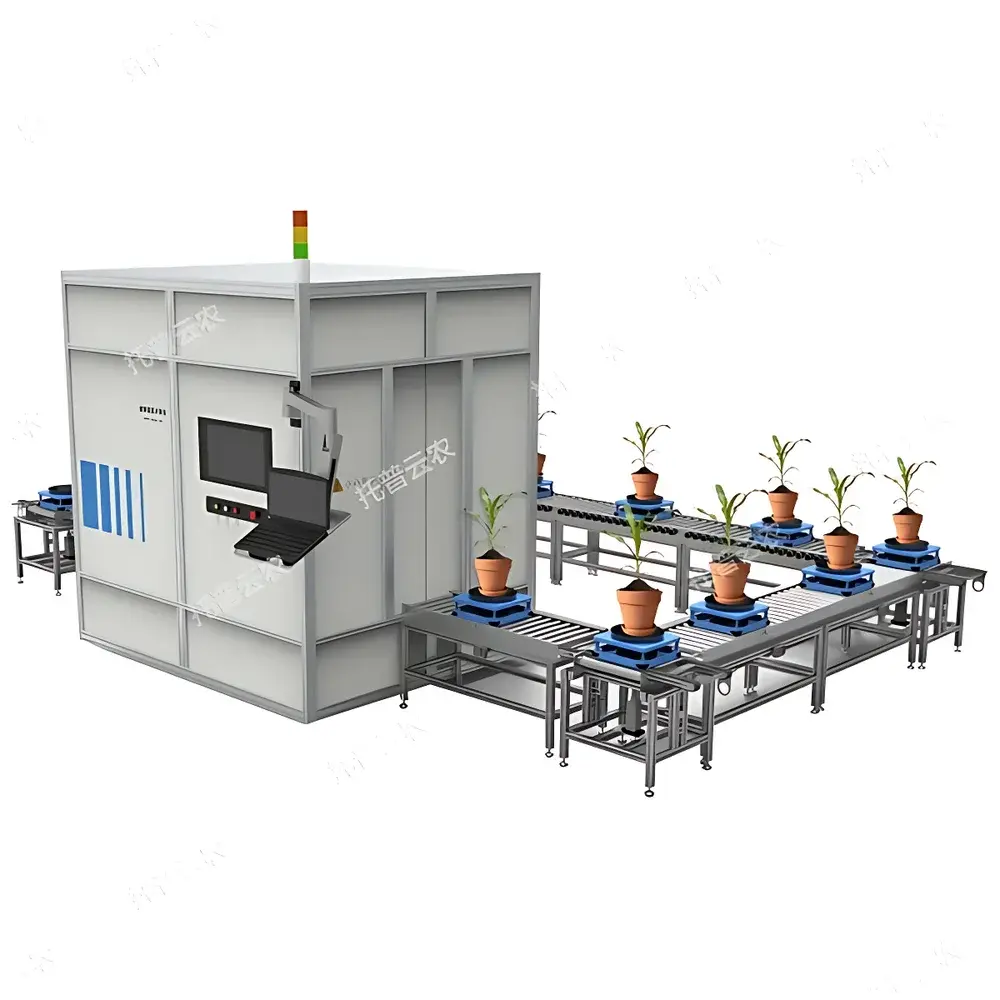
Top Cloud-agri TP-GTL-W High-Throughput Pot-Based Plant Phenotyping Imaging System
| Brand | Top Cloud-agri |
|---|---|
| Origin | Zhejiang, China |
| Manufacturer Type | Original Equipment Manufacturer (OEM) |
| Country of Origin | China |
| Model | TP-GTL-W |
| Pricing | Upon Request |
Overview
The Top Cloud-agri TP-GTL-W High-Throughput Pot-Based Plant Phenotyping Imaging System is an integrated, automation-driven platform engineered for non-destructive, quantitative phenotypic characterization of potted plants under controlled greenhouse environments. It operates on a conveyor-based workflow architecture, where individual plant pots are precisely indexed, transported through a light-controlled imaging chamber, and sequentially interrogated by synchronized multimodal sensors. The system implements a closed-loop “plant–sensor–analysis” paradigm grounded in optical metrology principles—including 2D/3D visible-light photogrammetry and hyperspectral reflectance spectroscopy—to extract morphological, structural, textural, chromatic, and biochemical traits at scale. Designed for reproducible longitudinal monitoring, it supports time-series acquisition across developmental stages and environmental perturbations, enabling statistically robust genotype–phenotype association studies. Its modular sensor integration aligns with FAIR data principles and facilitates compliance with GLP-aligned experimental protocols in academic, breeding, and regulatory research settings.
Key Features
- Automated conveyor transport system with ±2 mm positional repeatability and RFID-based per-pot identification, ensuring traceable sample tracking throughout acquisition cycles.
- Modular multimodal imaging suite: co-registered visible-light 2D RGB (5120 × 5120 resolution, 2.5 µm pixel pitch), visible-light 3D photogrammetric reconstruction (360° rotating platform, multi-height imaging), and push-broom hyperspectral imaging (400–1000 nm, 1200 spectral bands, 2.5 nm spectral resolution).
- Edge-integrated real-time processing unit executing embedded phenotypic algorithms—including convex hull area, canopy height, leaf angle distribution, NDVI/RVI/GVI indices, chlorophyll-a/b estimation, and nitrogen content prediction—without reliance on cloud infrastructure.
- Weight-sensing option with high-precision load cells integrated into the conveyor path, enabling concurrent biomass estimation and growth rate modeling.
- Zero-calibration 3D reconstruction pipeline: automatic camera pose estimation and mesh generation from multi-angle RGB inputs; no manual marker placement or external calibration required.
- Secure local network deployment architecture supporting both LAN and hybrid WAN configurations; encrypted data transmission (TLS 1.2+), role-based access control, and audit-trail logging compliant with ISO/IEC 27001-informed security practices.
Sample Compatibility & Compliance
The TP-GTL-W accommodates standard horticultural pots (diameter 8–30 cm) and supports monocot and dicot species including maize, rice, soybean, Arabidopsis, tomato, and wheat. Its imaging chamber dimensions (W × D × H: 120 × 80 × 180 cm) permit upright growth monitoring without mechanical constraint. All optical modules meet IEC 61000-4 electromagnetic compatibility standards. Hyperspectral data acquisition adheres to ASTM E2907–22 guidelines for spectral reflectance measurement geometry. Software workflows support metadata tagging per MIAPPE v1.1 and comply with minimum information standards for plant phenotyping experiments. Data provenance—including timestamp, sensor configuration, illumination intensity, and environmental log (optional integration with greenhouse BMS)—is embedded in every dataset to satisfy GLP documentation requirements.
Software & Data Management
The proprietary TopPheno™ software suite provides a unified interface for experiment scheduling, sensor orchestration, raw data ingestion, batch analysis, and visualization. It features an extensible plugin framework allowing integration of user-defined segmentation models (e.g., U-Net variants) or third-party trait extraction libraries (e.g., PlantCV, PhenoImage). All processed outputs—including 2D trait tables, 3D point clouds (.ply), hyperspectral cubes (.env/.hdr), and derived indices—are stored in vendor-agnostic HDF5 containers with embedded schema definitions. Automated backup to NAS or S3-compatible object storage ensures redundancy. Audit logs record operator actions, parameter changes, and algorithm versioning—meeting FDA 21 CFR Part 11 electronic record/electronic signature (ER/ES) readiness criteria when deployed with optional digital certificate authentication.
Applications
- Quantitative genetic mapping: high-resolution phenotyping of mutant populations and biparental RILs for QTL discovery under abiotic stress (drought, salinity, heat) and biotic stress (pathogen inoculation, herbivory).
- Breeding program acceleration: automated selection of ideotypes based on canopy architecture, stay-green metrics, and nutrient-use efficiency proxies derived from hyperspectral indices.
- Physiological response profiling: time-resolved analysis of senescence dynamics, stomatal conductance surrogates (via thermal–visible fusion), and photosynthetic capacity shifts under controlled CO₂ or light regimes.
- Disease phenomics: spatially resolved detection of early infection signatures via spectral anomaly mapping (e.g., chlorophyll fluorescence quenching, anthocyanin accumulation) prior to macroscopic symptom onset.
- Eco-physiological modeling: generation of training datasets for machine learning models predicting yield potential, water use efficiency, or carbon assimilation rates from non-invasive imaging biomarkers.
FAQ
What plant sizes and growth stages can the TP-GTL-W accommodate?
The system supports potted plants up to 120 cm in height and 30 cm in pot diameter, covering seedling through reproductive stages. Adjustable imaging heights and multi-pass scanning enable optimal focus across developmental phases.
Is the system compatible with existing greenhouse environmental control systems?
Yes—via Modbus TCP or MQTT API integration, the TP-GTL-W can synchronize acquisition timing with climate loggers, irrigation events, and lighting schedules to contextualize phenotypic responses.
How does the system ensure measurement consistency across operators and days?
Through hardware-level illumination stabilization (LED spectral stability <±0.5% over 10,000 hrs), automated white balance referencing before each scan, and daily dark-frame correction routines embedded in the acquisition protocol.
Can custom trait algorithms be deployed on the edge computing unit?
Yes—the onboard Linux-based edge node supports Dockerized Python environments; users may deploy trained PyTorch/TensorFlow models via the TopPheno™ SDK with hardware-accelerated inference on integrated GPU resources.
What level of technical support and software updates are provided post-purchase?
Top Cloud-agri offers 3-year comprehensive warranty, remote diagnostics, annual firmware/software releases aligned with Crop Ontology updates, and on-site validation support for method transfer in regulated environments.




