
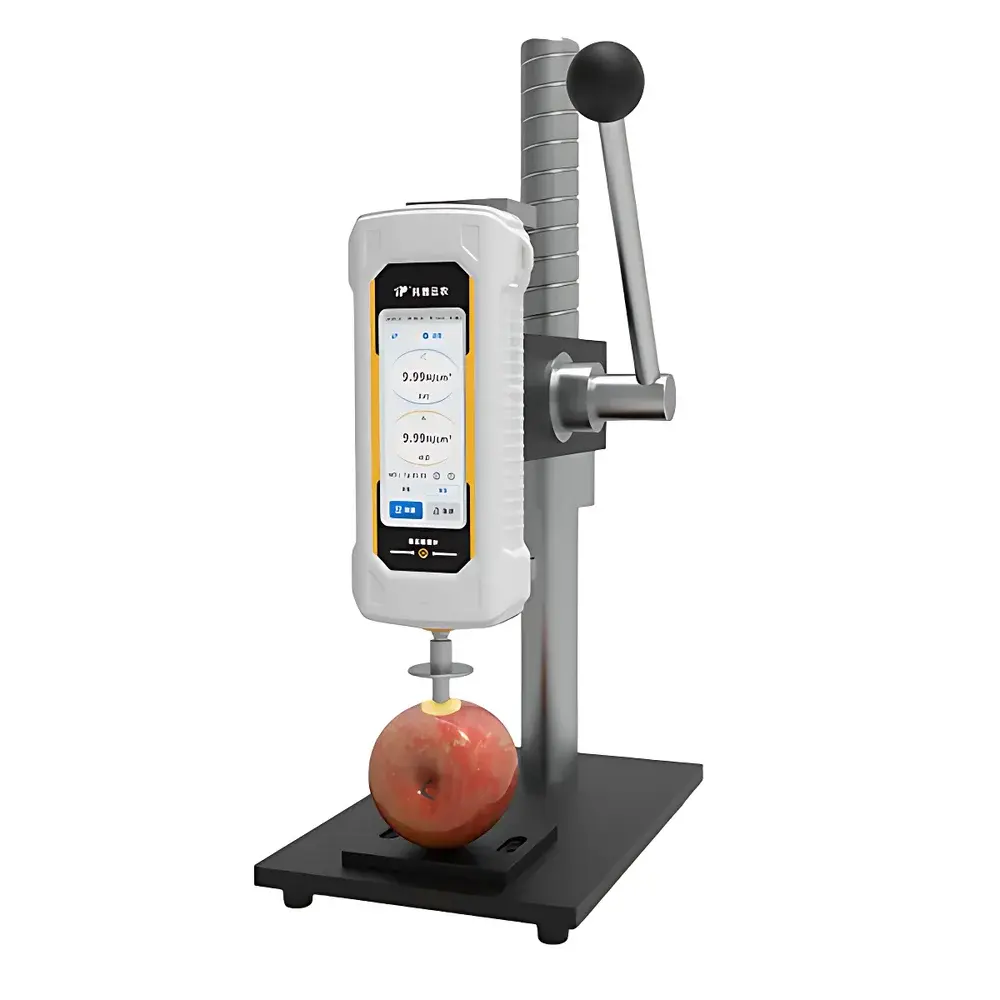
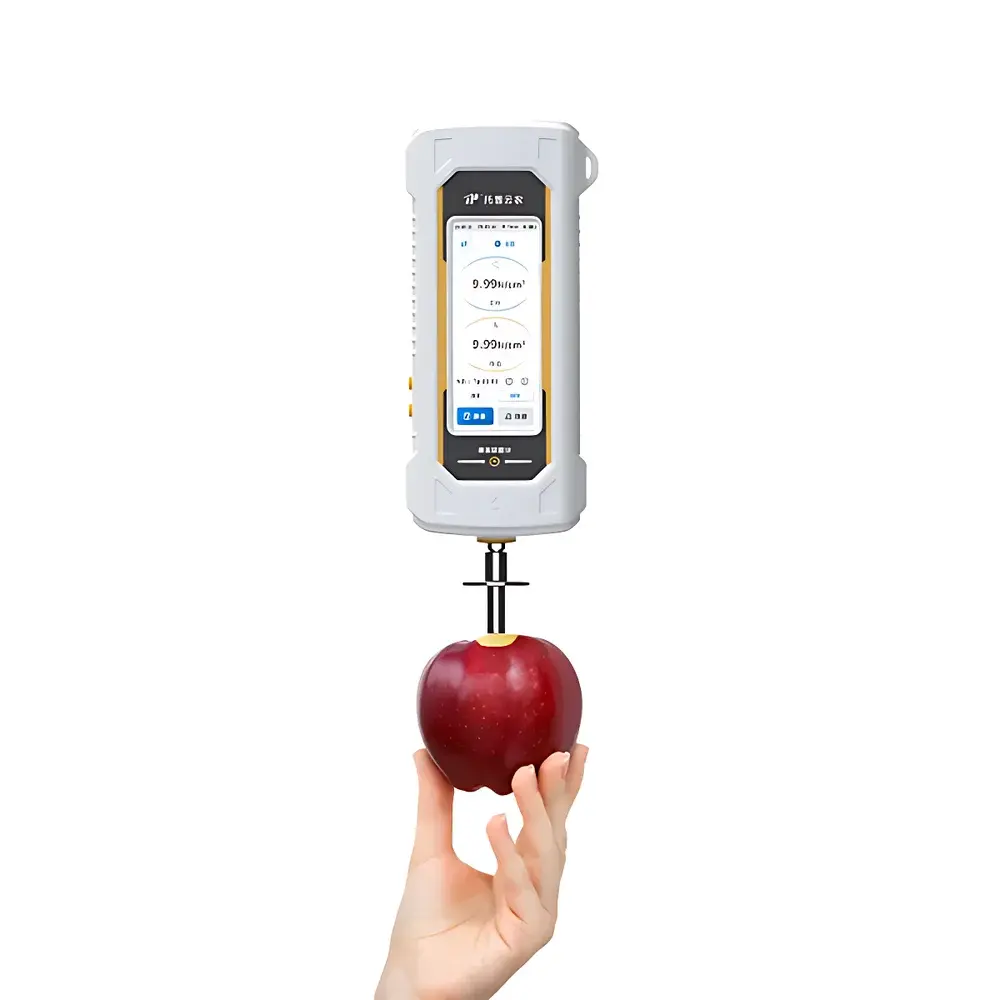
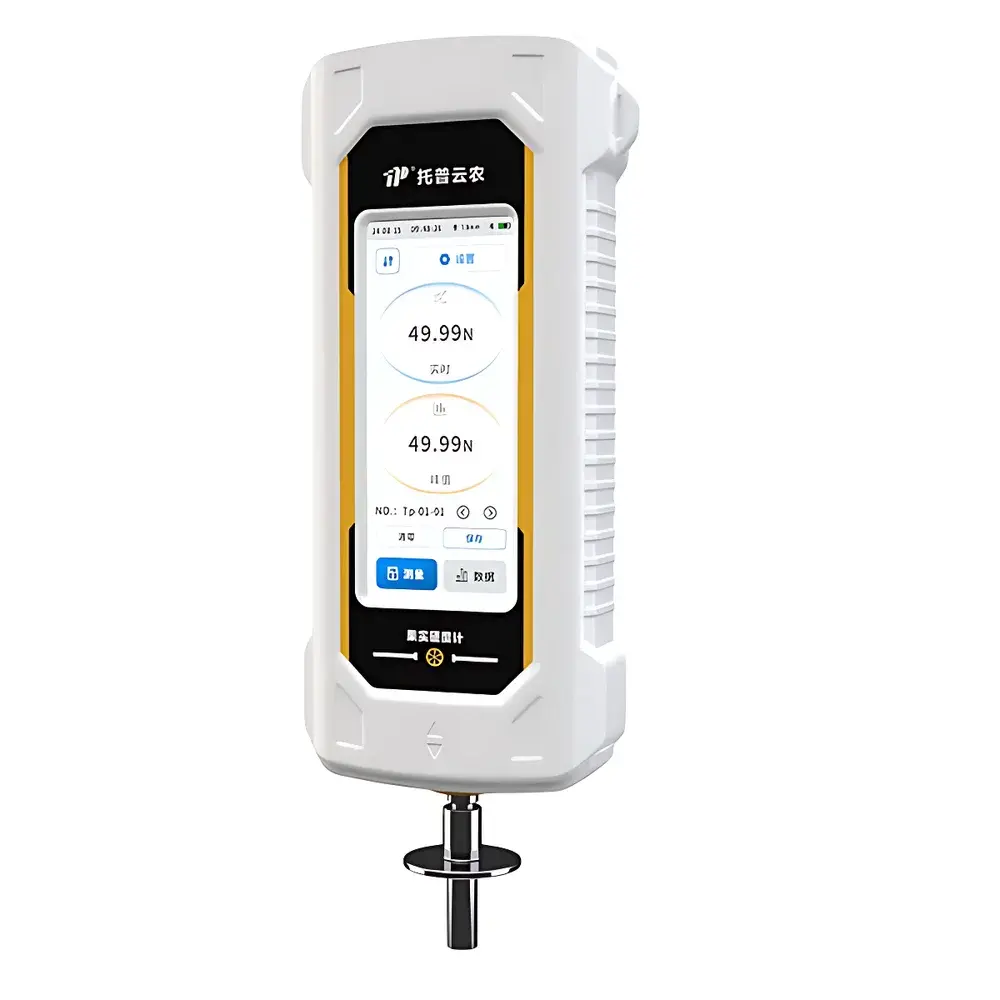
Top Cloud-agri TP-GY-4 Digital Fruit Hardness Tester
| Brand | Top Cloud-agri |
|---|---|
| Origin | Zhejiang, China |
| Manufacturer Type | Manufacturer |
| Country of Origin | Domestic (China) |
| Model | TP-GY-4 |
| Price | USD 520 (approx.) |
| Dimensions | 206 × 85 × 40 mm |
| Probe Diameters | Φ11.1 mm, Φ7.9 mm, Φ3.5 mm |
| Max Load | 52 / 102 / 520 kg/cm² (per probe) |
| Measurement Units | kg/cm², N/cm², lb/cm², kPa |
| Resolution | 0.01 N/cm² |
| Accuracy | ±0.1% FS |
| Penetration Depth | 10 mm |
| Weight | <500 g |
| Operating Temp | –10°C to +60°C |
| Humidity Range | 0–80% RH |
| Battery Life | 12 h continuous operation |
| Data Storage | >10,000 records |
| Compliance | Designed for ASTM F2527-22 (Standard Test Method for Firmness of Fruits and Vegetables Using a Penetrometer), ISO 8745:2022 (Fruit and Vegetable Products — Determination of Firmness), and aligned with USDA and FAO postharvest quality assessment protocols |
Overview
The Top Cloud-agri TP-GY-4 Digital Fruit Hardness Tester is a handheld, portable penetrometer engineered for precise, non-destructive measurement of fruit and vegetable firmness in agricultural research, postharvest physiology labs, food processing QA/QC environments, and commercial orchard operations. Based on standardized mechanical penetration principles—where a calibrated cylindrical probe is driven at controlled velocity into the fruit tissue—the instrument quantifies resistance force (in units of pressure per unit area) as an objective indicator of turgor, cell wall integrity, and ripening stage. Unlike subjective sensory evaluation or bulk compression methods, the TP-GY-4 delivers repeatable, traceable, and operator-independent readings compliant with internationally recognized firmness testing frameworks, including ASTM F2527-22 and ISO 8745:2022. Its compact ergonomic design enables field-deployable measurements without requiring external power sources or benchtop infrastructure.
Key Features
- Triple interchangeable probes (Φ11.1 mm, Φ7.9 mm, Φ3.5 mm) optimized for diverse produce—e.g., apples and pears (larger probe), berries and tomatoes (medium), and small fruits like grapes or cherries (fine-tip probe)—ensuring appropriate stress distribution and minimizing surface deformation artifacts.
- Real-time force acquisition via high-stability load cell and integrated tilt compensation sensor, eliminating angular error during handheld use and maintaining measurement fidelity across variable operator technique.
- Auto-hold peak detection with simultaneous live-value display, enabling accurate capture of maximum resistance without timing dependency—a critical capability for heterogeneous tissues where peak force may occur transiently.
- On-device data management supporting up to 200 measurement groups (96 entries/group), with automatic timestamping, GPS-enabled geotagging (via paired mobile app), and user-assigned sample IDs—facilitating longitudinal tracking across harvest batches or storage trials.
- Configurable display orientation (180° screen flip), adjustable backlight intensity, programmable auto-shutdown (1–30 min), and low-battery/overload acoustic alerts—enhancing usability under varying ambient lighting and operational conditions.
- Multi-unit conversion engine: seamless switching among kg/cm², N/cm², lb/cm², and kPa, with automatic scaling based on selected probe geometry—eliminating manual correction factors required by legacy analog penetrometers.
Sample Compatibility & Compliance
The TP-GY-4 is validated for use with intact, unpeeled fruits and vegetables exhibiting surface firmness within its dynamic range (52–520 kg/cm², dependent on probe selection). It supports standardized sampling protocols defined in USDA Handbook 66 (Fresh Fruits and Vegetables) and FAO Postharvest Compendium guidelines. All probe geometries conform to the dimensional tolerances specified in ISO 8745:2022 Annex A. Device firmware implements audit-ready metadata logging—including measurement time (UTC), device serial number, probe ID, ambient temperature/humidity (when connected to optional environmental module), and operator ID—supporting GLP-aligned documentation requirements. While not FDA 21 CFR Part 11 certified out-of-box, raw CSV export enables integration into validated LIMS or ELN platforms meeting regulatory data integrity standards.
Software & Data Management
Measurements are wirelessly synchronized via Bluetooth 5.0 to the proprietary Top Cloud-agri AgriLab Mobile App (iOS/Android), which provides real-time visualization, statistical summaries (mean, SD, CV%, min/max per group), and export options (CSV, PDF report templates). Cloud-based aggregation through the AgriLab Research Assistant Platform allows multi-site data pooling, trend analysis across cultivars or storage durations, and automated generation of maturity heatmaps. Local device storage retains >10,000 timestamped records with full metadata; no cloud upload is mandatory, preserving data sovereignty. PC desktop software (Windows/macOS) supports batch calibration validation, probe-specific coefficient management, and compliance with internal SOP version control.
Applications
- Determining optimal harvest windows for apple, pear, peach, and kiwifruit based on firmness thresholds correlated with starch index and ethylene evolution.
- Monitoring softening kinetics during cold storage or controlled-atmosphere transport to validate shelf-life models.
- Screening breeding lines for textural traits in horticultural genetics programs.
- Validating postharvest treatments (e.g., calcium dips, 1-MCP exposure) for their impact on cell wall metabolism.
- Supporting HACCP critical control point verification in fresh-cut processing facilities where texture deviation indicates microbial or enzymatic spoilage risk.
FAQ
What standard does the TP-GY-4 comply with for fruit firmness testing?
It adheres to ASTM F2527-22 and ISO 8745:2022 methodologies, using probe geometry and penetration depth parameters specified therein.
Can measurement data be exported for statistical analysis in R or Python?
Yes—CSV exports include all raw values, timestamps, geolocation, and metadata columns compatible with Pandas, R data.table, or JMP workflows.
Is calibration traceable to national metrology institutes?
Factory calibration uses NIST-traceable deadweight standards; users may perform field verification with supplied reference check weights (optional accessory kit).
How is probe wear accounted for in long-term accuracy?
Each probe carries a unique ID; firmware logs cumulative actuation cycles and prompts recalibration alerts after 5,000 penetrations or annually—whichever occurs first.
Does the device support multi-language UI beyond English?
The embedded interface is English-only; however, the mobile app supports Chinese, Spanish, French, and Arabic localization.






