Top Cloud-agri TP-PHY-KZ High-Throughput Whole-Plant Intelligent Phenotyping System for Soybean
| Brand | Top Cloud-agri |
|---|---|
| Origin | Zhejiang, China |
| Manufacturer Type | Direct Manufacturer |
| Country of Origin | China |
| Model | TP-PHY-KZ |
| Pricing | Upon Request |
| Imaging Unit | 4× 25-MP RGB industrial cameras (5120 × 5120 px, 2.5 µm pixel size) |
| Frame Rate | 1 fps |
| Max Sample Height | 500 mm |
| Max Sample Width (Canopy Spread) | 400 mm |
| Max Load Capacity | 22.5 kg |
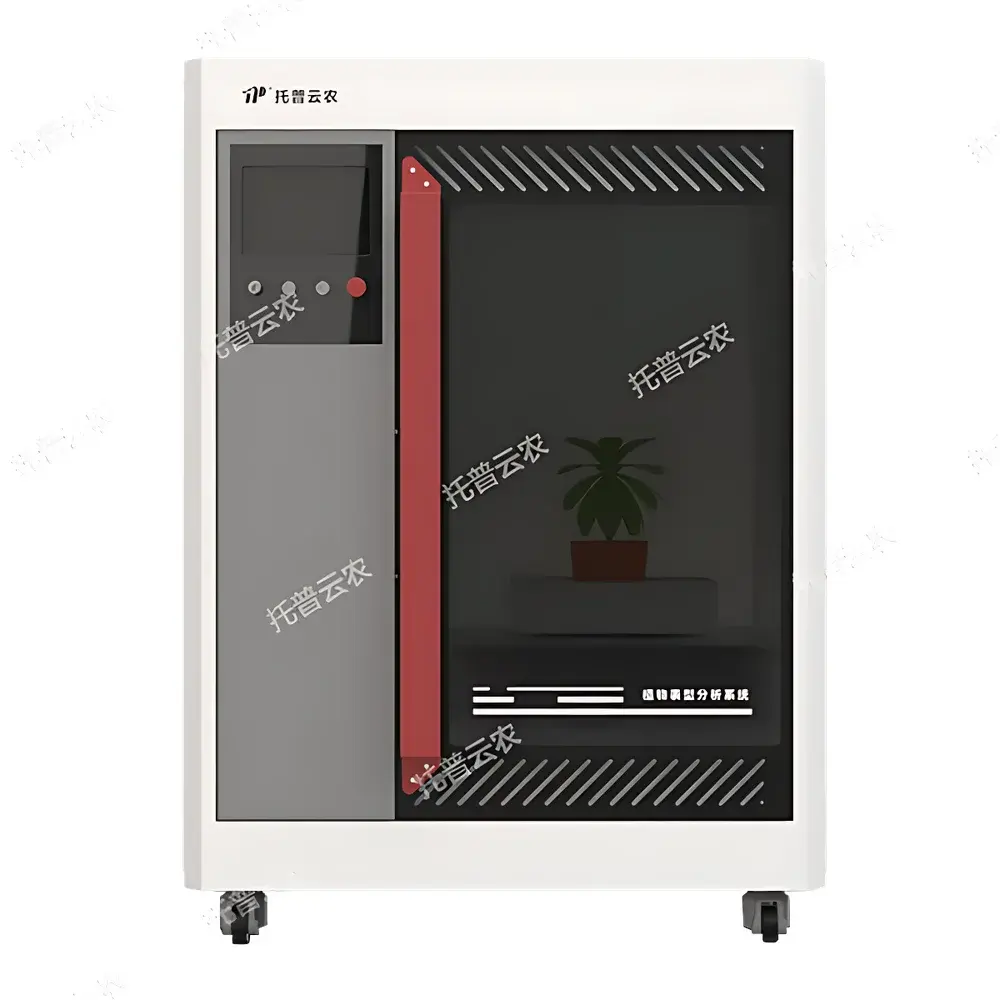
| Enclosure Dimensions (L×W×H) | 1400 × 935 × 1840 mm |
| Operating Temperature | 0–40 °C |
| Relative Humidity | ≤90% RH (non-condensing) |
| Power Supply | AC 220 V, 50 Hz |
| Total Power Consumption | <1 kW |
| IP Rating | IP53 |
| Enclosure Weight | 240 kg |
| Touch Interface | 10.1″ capacitive touchscreen |
| Lighting | Uniform diffused LED panel illumination |
Overview
The Top Cloud-agri TP-PHY-KZ High-Throughput Whole-Plant Intelligent Phenotyping System for Soybean is a vertically integrated, enclosed phenotyping platform engineered for non-destructive, time-series morphological and physiological trait quantification across the entire soybean growth cycle—from seedling emergence through pod maturation. Built upon a rigid, climate-stable enclosure architecture, the system employs synchronized multi-angle visible-light imaging combined with structure-from-motion (SfM) and deep learning–enhanced 3D reconstruction to generate geometrically accurate point clouds and Gaussian-surface models. Unlike open-field or gantry-based systems, the TP-PHY-KZ operates under controlled indoor conditions—ensuring repeatability, eliminating ambient light interference, and enabling precise environmental monitoring (temperature, humidity) during acquisition. Its design conforms to standard laboratory spatial constraints and integrates seamlessly into GLP-compliant workflows in plant science laboratories, controlled-environment chambers, phytotrons, and vertical farming research facilities.
Key Features
- Multi-View Visible-Light Imaging Architecture: Four synchronized 25-megapixel RGB industrial cameras (5120 × 5120 resolution, 2.5 µm pixel pitch) are arranged in top-and-side dual-view configuration, enabling full 360° rotational capture at 1 frame per second. Users may define custom angular increments (e.g., 5°, 10°), yielding up to 72 lateral views per rotation.
- AI-Augmented 3D Reconstruction Pipeline: Proprietary computer vision algorithms process raw image sequences to reconstruct high-fidelity 3D point clouds and Gaussian surface representations—preserving structural detail critical for stem segmentation, pod localization, and canopy volume estimation.
- Automated Trait Extraction Engine: Delivers quantitative outputs for ≥30 biologically validated phenotypic parameters—including height, stem diameter, canopy spread, canopy height ratio, canopy coverage index, pod count, internode length, leaf color indices (RGB-based hue/saturation/value), chlorophyll retention metrics, senescence progression scores, total leaf area, projected leaf area index (LAI), plant volume, and surface area.
- Integrated Human-Machine Interface: A 10.1″ industrial-grade capacitive touchscreen provides real-time access to environmental sensor data (temperature/humidity), motorized turntable position, lighting intensity control, door lock status, and emergency reset functions—all without external PC dependency.
- Robust Mechanical Design: Steel-framed enclosure with IP53-rated protection, castor-mounted mobility (Fuma-type locking wheels), and uniform diffused LED panel illumination ensure operational stability, operator safety, and optical consistency across repeated acquisitions.
Sample Compatibility & Compliance
The TP-PHY-KZ accommodates potted soybean plants up to 500 mm in height and 400 mm in maximum canopy spread, with a maximum supported weight of 22.5 kg per sample. Its sealed enclosure maintains stable internal microclimate conditions (0–40 °C, ≤90% RH non-condensing), minimizing abiotic stress artifacts during imaging. The system supports barcode-enabled sample tracking (optional QR code module), facilitating traceability from planting to phenotype—aligning with FAIR data principles (Findable, Accessible, Interoperable, Reusable). While not certified to ISO/IEC 17025, its hardware calibration protocols and software audit logs support method validation under internal SOPs compliant with OECD Test Guidelines and USDA ARS phenotyping standards.
Software & Data Management
The proprietary analysis suite offers three operational modes: fully automated batch processing, semi-automated manual refinement, and interactive single-plant analysis. All processed datasets—including raw images, reconstructed 3D models, trait tables, and time-series graphs—are stored locally on encrypted SSD storage with configurable auto-backup intervals. Metadata fields (genotype, treatment, date/time stamp, operator ID) are embedded at ingestion. Export formats include CSV, PNG, OBJ, and PLY—enabling interoperability with R, Python (Open3D, scikit-image), and commercial platforms such as PlantCV or LemnaTec’s IAP. Audit trails record all user actions (e.g., parameter edits, model re-runs), satisfying documentation requirements for GLP audits and internal QA/QC review.
Applications
This system is routinely deployed in academic and industrial breeding programs for quantitative trait locus (QTL) mapping, genome-wide association studies (GWAS), and selection index development. It supports drought, salinity, and nutrient-stress phenotyping by tracking dynamic changes in canopy closure rate, leaf wilting index, and pod-set efficiency over time. In functional genomics, it enables high-resolution characterization of CRISPR-edited lines—particularly for traits affecting architecture (e.g., determinacy, branching angle) and reproductive timing. Its throughput (average 3 minutes per plant from scan to trait table) makes it suitable for F₂, RIL, and NIL population screening at scale—without compromising measurement fidelity.
FAQ
What soybean growth stages can be imaged?
The system is validated for use from VE (emergence) through R8 (full maturity), including vegetative, flowering, pod-fill, and senescence phases.
Is external computing hardware required?
No—the onboard industrial PC handles image acquisition, 3D reconstruction, and trait computation. A dedicated workstation is optional for large-scale data archiving or advanced modeling.
Can the system be integrated with existing LIMS or ELN platforms?
Yes—via RESTful API endpoints and standardized CSV/JSON export, supporting integration with LabVantage, Benchling, or custom laboratory informatics infrastructure.
Does the software support multi-species phenotyping?
While optimized for soybean morphology and developmental markers, the core imaging and reconstruction modules are adaptable to other dicot species (e.g., Arabidopsis, tomato, pea) with appropriate calibration and training data.
How is system calibration maintained over time?
A built-in checkerboard target and photometric reference card enable daily geometric and radiometric verification; calibration logs are retained with each dataset for traceability.