
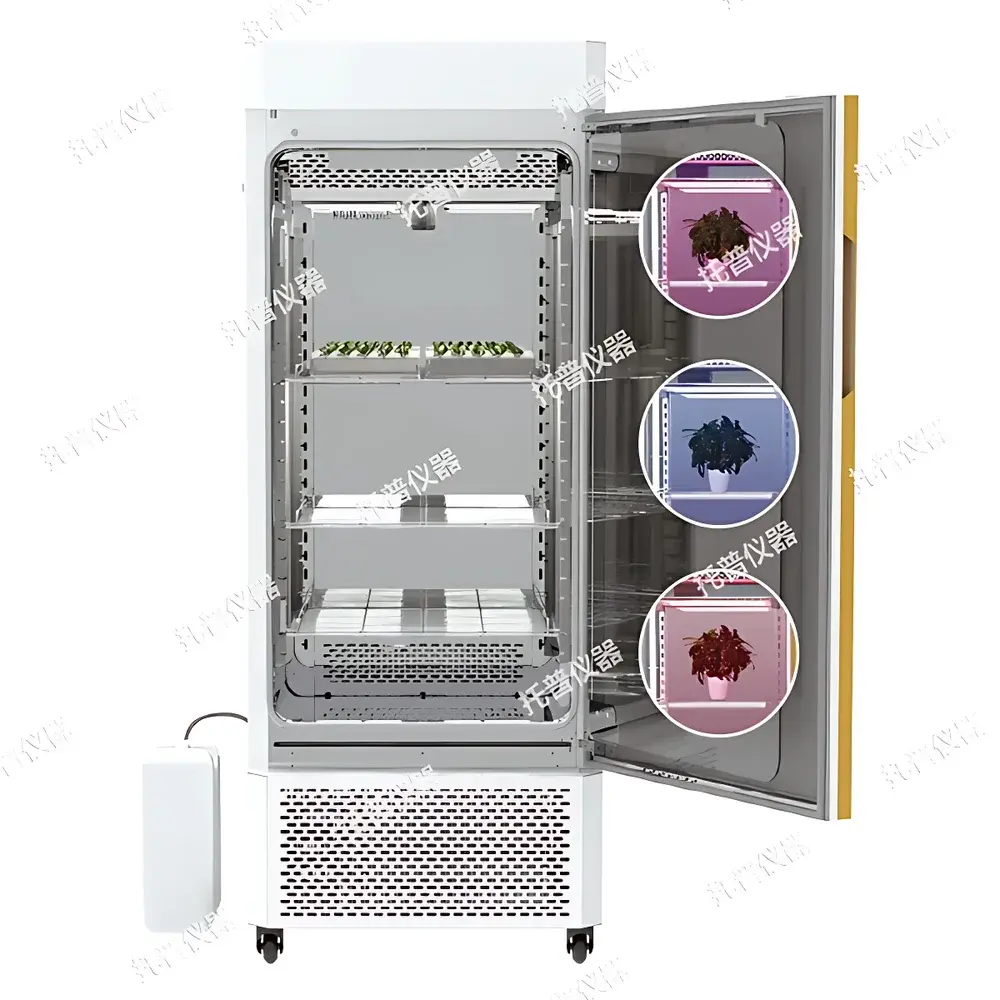
Top Cloud-agri TP-R420D-VB & TP-R1000D-VB Environmental-Controlled Plant Phenotyping Imaging System
| Brand | Top Cloud-agri |
|---|---|
| Origin | Zhejiang, China |
| Manufacturer Type | OEM/ODM Producer |
| Model | TP-R420D-VB / TP-R1000D-VB |
| Internal Volume | 420 L / 1000 L |
| Temperature Range | 0–65 °C (light-off), 10–55 °C (light-on) |
| Humidity Range | 50–95 %RH (10–50 °C), down to <40 %RH (60–65 °C) |
| Illumination | 0–22,000 lux (top-mounted, full-spectrum LED) |
| Spectral Channels | 400–700 nm (white), 450 nm (blue), 660 nm (red), 730 nm (far-red) |
| Airflow Control | 30–100 % stepwise adjustable internal circulation + manual external air exchange |
| Temp. Uniformity | ±0.1 °C (TP-R420D-VB), ±0.3 °C (TP-R1000D-VB) @ 25 °C / 50 %RH |
| Humidity Uniformity | ±2 %RH (TP-R420D-VB), ±3 %RH (TP-R1000D-VB) @ 25 °C / 50 %RH |
| Imaging Resolution | 4000 × 3000 pixels (industrial-grade CMOS sensor) |
| Data Connectivity | RJ45, USB 2.0, Wi-Fi 802.11 b/g/n |
| Power Supply | AC 220 V / 50 Hz / 10 A (TP-R420D-VB), 16 A (TP-R1000D-VB) |
| Safety Compliance | Over-temperature, over-humidity, door-open, sensor-failure, current-overload, compressor-overload, and leakage protection |
| Software | Cloud-integrated platform with AI-powered phenotypic analysis, remote monitoring via web/app/WeChat QR code, GLP-compliant audit trail (optional), FDA 21 CFR Part 11-ready configuration |
Overview
The Top Cloud-agri TP-R420D-VB and TP-R1000D-VB Environmental-Controlled Plant Phenotyping Imaging Systems are integrated climate-controlled imaging incubators engineered for non-invasive, longitudinal in vivo plant phenotyping under precisely regulated environmental conditions. These systems combine high-fidelity environmental control—spanning temperature (0–65 °C), relative humidity (40–95 %RH), spectrally tunable illumination (4-channel LED, 400–730 nm), airflow dynamics, and CO2-capable optional sensing—with synchronized high-resolution digital imaging (4000 × 3000 px) to enable quantitative time-series analysis of morphological, physiological, and developmental traits across the entire plant life cycle—from seed germination through vegetative growth, flowering, and senescence. Designed for reproducible experimental biology, each unit operates as a closed-loop, GxP-aligned environment where physical parameters are continuously logged, validated, and traceable—supporting compliance with ISO 17025, OECD Test Guidelines, and institutional GLP protocols.
Key Features
- Precision Environmental Regulation: Dual-stage PID-controlled heating/cooling and ultrasonic humidification deliver ±0.1 °C (TP-R420D-VB) and ±0.3 °C (TP-R1000D-VB) temperature uniformity at setpoint; humidity stability maintained within ±2–3 %RH across operational ranges.
- Programmable Multi-Spectral Illumination: Four independently controllable LED channels (blue: 450 nm, white: 400–700 nm PAR, red: 660 nm, far-red: 730 nm) support 1004 discrete spectral combinations—enabling simulation of diurnal cycles, shade avoidance responses, photomorphogenic transitions, and photoperiodic treatments.
- Dynamic Imaging Architecture: Industrial CMOS camera mounted on a fixed optical axis captures high-SNR images at user-defined intervals (1 min to 24 h); automated image stitching and time-lapse reconstruction generate continuous growth trajectories.
- Modular Physical Design: Pull-out stainless-steel mesh shelves (≥3 standard layers, height-adjustable), large-radius mirror-finish interior, panoramic tempered glass inner door, and electromagnetic locking mechanism minimize thermal disturbance during observation and ensure sample integrity.
- Intelligent Air Management: Dual-path airflow system includes programmable internal recirculation (30–100 % stepwise) and manually adjustable fresh-air intake—critical for maintaining O2/CO2 balance during extended assays or microbial co-cultivation.
- Robust Data Infrastructure: Onboard storage + real-time cloud synchronization via encrypted HTTPS; local UVC-compliant USB export; full metadata tagging (operator ID, experiment protocol, timestamped environmental logs, image acquisition parameters).
Sample Compatibility & Compliance
The TP-R series accommodates diverse biological specimens—including Arabidopsis thaliana, rice, maize, tomato, lettuce, tissue culture explants, fungal colonies, insect larvae (e.g., Drosophila), and small vertebrates—within standardized growth vessels (Petri dishes, Magenta boxes, hydroponic trays, custom pots). All units meet CE marking requirements for electrical safety (EN 61000-6-3, EN 61000-6-4) and incorporate redundant hardware safeguards: door-open timeout alerts, compressor thermal cutoff, current overload relays, and leakage current protection. Optional configurations support integration with third-party sensors for soil moisture (TDR), pH, EC, and CO2 (NDIR), enabling multi-domain environmental correlation analysis. For regulated environments, audit-trail-enabled firmware and role-based access control align with FDA 21 CFR Part 11 and EU Annex 11 expectations when deployed in preclinical or agro-biotech QA/QC workflows.
Software & Data Management
The proprietary Phenotrack™ software suite provides browser-based (Chrome/Firefox/Safari) and native iOS/Android application access. Core modules include: (1) Protocol Designer, supporting multi-step gradient programs (e.g., ramped temperature + pulsed far-red exposure + variable airflow); (2) Image Analytics Engine, applying deep learning models (U-Net architecture) for automatic seed detection, germination scoring, leaf area quantification, hypocotyl elongation measurement, and chlorosis index calculation; (3) Data Dashboard, visualizing temporal trends with overlay of environmental variables against phenotypic outputs; (4) Export Manager, generating CSV/Excel reports compliant with MIAPPE v1.1 metadata standards. All data undergoes SHA-256 hashing prior to cloud upload; version-controlled firmware updates occur via secure OTA (Over-The-Air) using TLS 1.3 encryption.
Applications
- High-throughput screening of abiotic stress tolerance (drought, heat, cold, salinity)
- Functional genomics validation: CRISPR/Cas9 mutant phenotyping under controlled photoperiods
- Seed vigor and dormancy kinetics assessment with automated germination rate modeling
- Root architecture analysis in transparent gel media under variable R:FR ratios
- Phytohormone response profiling (e.g., auxin-induced hypocotyl elongation under blue light)
- Microbiome–host interaction studies requiring stable microaerobic conditions
- Regulatory submission support for EPA, EFSA, or USDA-APHIS evaluations of transgenic crops
FAQ
What is the maximum allowable ambient room temperature for stable operation?
The system requires ambient conditions ≤30 °C and ≤70 %RH for optimal cooling performance at high setpoints (≥55 °C). Installation in air-conditioned laboratories is recommended.
Can the imaging module be calibrated for absolute reflectance or NDVI?
Yes—calibration targets (Spectralon® 99 % reflectance standard) and built-in dark-frame correction routines enable radiometric calibration; NDVI and other vegetation indices are computed automatically from registered RGB + near-infrared channel data (when NIR filter option is installed).
Is remote troubleshooting supported?
Field engineers can initiate secure remote desktop sessions via AES-256 encrypted VNC tunneling after customer authorization; diagnostic logs, sensor calibration histories, and thermal map snapshots are accessible in real time.
How is data integrity ensured during network outages?
All environmental and image metadata are buffered locally on industrial-grade eMMC storage (32 GB) with write-cycle optimization; synchronization resumes automatically upon network recovery without data loss.
Does the system comply with ISO/IEC 17025 for accredited testing labs?
When configured with NIST-traceable temperature/humidity probes and enabled audit-trail logging, the TP-R series meets Clause 7.7 (Equipment) and Clause 7.8.2 (Measurement Traceability) requirements—subject to lab-specific validation per ISO/IEC 17025:2017 Annex A.





