
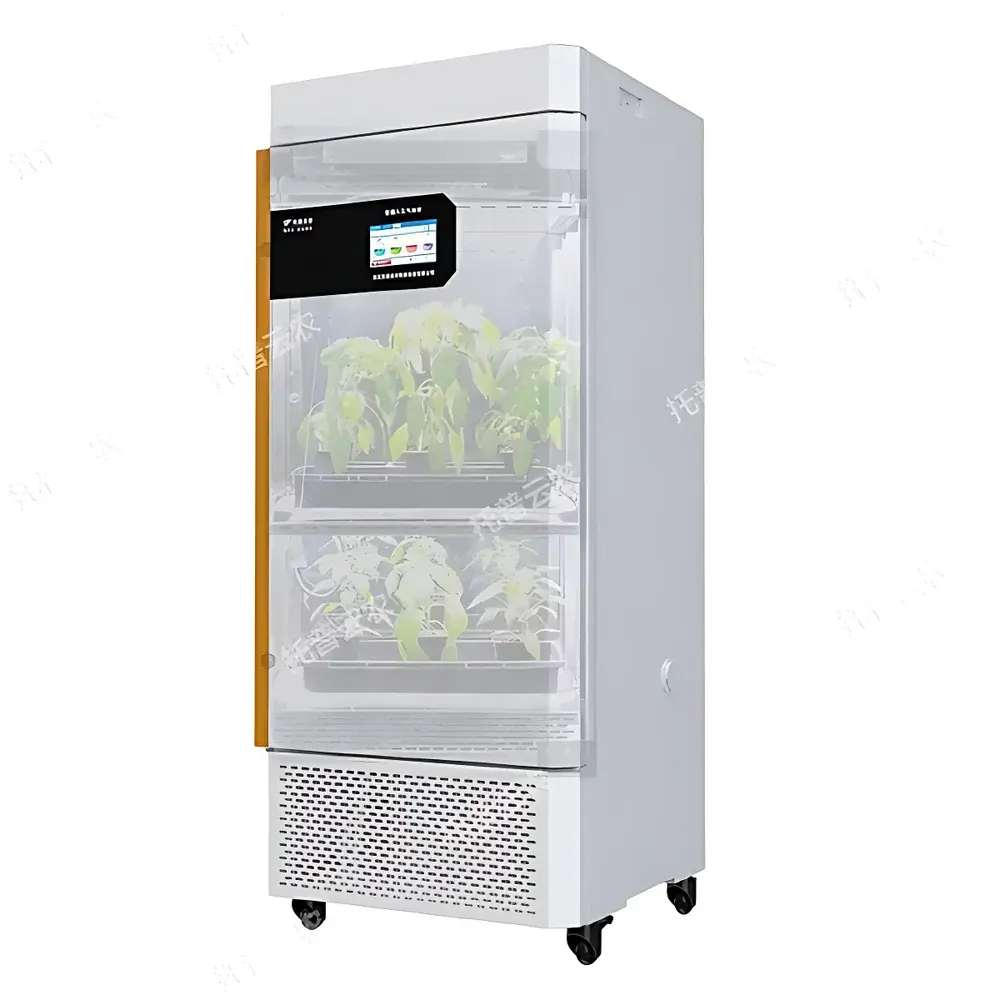
Top Cloud-agri TP-R420DK-G & TP-R1000DK-G Mobile High-Intensity Light Artificial Climate Incubator
| Brand | Top Cloud-agri |
|---|---|
| Origin | Zhejiang, China |
| Manufacturer Type | Direct Manufacturer |
| Model | TP-R420DK-G / TP-R1000DK-G |
| Illuminance Range | 0–40,000 lx (infinitely adjustable) |
| Temperature Control Range | 0–65 °C |
| Temp. Uniformity | ±0.1 °C (at 25.0 °C, 50% RH) / ±0.3 °C (TP-R1000DK-G) |
| Humidity Control Range | 50–95% RH |
| Humidity Uniformity | ±2% RH / ±3% RH (TP-R1000DK-G) |
| Airflow Regulation | 30–100% stepless adjustment |
| Internal Volume | 420 L / 1000 L |
| Power Supply | AC 220 V, 50 Hz, 10 A / 16 A |
| Max. Power Consumption | 1200 W / 2500 W |
| Display | 7-inch full-color touchscreen (1024 × 600) |
| Data Export | USB flash drive |
| Connectivity | Ethernet port, CO₂ inlet ×1, fresh air inlets ×2 |
| Compliance | Designed for GLP-aligned environmental simulation |
Overview
The Top Cloud-agri TP-R420DK-G and TP-R1000DK-G Mobile High-Intensity Light Artificial Climate Incubators are engineered for precision-controlled plant phenotyping, accelerated breeding cycles, and reproducible environmental simulation across life science laboratories. These units operate on a dual-axis climate regulation principle: active thermoelectric + compressor-based temperature modulation combined with closed-loop humidity feedback and digitally calibrated high-output LED lighting arrays. Unlike conventional incubators limited to low-to-moderate irradiance, these systems deliver up to 40,000 lux—enabling photobiological studies of shade-intolerant species, C4 photosynthesis optimization, and photomorphogenic assays under physiologically relevant light intensities. Their mobile chassis design (integrated casters with locking brakes) allows flexible deployment across greenhouse corridors, growth chambers, biosafety labs, or field-deployable research trailers—without requiring permanent utility integration.
Key Features
- Precision Photobiological Environment: Full-spectrum white LED lighting system (400–700 nm PAR range), dimmable from 0–100% in 1% increments; spectral output validated per IEC 62471 for photobiological safety.
- Thermal Stability Architecture: Dual-stage cooling (compressor + Peltier assist), insulated with cyclopentane-blown polyurethane (R-value ≥ 3.8 m²·K/W); internal chamber constructed from electropolished 304 stainless steel with radius ≥ 15 mm corners for cleanability and condensate management.
- Humidity Integrity System: Ultrasonic humidification with 304 stainless steel reservoir (20 L optional external tank); internal recirculation loop minimizes water consumption; humidity sensors calibrated traceably to NIST standards.
- Uniform Air Distribution: Rear-mounted perforated diffuser panel coupled with variable-speed axial fans ensures ≤ ±0.5 °C vertical/horizontal temperature gradient across full load (per ISO 15378 Annex D methodology).
- Intelligent Operational Security: Dual-lock mechanism (electromagnetic door latch + GUI-level password protection); power-loss memory retains all setpoints, program stage, and elapsed runtime; thermal bypass defrost prevents interruption during long-duration trials.
- Human-Centric Ergonomics: 6 mm tempered glass inner door for non-intrusive observation; pull-out adjustable shelving with quick-connect light panel mounts; manual fresh-air damper controls for O₂/CO₂ balance tuning without altering core climate parameters.
Sample Compatibility & Compliance
These incubators support multi-tiered biological sample configurations—including Petri dishes, Magenta boxes, hydroponic trays, insect rearing cages (up to 20 cm height), and small mammal enclosures (e.g., zebrafish tanks or mouse breeding modules). Chamber geometry complies with ASTM E145-22 Class II requirements for uniformity validation. All firmware and data logging functions meet ALCOA+ principles: attributable, legible, contemporaneous, original, accurate, complete, consistent, enduring, and available. Audit trails record operator ID, timestamp, parameter changes, alarm events, and calibration actions—fully compatible with FDA 21 CFR Part 11-compliant electronic signature workflows when deployed with validated third-party LIMS integration.
Software & Data Management
Embedded Linux-based controller runs proprietary TopCloud OS v3.2, supporting up to 30 independent multistage programs (99 segments each, infinite looping). Each experiment generates a unique alphanumeric ID and scannable QR code linked to real-time telemetry: temperature, RH, illuminance, fan speed, and door-open duration. Data export is available via USB mass storage (CSV/Excel format) or secure HTTPS upload to cloud-hosted Web Dashboard (accessible via desktop browser or WeChat Mini Program). Remote operations include start/stop, segment jump, parameter override, and alarm acknowledgment—all authenticated via role-based access control (RBAC). Over-the-air (OTA) firmware updates ensure continuous alignment with evolving ISO/IEC 17025 documentation requirements and cybersecurity patches.
Applications
- Accelerated generation advancement in wheat, rice, maize, and soybean breeding pipelines (e.g., speed breeding at 3–4 generations/year)
- Photoperiod-sensitive trait screening (flowering time, tuberization, vernalization response)
- Abiotic stress modeling: drought (via RH ramping), heatwaves (controlled 45 °C spikes), and high-light oxidative stress assays
- Microbial culture under defined light-oxygen regimes (e.g., cyanobacteria nitrogen fixation, fungal secondary metabolite induction)
- Phytochemical stability testing for pharmaceutical excipients exposed to ICH Q1B photostability conditions
- Entomological rearing of pollinators (e.g., bumblebee microcolonies) and biocontrol agents (Trichogramma spp.) under circadian-synchronized lighting
FAQ
What is the maximum sustained illuminance achievable across the full chamber volume?
The system delivers ≥ 38,500 lux (±3%) at 15 cm below lamp plane under standard calibration conditions (25 °C, 50% RH, 100% light output, center-point measurement per CIE S 026/E:2019).
Does the unit support CO₂ enrichment integration?
Yes—a dedicated CO₂ inlet port (¼” BSP thread) enables connection to external gas manifolds; optional mass flow controller integration is supported via Modbus RTU protocol.
How is temperature uniformity verified and documented?
Each unit ships with a factory-generated ISO/IEC 17025-accredited uniformity report (9-point sensor mapping per ICH Q5C Annex 2), valid for 12 months post-installation.
Can the incubator operate unattended for extended periods (e.g., weekends or holidays)?
Fully supported: 20 L auxiliary water tank option extends humidification runtime to ≥ 120 hours; UPS-compatible power input; automatic email/SMS alerting via WeChat webhook upon critical fault detection.
Is UV-C sterilization cycle validated for microbial log-reduction efficacy?
The 254 nm UV lamp module achieves ≥ 3-log reduction of Bacillus atrophaeus spores on stainless steel surfaces after 30 min exposure (validated per ISO 15714:2019).
Related Products



