
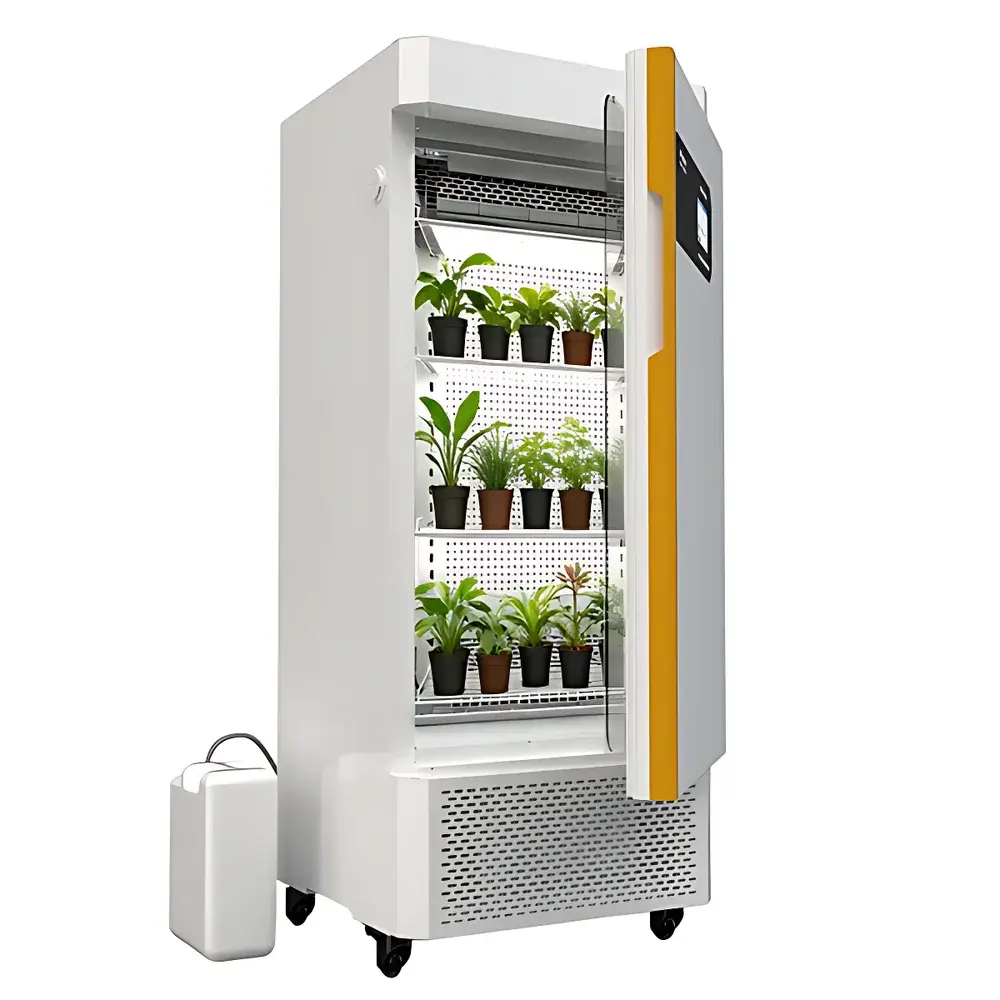
Top Cloud-agri TP-R-C Series Artificial Climate Incubator Platform
| Brand | Top Cloud-agri |
|---|---|
| Origin | Zhejiang, China |
| Manufacturer Type | Direct Manufacturer |
| Country of Origin | China |
| Model | TP-R-C Series (TP-R420C-C / TP-R420D-C / TP-R420D-KC / TP-R1000C-C / TP-R1000D-C / TP-R1000D-KC) |
| Capacity | 420 L or 1000 L |
| Temperature Range | 0–65 °C |
| Temp. Uniformity | ±0.1 °C (at 25.0 °C, 50% RH) / ±0.3 °C |
| Humidity Range | 50–95% RH |
| Humidity Uniformity | ±2% RH / ±3% RH |
| Illumination | 0–22,000 lx, continuously adjustable |
| Spectral Control | Full-spectrum quad-LED (white/red/blue/IR), 1004 programmable spectral combinations |
| CO₂ Range | Ambient – 5% (50,000 ppm) |
| CO₂ Accuracy | ±1 ppm |
| Air Velocity | 30–100% stepless adjustment |
| Power Input | AC 220 V / 50 Hz (10 A or 16 A) |
| Interface | CO₂ inlet ×1, USB ×1, Fresh-air inlet/outlet ×2, Ethernet ×1 |
Overview
The Top Cloud-agri TP-R-C Series Artificial Climate Incubator Platform is an engineered environmental simulation system designed for reproducible, multi-parameter control of plant growth conditions in controlled laboratory and research settings. Built upon a dual-chamber thermal architecture with precision PID-driven regulation, the platform implements coupled control of temperature, relative humidity, photosynthetic photon flux density (PPFD), spectral quality, carbon dioxide concentration, and airflow velocity—enabling physiologically relevant emulation of natural and experimental bioclimates. Unlike conventional incubators limited to temperature and humidity, the TP-R-C integrates photobiological actuation (quad-LED spectral tuning), gas-phase modulation (CO₂ feedback loop), and dynamic ventilation management—making it suitable for advanced phenotyping, tissue culture optimization, seed germination standardization, and pre-clinical botanical pharmacology studies under GLP-aligned operational protocols.
Key Features
- High-fidelity environmental regulation: Temperature control range 0–65 °C with stability ≤±0.1 °C (measured at 25.0 °C/50% RH); humidity 50–95% RH with uniformity ≤±2% RH; CO₂ concentration tunable from ambient to 5% (50,000 ppm) with resolution ±1 ppm via NDIR sensing and proportional solenoid dosing.
- Programmable full-spectrum illumination: Four-channel LED array (white, red, blue, near-infrared) enables independent intensity and ratio control across 1004 discrete spectral configurations—supporting stage-specific photomorphogenesis modeling (e.g., de-etiolation, flowering induction, anthocyanin synthesis).
- 7-inch capacitive touchscreen interface (1024×600 resolution) with real-time multivariable visualization: simultaneous display of temperature/humidity/CO₂/PPFD/air velocity trends, active program progress, alarm status, and historical curve overlays.
- Robust mechanical design: Electrophoretically coated steel exterior; mirror-finish 304 stainless steel interior with radius-corner geometry; 6 mm tempered glass inner door with auto-fan shutoff on opening; cyclopentane-blown polyurethane insulation (≥80 mm thickness) for thermal efficiency and low standby power draw.
- Dual-mode air distribution: Rear-mounted perforated matrix ducting combined with internal recirculation fans ensures horizontal airflow uniformity (≤±0.5 °C/±1.5% RH across shelf levels); fan speed adjustable in 10% increments from 30–100% capacity.
- Integrated operational safeguards: UV-C sterilization cycle (254 nm, timed activation); electromagnetic door lock + GUI password protection; power-loss memory retention; hot-gas bypass defrosting to maintain uninterrupted climate continuity during frost accumulation.
Sample Compatibility & Compliance
The TP-R-C platform accommodates diverse biological specimens including seed batches, tissue culture vessels (Magenta boxes, Petri dishes, bioreactor flasks), insect rearing trays, small-mammal cages (up to juvenile rodent scale), microbial plates, and pharmaceutical stability test samples. Its modular shelving system—with telescoping height-adjustable racks and quick-connect light panels—supports vertical growth profiling across developmental stages. The system complies with core environmental testing frameworks referenced in ISO 17025-accredited labs, including ASTM E1822 (seed germination), ISO 20612 (plant tissue culture), and USP (environmental control for biological products). While not FDA 21 CFR Part 11-certified out-of-box, audit-ready data logging—including operator ID tagging, timestamped parameter changes, and immutable experiment UUID generation—facilitates validation documentation for GxP environments when deployed with supplementary SOPs.
Software & Data Management
All TP-R-C units embed a Linux-based embedded controller running proprietary firmware with local data persistence (≥30 days of 1-minute interval logs). Each experimental run generates a unique alphanumeric identifier and scannable QR code, enabling traceability across sample batches. Raw time-series data (temperature, RH, CO₂, light intensity, fan speed) are exportable via USB mass storage in CSV format. Remote access is enabled through a secure web portal (HTTPS/TLS 1.2) and native WeChat Mini Program integration—allowing authenticated users to monitor live parameters, modify active programs, acknowledge alarms, and download trend reports from any network-connected device. Firmware updates are delivered over-the-air (OTA) with SHA-256 signature verification, ensuring version integrity and backward compatibility across hardware revisions.
Applications
- Controlled-environment agriculture (CEA) research: Quantifying genotype-by-environment interactions under defined photoperiods, spectral ratios, and CO₂ enrichment gradients.
- Plant tissue culture process development: Optimizing callus induction, shoot proliferation, and root differentiation media responses under spectrally tuned light regimes.
- Seed viability and dormancy studies: Standardized germination assays per ISTA guidelines with precise moisture and thermal ramping profiles.
- Phytochemical stability testing: Accelerated oxidation trials for nutraceuticals and botanical extracts under elevated O₂/CO₂ and UV-exposed conditions.
- Entomological rearing: Maintaining synchronized life-cycle cohorts of model insects (e.g., Drosophila, Tribolium) with diurnal light/dark cycling and regulated humidity setpoints.
- Microbial physiology: Culturing phototrophic bacteria (e.g., Rhodobacter) under anaerobic/microaerophilic CO₂-controlled atmospheres with NIR supplementation.
FAQ
What is the maximum CO₂ concentration achievable, and how is it maintained?
The system supports CO₂ concentrations up to 5% (50,000 ppm) using closed-loop feedback control with a calibrated NDIR sensor and proportional solenoid valve. Concentration stability is maintained within ±1 ppm under steady-state conditions.
Can the lighting spectrum be customized for specific plant species?
Yes—the quad-LED driver allows independent adjustment of white, red (660 nm), blue (450 nm), and near-infrared (730 nm) channels, enabling construction of 1004 distinct spectral power distributions optimized for species-specific photoreceptor activation.
Is remote monitoring compatible with institutional IT security policies?
The embedded web server supports TLS 1.2 encryption, configurable static IP assignment, VLAN segmentation, and optional reverse-proxy deployment behind institutional firewalls—ensuring compliance with university and hospital network governance standards.
How does the system handle condensation during high-humidity operation?
A dedicated condensate evaporation tray with PTC heating element actively manages internal moisture accumulation; combined with intelligent dew-point prediction algorithms, this prevents water pooling and maintains chamber sterility without manual drainage.
Are calibration certificates available for regulatory submissions?
Factory calibration reports (NIST-traceable for temperature, humidity, and CO₂ sensors) are provided with each unit. On-site metrological verification services—including uncertainty budgeting per ISO/IEC 17025—are available upon request through authorized service partners.





