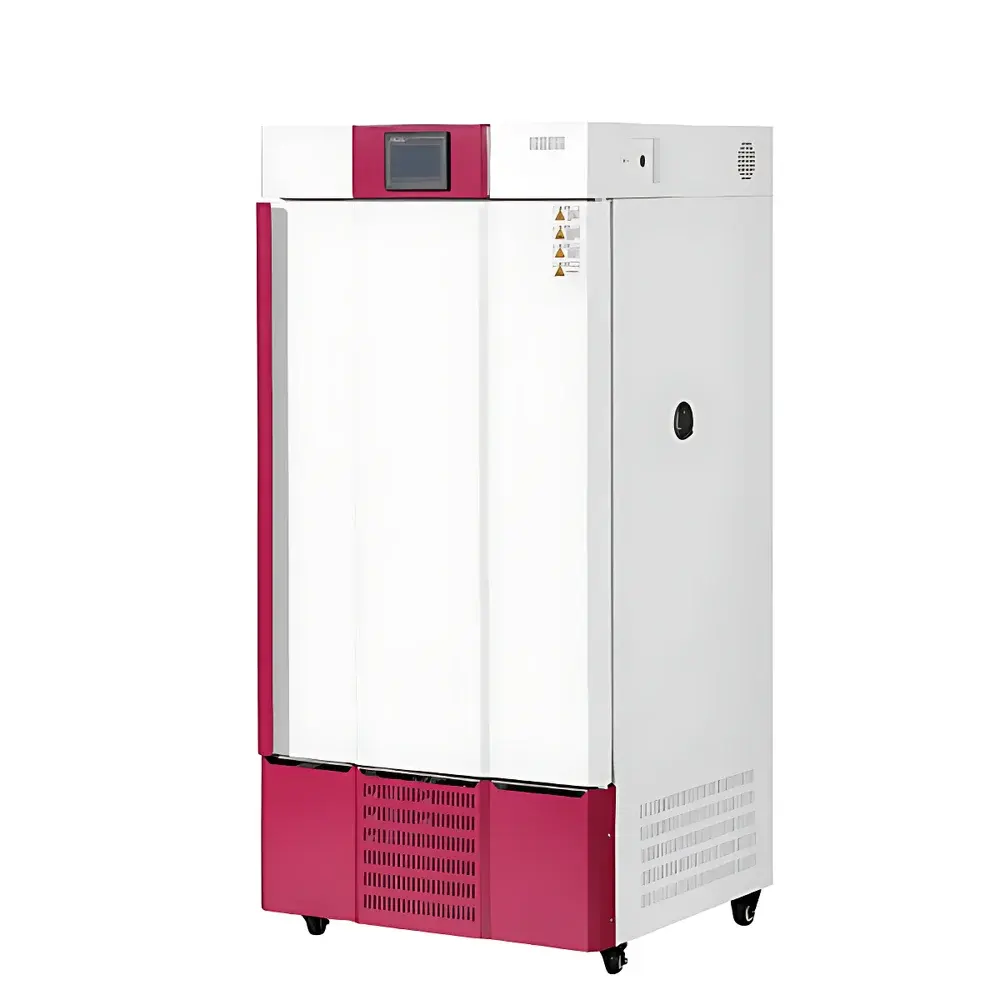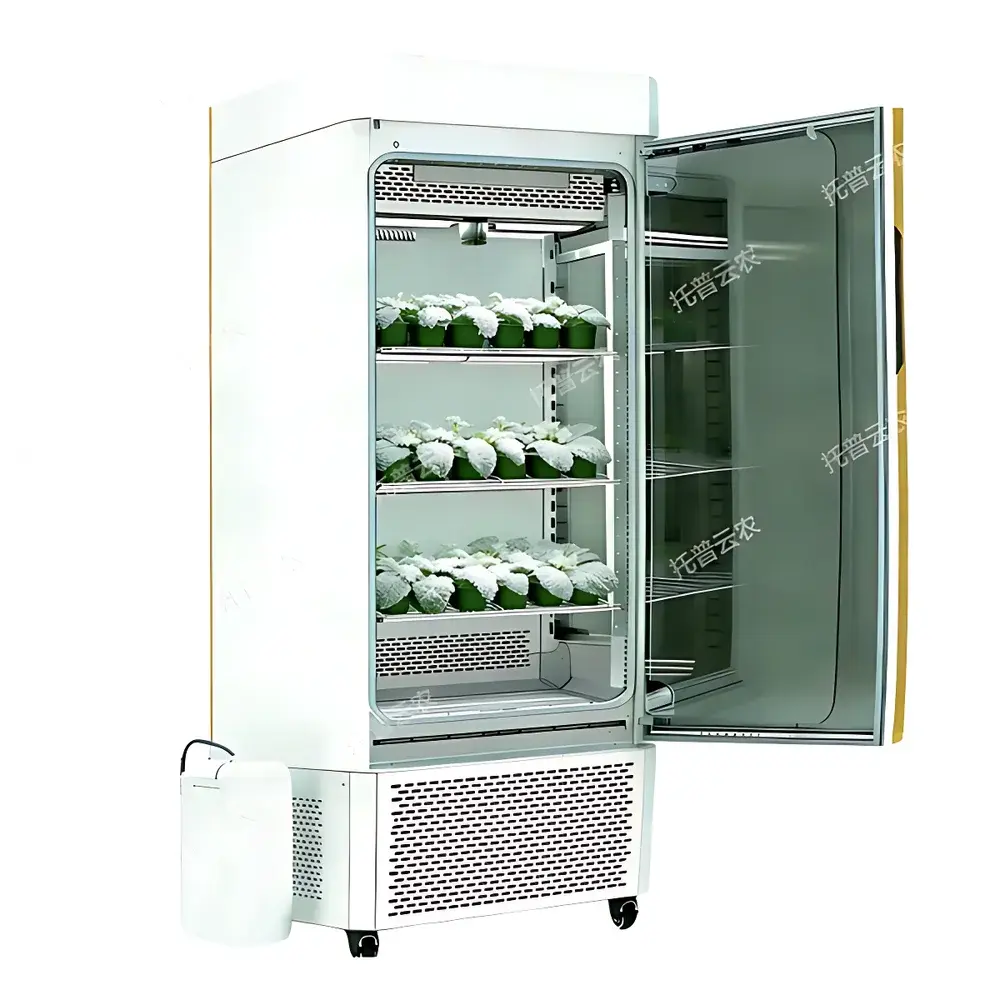
Top Cloud-agri TP-R Series Low-Temperature Plant Growth Chambers
| Brand | Top Cloud-agri |
|---|---|
| Model | TP-R420C-S / TP-R420D-S / TP-R1000C-S / TP-R1000D-S |
| Temperature Range (light off) | –15–50°C (TP-R420C-S), –10–50°C (TP-R420D-S), –15–50°C (TP-R1000C-S), –10–50°C (TP-R1000D-S) |
| Temperature Range (light on) | 10–50°C (all models) |
| Temp. Uniformity | ≤±0.5°C (TP-R420C-S), ≤±1.0°C (TP-R420D-S/TP-R1000C-S/TP-R1000D-S) |
| Temp. Stability | ±0.1°C (TP-R420C-S), ±0.3°C (other models) at 25.0°C / 50% RH |
| Humidity Range | 50–95% RH (not controlled below 10°C) |
| Humidity Stability | ±2% RH (TP-R420C-S), ±3% RH (other models) at 25.0°C / 50% RH |
| Illumination | Triple-side LED (C-series) or top-mounted multi-layer LED (D-series) |
| Light Intensity | 0–22,000 lx (customizable higher) |
| Light Control | 0–100% stepless dimming |
| Airflow Control | 30–100% adjustable in discrete steps per program segment |
| Defrost Method | Hot-gas bypass defrost with concurrent temperature/humidity compensation |
| Internal Volume | 420 L (TP-R420), 1000 L (TP-R1000) |
| Power Supply | AC 220 V / 50 Hz / 10 A (TP-R420), 16 A (TP-R1000) |
| Dimensions (W×D×H, mm) | 762×765×1900 (TP-R420C-S), 1552×765×1940 (TP-R1000D-S) |
| Interior Dimensions (W×D×H, mm) | 635×560×1165 (TP-R420), 1415×560×1165 (TP-R1000) |
| Total Power Consumption | 1200 W (TP-R420), 2500 W (TP-R1000) |
| Compliance | CE-marked design principles |
Overview
The Top Cloud-agri TP-R Series Low-Temperature Plant Growth Chambers are precision-engineered artificial climate incubators designed for controlled-environment plant phenotyping, abiotic stress simulation, and long-term physiological studies under sub-ambient thermal conditions. These chambers operate on a dual-mode environmental control architecture: refrigeration-based low-temperature generation (down to –15°C) combined with active humidification, programmable spectral illumination, and laminar airflow management. Unlike standard biological incubators, the TP-R Series integrates photobiological fidelity—via full-spectrum, intensity-tunable LED arrays—and climatic reproducibility—through PID-driven cascade control of evaporator superheat, condenser fan speed, and humidifier duty cycle. This enables rigorous replication of diurnal cycles, cold acclimation protocols, vernalization treatments, and frost-thaw stress regimes essential for crop resilience research, seed dormancy analysis, and functional genomics validation.
Key Features
- Multi-Zone Environmental Precision: Independent regulation of temperature (±0.1°C stability), relative humidity (50–95% RH, compensated during defrost), and photosynthetic photon flux density (PPFD up to 2,000 µmol/m²/s equivalent) within a single chamber volume.
- Dual Illumination Configurations: C-series models feature triple-side diffuse lighting optimized for uniform canopy irradiance; D-series employ modular top-mounted LED panels with adjustable vertical spacing—enabling dynamic light-height alignment across vegetative, bolting, and reproductive growth stages.
- Intelligent Defrost Architecture: Hot-gas bypass defrosting maintains setpoint continuity by dynamically modulating refrigerant flow and reheating coil output—eliminating temperature spikes and humidity collapse during maintenance cycles.
- Programmable Air Dynamics: Three-tier airflow modulation (30%, 60%, 100%) synchronized with time-temperature-light profiles ensures consistent boundary layer conditions across sample zones without mechanical turbulence.
- Secure Remote Operation: Embedded Linux controller supports encrypted MQTT/WiFi/RJ45 communication, enabling real-time parameter adjustment, alarm acknowledgment, and firmware OTA updates from web dashboard or iOS/Android applications.
- GLP-Ready Data Integrity: All environmental logs include timestamped metadata (operator ID, protocol version, sensor calibration status), tamper-evident digital signatures, and exportable CSV/Excel reports compliant with ISO/IEC 17025 documentation requirements.
Sample Compatibility & Compliance
The TP-R Series accommodates diverse botanical specimens—from Arabidopsis thaliana petri plates and rice seedlings in germination trays to mature tomato plants in hydroponic rafts—within stainless-steel interiors featuring radius-cornered welds and electropolished surfaces (Ra ≤ 0.4 µm) to minimize microbial adhesion. Chamber door seals meet ASTM F2096 bubble leak test criteria, while internal UV-C lamps (254 nm, 30-min auto-cycle) provide non-contact surface decontamination between experiments. The system adheres to IEC 61000-6-3 EMC emission limits and incorporates redundant safety interlocks: door-open thermal cutoff, compressor overcurrent protection, humidity sensor fault detection, and configurable timeout alarms for unattended operation. For regulatory submissions, raw sensor data streams are traceable to NIST-traceable reference standards via integrated calibration verification routines.
Software & Data Management
Control and analytics are unified through the Top Cloud-agri AgriCloud Platform—a browser-accessible SaaS environment supporting role-based access control (RBAC), multi-user experiment scheduling, and automated report generation. Image-based seed germination analysis leverages YOLOv8-trained convolutional neural networks to quantify emergence rate, coleoptile length, and radicle angle from time-lapse sequences captured by integrated 12-MP global-shutter cameras. Environmental telemetry is archived with millisecond-resolution timestamps and annotated with contextual tags (e.g., “Vernalization_Day7”, “Drought_Stress_Hour12”). Data exports include ISO/IEC 17025 Annex A3-compliant audit trails showing every parameter change, user action, and system event—fully compatible with FDA 21 CFR Part 11 electronic record requirements when deployed with optional digital certificate authentication.
Applications
- Cold acclimation kinetics and freezing tolerance assays in cereals and Brassicaceae
- Photoperiodic flowering induction under controlled low-temperature vernalization
- High-throughput screening of drought/cold co-stress responses using root architecture imaging
- Seed longevity and after-ripening studies across temperature-humidity gradients
- Microbial community dynamics in rhizosphere soil microcosms under sub-zero chilling
- Pre-commercial testing of LED spectral recipes for vertical farming crop optimization
FAQ
What is the lowest operational temperature with illumination enabled?
The chamber maintains stable setpoints down to 10°C when lights are active; below this threshold, illumination automatically disables to prevent condensation-induced optical degradation and thermal load imbalance.
Can humidity be controlled below 10°C?
No—humidification is suspended below 10°C to avoid frost accumulation on sensors and mist nozzles; however, passive RH monitoring remains functional for ambient characterization.
Is CO₂ concentration monitoring available as a factory option?
Yes—NDIR-based CO₂ sensors (0–5000 ppm, ±30 ppm accuracy) can be integrated into the multi-parameter environmental suite with dedicated gas sampling manifolds and pressure-compensated flow control.
How does the system ensure data integrity during power interruptions?
All running protocols and sensor histories are written to non-volatile FRAM memory; upon recovery, the controller resumes execution from the last validated checkpoint without data loss or state corruption.
Are third-party LIMS integrations supported?
The platform exposes RESTful APIs conforming to HL7 FHIR R4 standards, enabling bidirectional synchronization with enterprise laboratory information management systems including LabWare, Thermo Fisher SampleManager, and Siemens Healthineers Versa.