
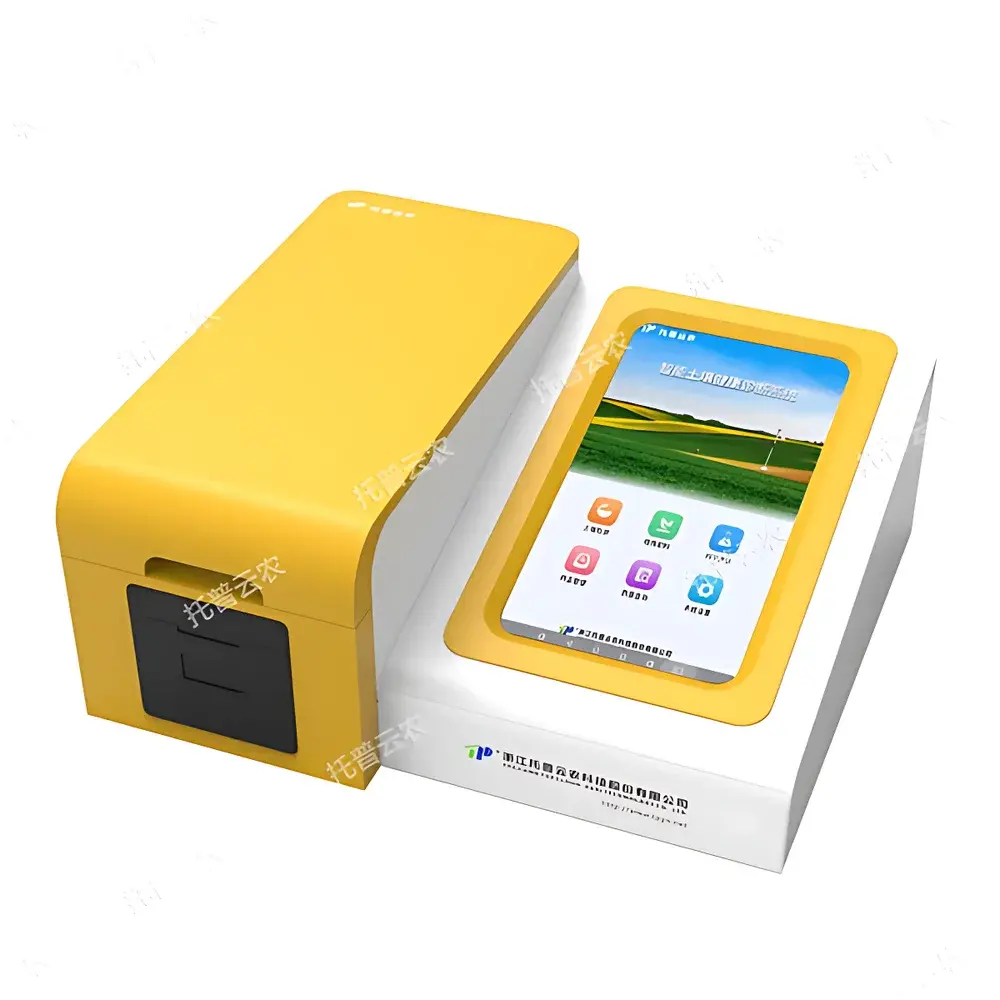
Top Cloud-agri TP-SNT-12A/12B Multi-Parameter Soil Nutrient Analyzer
| Brand | Top Cloud-agri |
|---|---|
| Origin | Zhejiang, China |
| Manufacturer Type | Direct Manufacturer |
| Instrument Category | Domestic |
| Model | TP-SNT-12A / TP-SNT-12B |
| Instrument Type | Multi-Parameter Soil Analyzer |
| Display | 10.1" capacitive touchscreen (800×1280 IPS) |
| Storage | 8 GB internal |
| Absorbance Range | 0.000–4.000 A (0.001 resolution) |
| Transmittance Range | 0.00–100.00% T (0.001 resolution) |
| Photometric Accuracy | ±2.0% T |
| Repeatability | ≤0.5% T |
| Photocurrent Drift | ≤0.5% (3 min) |
| Power Supply | 220 V ±10%, 12 V / 5 A DC adapter |
| Power Consumption | 20 W |
| Detection Channels | 12-channel photometric system (6 dual-wavelength groups) |
| Connectivity | Wi-Fi, USB 2.0 |
| GPS | Integrated high-sensitivity module (±2.5 m CEP) |
| Sample Types | Soil extracts, fertilizer solutions, plant tissue digests, aqueous environmental samples |
Overview
The Top Cloud-agri TP-SNT-12A and TP-SNT-12B are laboratory-grade multi-parameter soil nutrient analyzers engineered for quantitative spectrophotometric analysis of macro-, micro-, and heavy elements in agricultural and environmental matrices. Based on standardized colorimetric reaction principles—such as the indophenol blue method for ammonium nitrogen, molybdenum antimony anti-colorimetry for available phosphorus, and flame photometry-compatible extraction followed by visible/near-UV absorbance measurement for potassium—the instruments deliver traceable, reproducible results aligned with widely adopted agronomic protocols (e.g., ISO 11260, ASTM D5088, and Chinese national standards NY/T 1121 series). Designed for routine use in soil testing laboratories, extension service centers, and agro-research institutions, the TP-SNT platform integrates hardware precision with cloud-enabled data governance to support evidence-based nutrient management decisions across cropping systems.
Key Features
- 12-channel dual-wavelength photometric detection architecture: Six independent optical channel pairs minimize inter-channel spectral drift and enhance cross-batch comparability—critical for longitudinal monitoring and inter-laboratory validation.
- 10.1-inch full-view IPS capacitive touchscreen (800×1280 resolution): Intuitive graphical interface supports multilingual operation (English, Spanish, Arabic, and simplified Chinese), step-by-step assay guidance, and real-time QC flagging (e.g., out-of-range blank absorbance or calibration slope deviation).
- Integrated GNSS module with sub-3-meter positional accuracy: Geotags every sample record at point-of-collection; exports georeferenced metadata (WGS84 coordinates, timestamp, altitude) directly to cloud platform for spatial interpolation and field-level prescription mapping.
- Pre-validated reagent kits included: All consumables—including blank solutions, standard stock sets (N/P/K/micronutrients/heavy metals), and matrix-matched calibrants—are pre-formulated per AOAC and ISO reference methods, eliminating manual preparation errors and reducing turnaround time by ≥40% versus open-reagent workflows.
- Dual-mode data export: Local transfer via USB 2.0 (CSV/Excel-compatible .xlsx output) and secure cloud synchronization over TLS 1.2-encrypted Wi-Fi; supports role-based access control and audit-trail logging compliant with GLP requirements.
- Built-in agronomic decision engine: Contains >100 crop-specific nutrient response models calibrated against regional yield trials; computes recommended N-P-K and micronutrient application rates based on measured soil test values, target yield, crop removal coefficients, and fertilizer efficiency factors.
Sample Compatibility & Compliance
The TP-SNT-12A and TP-SNT-12B accept clarified aqueous extracts prepared from air-dried, sieved (<2 mm) soil samples (per ISO 11464), homogenized plant tissues (following AOAC 985.27 digestion protocol), and liquid fertilizers (diluted to linear absorbance range). Validated analytes include: total and available nitrogen species (NH₄⁺, NO₃⁻, NO₂⁻, hydrolyzable N); phosphorus fractions (Olsen-P, Bray-1 P, total P); exchangeable K⁺ and Ca²⁺; organic carbon (via dichromate oxidation); 12 essential micronutrients (Fe, Mn, Cu, Zn, B, Mo, Si, S, Co, Ni, Se, I); and regulated heavy metals (Pb, Cd, Cr, As, Ti, Al, CN⁻) at detection limits ranging from 0.05 mg/kg (soil) to 0.01 mg/L (solution). The instrument conforms to ISO/IEC 17025:2017 general requirements for competence of testing laboratories and supports full traceability under FDA 21 CFR Part 11-compliant electronic records when deployed with enabled cloud audit logs.
Software & Data Management
Firmware v3.2+ includes embedded Linux OS with dual-layer security: local device authentication (PIN + optional RFID badge) and encrypted cloud handshake (OAuth 2.0). All measurement sessions generate immutable metadata packets containing operator ID, instrument serial number, calibration certificate ID, raw absorbance arrays, and environmental conditions (ambient temperature/humidity logged via onboard sensors). Data resides in ISO 27001-certified EU-hosted cloud infrastructure; users may configure automated report generation (PDF/Excel), statistical summaries (ANOVA, correlation heatmaps), and API-driven integration with farm management software (e.g., Climate FieldView™, Granular®) via RESTful endpoints. Audit trails capture every edit, deletion, or export event with ISO 8601 timestamps and user attribution—fully satisfying GLP/GMP documentation requirements.
Applications
- Soil fertility assessment for precision agriculture planning and variable-rate fertilizer prescription.
- Quality control of commercial fertilizers (NPK blends, organic amendments, foliar sprays) per ISO 8157 and GB/T 15063 standards.
- Phytoremediation site monitoring: quantification of bioavailable metal fractions in rhizosphere soils.
- Research-grade nutrient budgeting in long-term field experiments (LTEs) and LCA studies.
- Extension service delivery: rapid on-site screening during farmer field days with instant cloud-based interpretation and bilingual advisory reports.
- Regulatory compliance testing for municipal compost and biosolids (EPA 503, EU Regulation (EC) No 1069/2009 Annex VI).
FAQ
What is the difference between TP-SNT-12A and TP-SNT-12B?
The TP-SNT-12B extends the TP-SNT-12A’s capability with validated protocols for total and extractable heavy metals (Pb, Cd, Cr, As, Ti, Al, cyanide) using EPA Method 3050B-compliant digestion and colorimetric detection—requiring additional optical filters and extended wavelength calibration.
Does the instrument require external calibration verification?
Yes. While factory-calibrated using NIST-traceable standards, users must perform quarterly verification using certified reference materials (CRMs) such as SRM 2710a (Montana Soil) or BCR-142R (Trace Elements in Soil); calibration certificates are auto-generated and stored with each batch.
Can the device operate offline?
All core analytical functions—including assay execution, result calculation, and local data storage—operate without internet connectivity; cloud sync and map visualization require Wi-Fi activation.
Is method validation documentation provided?
Each shipment includes a Technical Validation Report detailing limit of detection (LOD), limit of quantitation (LOQ), linearity (R² ≥0.999), recovery rates (85–115%), and inter-day precision (RSD ≤3.5%) for all supported analytes per ISO 5725-2.
How is data integrity ensured during cloud transmission?
All payloads undergo SHA-256 hashing prior to TLS 1.2 encryption; server-side validation confirms hash consistency before ingestion—preventing tampering or truncation during transit.
Related Products







