
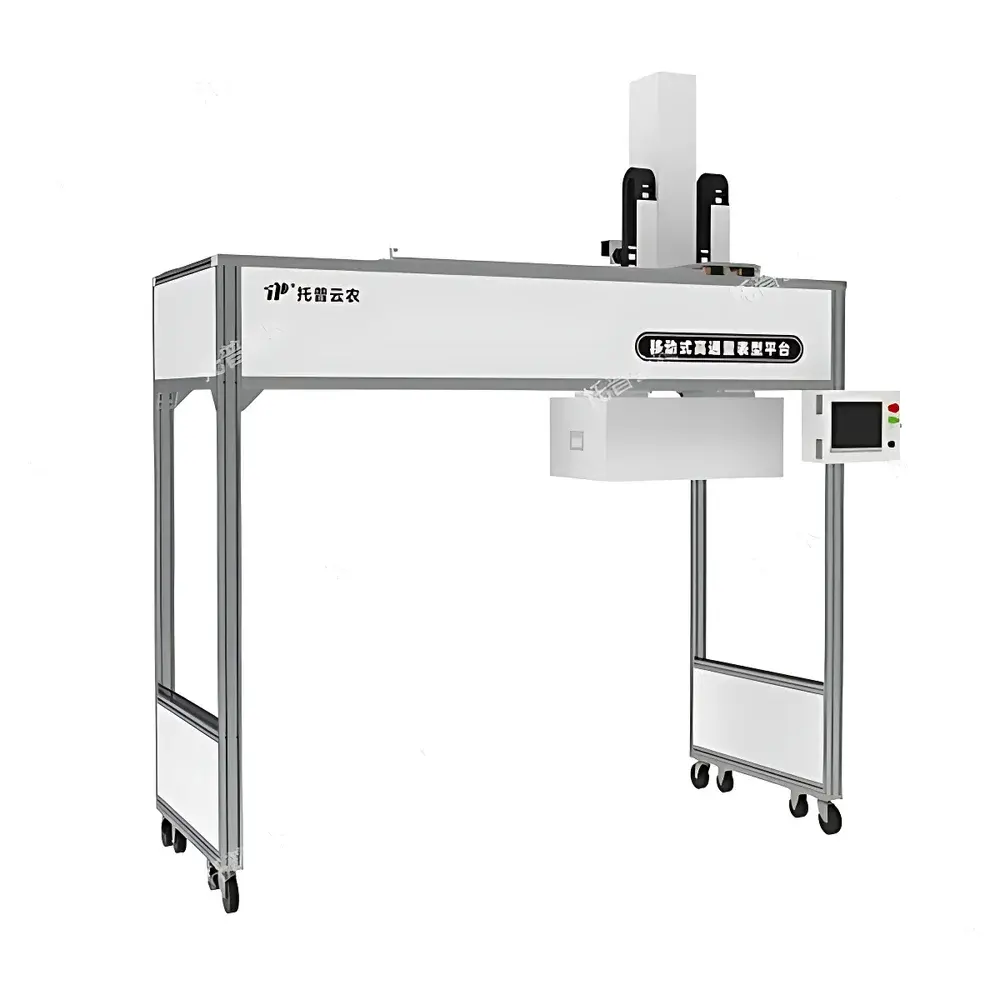
Top Cloud-agri TP-WS Intelligent Greenhouse Bench-Scale Plant Phenotyping System
| Brand | Top Cloud-agri |
|---|---|
| Origin | Zhejiang, China |
| Manufacturer Type | Direct Manufacturer |
| Product Origin | Domestic (China) |
| Model | TP-WS |
| Pricing | Available Upon Request |
| RGB Imaging Resolution | 8 MP |
| 龙门 X-Z Axis Travel Range | Customizable to Bench Dimensions |
| Working Distance | 500–800 mm |
| Operating Temperature | 0–50 °C |
| Operating Humidity | ≤90% RH |
Overview
The Top Cloud-agri TP-WS Intelligent Greenhouse Bench-Scale Plant Phenotyping System is an integrated, non-destructive imaging platform engineered for high-throughput, longitudinal monitoring of plants grown on single-tier greenhouse benches, climate chambers, or vertical farming modules. It operates on a precision-engineered compact gantry architecture—designed specifically for constrained bench-scale environments—enabling repeatable, spatially registered image acquisition across standardized plant arrays. The system employs dual-modal optical sensing: visible-light (RGB) imaging for 2D morphological and colorimetric trait extraction, and structured-light or time-of-flight depth sensing for voxel-based 3D reconstruction. This dual-path acquisition supports quantitative phenotypic profiling aligned with FAO Crop Ontology standards and facilitates correlation with physiological endpoints such as biomass accumulation, stress-induced chlorosis, or architectural plasticity under controlled abiotic gradients.
Key Features
- Compact Gantry Architecture: A low-profile, rigid X-Z龙门 structure ensures mechanical stability during repeated traversals; optimized for installation over standard 1.2–3.0 m wide cultivation benches without obstructing overhead lighting or HVAC ductwork.
- Dual-Modal Imaging Module: Interchangeable sensor heads support synchronized RGB capture (8 MP resolution, 12-bit dynamic range) and depth mapping (sub-millimeter Z-axis resolution), enabling concurrent extraction of 2D canopy metrics and 3D structural descriptors.
- Precision Positioning Control: Motorized X-Z translation with ±0.1 mm repeatability allows pixel-accurate targeting of individual pots or sub-canopy regions; manual override mode available for calibration and troubleshooting.
- Automated Acquisition Workflow: Scheduled imaging sequences trigger synchronized exposure, focus adjustment, and depth scan initiation—minimizing operator intervention while maintaining temporal consistency across diurnal or multi-week trials.
- Embedded Trait Computation Engine: On-device inference using pre-trained convolutional neural networks (CNNs) performs real-time segmentation and metric derivation—including projected leaf area, green/yellow pixel ratio, convex hull geometry, hue-saturation-value (HSV) distribution statistics, and point-cloud-derived height, volume, and surface area.
Sample Compatibility & Compliance
The TP-WS system accommodates standard propagation trays (e.g., 72-cell, 128-cell), 10–15 cm diameter pots, and hydroponic rafts up to 30 cm in width. It is validated for use with dicotyledonous species (e.g., Arabidopsis thaliana, tomato, lettuce, soybean) and select monocots (e.g., rice seedlings, barley) during vegetative and early reproductive stages. All hardware complies with IEC 61000-6-2 (EMC immunity) and IEC 60529 IP20 enclosure rating for indoor laboratory environments. Software workflows support audit-ready metadata tagging per ISO/IEC 17025 requirements, including timestamped operator ID, environmental log integration (via optional RS-485 sensor interface), and immutable storage of raw images and derived parameters.
Software & Data Management
The proprietary PhenotypeStudio software suite provides a secure, locally hosted client-server architecture. It features role-based access control (RBAC), encrypted local database storage (SQLite with WAL journaling), and TLS 1.2–secured API endpoints for integration with LIMS or ELN systems. All analyses generate FAIR-compliant outputs: TIFF/GeoTIFF for imagery, CSV/JSON for trait tables, and OBJ/PLY for 3D meshes. Built-in versioning tracks algorithm updates, parameter thresholds, and user-defined ROI masks. Export functions support direct generation of publication-ready figures (PNG/SVG) and statistical summaries compliant with R/Python data science pipelines. Full audit trail—including image acquisition logs, processing timestamps, and user-initiated edits—is retained indefinitely and exportable for GLP/GMP regulatory submissions.
Applications
- High-resolution time-series phenotyping in controlled-environment breeding programs targeting drought tolerance, nutrient-use efficiency, or photomorphogenic responses.
- Validation of gene-editing outcomes via quantitative comparison of mutant vs. wild-type architectural traits (e.g., rosette diameter, petiole angle, internode elongation).
- Non-invasive assessment of biotic stress progression (e.g., powdery mildew lesion expansion, aphid colonization density) using spectral divergence indices.
- Calibration and ground-truthing of UAV- or field-scanner-derived vegetation indices through controlled-bench reference datasets.
- Development and benchmarking of open-source phenotyping algorithms within the PlantCV and DeepPlant frameworks.
FAQ
What types of plant growth stages can the TP-WS system reliably monitor?
The system is optimized for seedling through early flowering stages (BBCH scale 10–59), particularly where canopy closure remains below 70%. Late-stage tall crops (e.g., mature maize) require customized gantry height extension.
Does the software support third-party algorithm integration?
Yes—PhenotypeStudio exposes a documented Python SDK and RESTful API for importing custom segmentation models, trait calculators, or statistical post-processors.
Is remote system monitoring supported?
Local network access enables real-time status dashboards (gantry position, sensor health, storage utilization); cloud synchronization is disabled by default and requires explicit configuration per institutional IT policy.
How is calibration maintained across long-term deployments?
System includes automated daily dark-frame and flat-field correction routines; optional NIST-traceable color chart and depth target kits enable quarterly metrological validation.
Can the TP-WS be integrated with environmental control systems?
Via Modbus RTU or MQTT protocols, the platform accepts external sensor inputs (air temperature, PAR, CO₂) and can trigger imaging events based on threshold-crossing logic or scheduled environmental ramps.




