
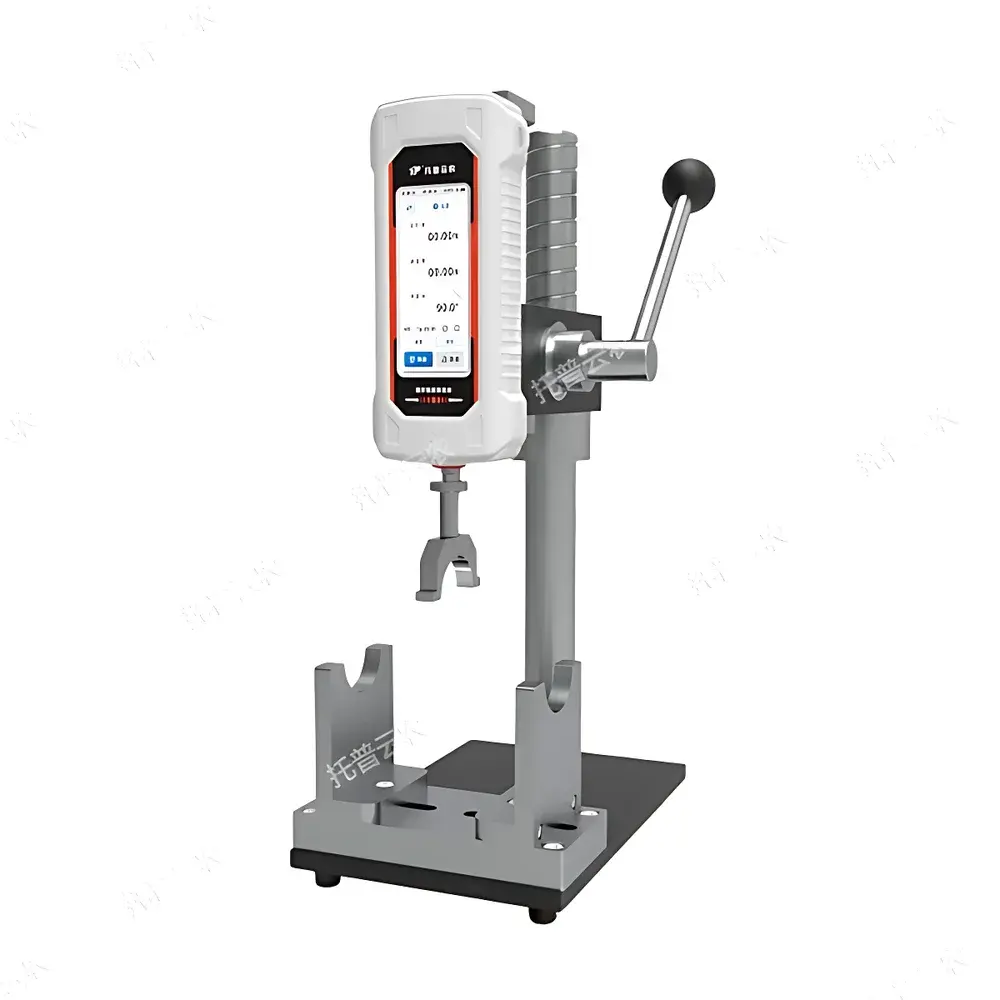
Top Cloud-agri TP-YYD-1 Plant Stem Strength Tester
| Brand | Top Cloud-agri |
|---|---|
| Origin | Zhejiang, China |
| Manufacturer Type | Manufacturer |
| Country of Origin | Domestic (China) |
| Model | TP-YYD-1 |
| Price | Upon Request |
| Measuring Range | 0–500 N |
| Resolution | 0.01 N |
| Accuracy | ±0.1% FS |
| Stem Diameter Capacity | 0–40 mm |
| Tilt Angle Range | ±90° |
| Angle Resolution | 0.1° |
| Angle Accuracy | ±0.1° |
| Power Supply | Rechargeable Li-ion battery (12 h continuous operation) |
| Operating Temperature | −10°C to +60°C |
| Relative Humidity | 0–80% RH |
| Data Storage | >10,000 records |
| Connectivity | Bluetooth 5.0 (mobile app integration) |
Overview
The Top Cloud-agri TP-YYD-1 Plant Stem Strength Tester is an engineered field-portable mechanical testing instrument designed for quantitative biomechanical assessment of plant stem structural integrity. It operates on fundamental principles of applied force mechanics—specifically three-point bending, axial compression, and quasi-static puncture—to quantify resistance to lodging under controlled loading conditions. Unlike qualitative visual scoring methods, this device delivers traceable, repeatable metrics in SI-compliant units (N, kgf, lbf), enabling comparative analysis across genotypes, growth stages, agronomic treatments, and environmental regimes. Its modular architecture supports both laboratory-based standardized phenotyping and in situ field measurements—critical for breeding programs targeting improved stalk strength in cereals (e.g., wheat, rice), bioenergy crops (e.g., sorghum, sugarcane), and tall-stemmed horticultural species.
Key Features
- Multi-modal mechanical probing: Interchangeable test heads—including bending probe, tensile hook, compression plate, and puncture needle—enable standardized execution of ASTM E8/E9-inspired protocols adapted for botanical tissues.
- Field-deployable modularity: Main unit detaches from the adjustable tripod-style test frame, permitting handheld use with calibrated displacement control via manual micrometer drive—ensuring consistent strain rate without external power.
- Precision dual-sensor fusion: Integrated high-stability load cell (0.01 N resolution, ±0.1% full-scale accuracy) and MEMS-based inclinometer (±0.1° angular accuracy, 0.1° resolution) simultaneously record force-angle response curves during deformation.
- Structured data management: Supports up to 200 experiment groups; each group stores up to 96 individual measurements with timestamp, peak load, deflection angle, and positional metadata—enabling statistical aggregation (mean, SD, CV%) per genotype or treatment.
- Configurable display & ergonomics: Backlit LCD with reversible numeric orientation facilitates reading from multiple angles; user-adjustable auto-dimming, screen timeout, and sleep modes extend battery life under variable ambient lighting.
- Real-time feedback system: Audible alerts trigger at preset angular thresholds, sensor over-range conditions, and low-battery states (≤15% remaining), ensuring measurement integrity and operator awareness.
- Wireless data pipeline: Bluetooth 5.0 interface transmits raw and processed datasets to the companion Android/iOS application, which synchronizes with cloud-based research platforms compliant with FAIR (Findable, Accessible, Interoperable, Reusable) data principles.
Sample Compatibility & Compliance
The TP-YYD-1 accommodates stems ranging from 0–40 mm in diameter—covering monocot (e.g., Oryza sativa, Triticum aestivum) and dicot (e.g., Zea mays, Sorghum bicolor) species at vegetative, booting, and grain-filling stages. Its non-destructive, contact-based methodology aligns with ISO 22372:2020 guidelines for plant biomechanical property evaluation. While not certified to GLP or FDA 21 CFR Part 11 out-of-the-box, the device’s audit-ready data export (CSV/Excel), time-stamped records, and immutable storage log support integration into GxP-aligned workflows when deployed within validated laboratory information management systems (LIMS).
Software & Data Management
Data acquisition and post-processing occur via the proprietary Top Cloud-agri Phenotype Assistant mobile application. The app provides real-time visualization of force–angle plots, automatic detection of yield point and failure threshold, and batch export in UTF-8 encoded CSV format. All stored entries include unique identifiers (device ID, operator tag, GPS-assisted location stamp where enabled), supporting spatial-temporal mapping in QGIS or R-based phenomic pipelines. Exported files are compatible with statistical software (R, SAS, JMP) and machine learning frameworks for trait–genotype association modeling.
Applications
- Quantitative lodging resistance screening in cereal breeding pipelines
- Functional validation of candidate genes involved in lignin biosynthesis or cell wall remodeling
- Evaluation of plant growth regulator (PGR) efficacy on stem reinforcement
- Soil nutrient stress studies (e.g., K⁺ or Si deficiency effects on mechanical tissue development)
- Climate resilience phenotyping—assessing thermal or drought-induced changes in stem elastic modulus
- Standardized calibration of hyperspectral or RGB-based proxy traits for high-throughput phenotyping platforms
FAQ
What mechanical testing standards does the TP-YYD-1 reference?
It implements adaptations of ASTM D790 (flexural properties), ASTM D695 (compressive properties), and ISO 11843 (detection capability for mechanical sensors) for botanical materials.
Can the device be calibrated traceably to national standards?
Yes—load cell calibration certificates (NIST-traceable or CNAS-accredited) are available upon request; users may perform field verification using certified dead-weight kits.
Is firmware upgradable in the field?
Firmware updates are delivered via the mobile app and require Bluetooth pairing; version history and changelogs are published in the device’s embedded help system.
How is measurement repeatability ensured across operators?
The fixed-height test frame, micrometer-controlled descent rate, and auto-zero function before each measurement minimize inter-operator variability—typical CV% for repeated measurements on uniform maize internodes is ≤3.2% (n=12).
Does the system support multi-language UI?
The mobile application supports English, Chinese, Spanish, and French; instrument firmware displays are English-only by default but configurable via app-side language settings.



