
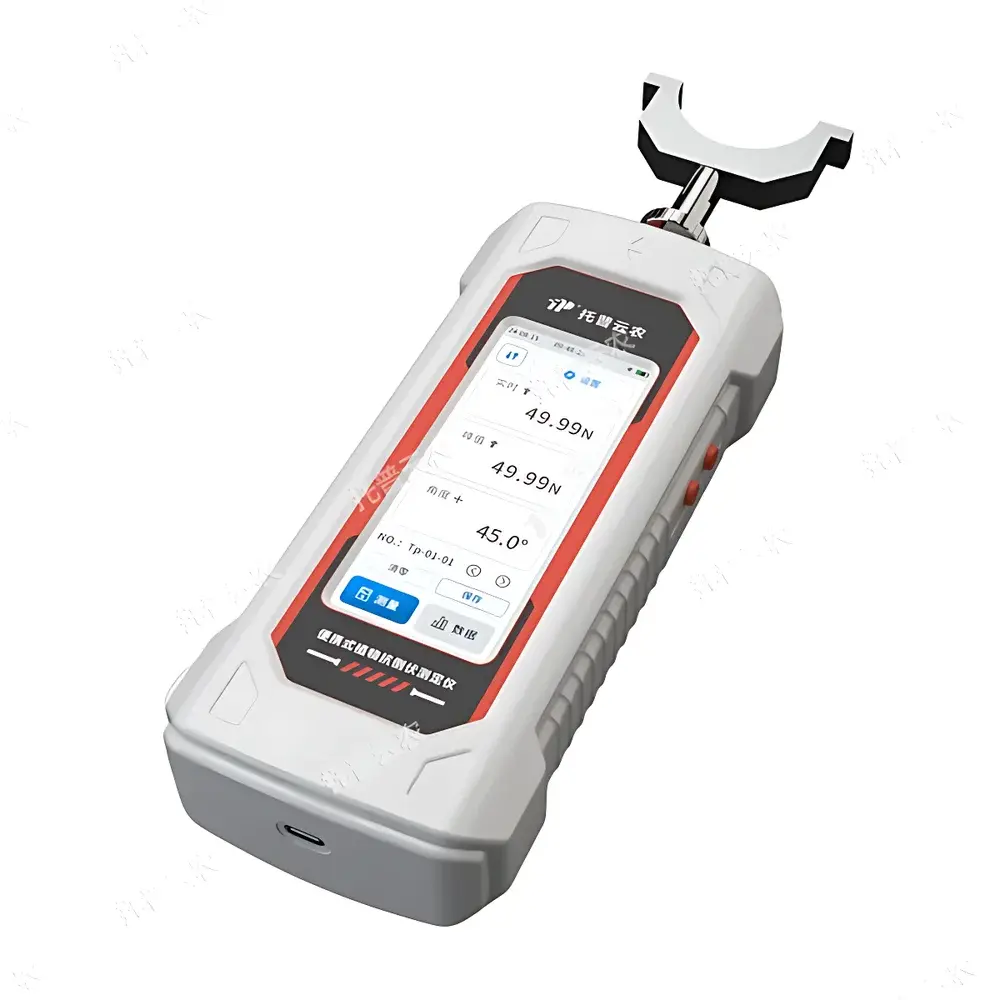
Top Cloud-agri TP-YYD-1A/1B Portable Plant Lodging Resistance Tester
| Brand | Top Cloud-agri |
|---|---|
| Origin | Zhejiang, China |
| Manufacturer Type | Manufacturer |
| Product Origin | Domestic |
| Model | TP-YYD-1A / TP-YYD-1B |
| Force Range | TP-YYD-1A: 0–50 N |
| TP-YYD-1B | 0–500 N |
| Resolution | TP-YYD-1A: 0.001 N |
| TP-YYD-1B | 0.01 N |
| Accuracy | ±0.1% FS |
| Stem Diameter Measurement Range | 0–40 mm |
| Tilt Angle Range | ±90° |
| Angle Resolution | 0.1° |
| Angle Accuracy | ±0.1° |
| Dimensions | 206 × 80 × 40 mm |
| Weight | <500 g |
| Battery Life | ≥12 h (continuous operation) |
| Operating Temperature | −10 °C to +60 °C |
| Operating Humidity | 0–80% RH |
| Data Storage Capacity | >10,000 records |
| Connectivity | Bluetooth 5.0 |
| Compliance | Designed for field-deployable biomechanical phenotyping per ISO 22714 (Plant Biomechanics), ASTM D790 (Flexural Properties), and GLP-aligned data capture protocols |
Overview
The Top Cloud-agri TP-YYD-1A/1B Portable Plant Lodging Resistance Tester is an integrated handheld biomechanical measurement system engineered for in-field quantification of stem mechanical integrity in cereal and broadleaf crops. It operates on fundamental principles of structural biomechanics—applying controlled axial compression, lateral bending, puncture, and tensile loading to intact stems—and simultaneously records force response (in newtons or kilopascals) and angular displacement (in degrees) with synchronized high-fidelity sampling. Unlike static morphological proxies (e.g., plant height or stem diameter), this instrument delivers direct, quantitative metrics of lodging resistance: flexural rigidity (EI), critical buckling load, puncture energy absorption, and tensile yield stress—all essential parameters for evaluating genotype-by-environment interactions in breeding programs. Its ultra-portable form factor (<500 g, palm-sized footprint) enables rapid deployment across heterogeneous field plots without requiring power infrastructure or sample excision, preserving physiological context and minimizing measurement artifacts.
Key Features
- Dual-Mode Force Sensing: Integrated push-pull transducer architecture supports both compressive and tensile loading modalities, enabling standardized application of ASTM D790 (flexural testing) and ASTM D638 (tensile testing) protocols directly on standing plants.
- Modular Probe System: Five interchangeable test heads—including conical puncture probe, flat compression plate, U-shaped tensile hook, 3-point bending jig, and calibrated bending arm—allow method-specific configuration for wheat, rice, maize, sorghum, and leguminous species.
- Synchronized Biomechanical Capture: Co-registered force (N/kPa) and tilt angle (±90°, 0.1° resolution) acquisition enables real-time plotting of load-deflection curves, facilitating derivation of stiffness, yield point, and post-yield plasticity indices.
- Field-Optimized Data Management: On-device grouping logic supports up to 200 experimental sessions (96 measurements/session); statistical summary (mean, min, SD) is computed onboard and exportable via timestamped CSV.
- Low-Power Embedded Architecture: Rechargeable Li-ion battery sustains ≥12 h continuous operation under mixed-mode usage; auto-dimming backlight and programmable sleep mode extend field usability in variable ambient light.
- Wireless Field-to-Cloud Workflow: Bluetooth 5.0 pairing with Android/iOS companion app enables live telemetry, geo-tagged measurement logging, and encrypted upload to cloud-hosted phenotyping databases compliant with MIAPPE v1.1 metadata standards.
Sample Compatibility & Compliance
The TP-YYD series accommodates intact, living stems with diameters from 2 mm (young tillers) to 40 mm (mature maize stalks), supporting non-destructive evaluation at multiple growth stages—from jointing to grain-fill. Its mechanical interface design minimizes slippage and localized crushing, ensuring reproducible contact conditions across genotypes. All firmware and data handling routines adhere to Good Laboratory Practice (GLP) principles: audit trails record operator ID, timestamp, GPS coordinates (via paired mobile device), sensor calibration status, and environmental metadata (ambient temperature/humidity). Raw measurement files are stored in vendor-agnostic CSV format, compatible with downstream analysis in R (plantphenomics package), Python (SciPy/Pandas), or commercial platforms such as BreedBase and FieldBook. The system meets ISO 22714:2020 requirements for plant biomechanical testing instrumentation and supports traceability under ISO/IEC 17025-accredited laboratory workflows.
Software & Data Management
The proprietary Top Cloud-agri PhenotypeLink™ mobile application provides real-time visualization of force-angle hysteresis loops, automatic detection of yield inflection points, and classification against a validated lodging resistance index (LRI) model. LRI integrates normalized bending stiffness, critical buckling load relative to plant height, and energy-to-failure—outputs are categorized into five empirically derived resistance grades (R1–R5). All raw and processed data are encrypted during Bluetooth transmission and archived in AES-256-encrypted cloud storage. Role-based access control, versioned data exports, and FDA 21 CFR Part 11–compliant electronic signature support are available in enterprise-tier deployments. Export formats include MIAPPE-compliant JSON-LD, ISA-Tab, and FAIR-aligned RDF triples for integration into institutional knowledge graphs.
Applications
- High-throughput screening of elite germplasm for lodging resistance in national wheat and rice breeding programs
- QTL mapping studies correlating mechanical traits (e.g., modulus of elasticity, failure strain) with genomic markers
- Evaluation of agronomic interventions—plant growth regulators, nitrogen management, planting density—on stem biomechanics
- Phenotypic validation of CRISPR-edited alleles affecting lignin biosynthesis or vascular bundle development
- Multi-location trial harmonization using standardized biomechanical endpoints aligned with CIMMYT and IRRI protocols
- Teaching laboratories for plant biomechanics, crop physiology, and precision agriculture curricula
FAQ
What stem morphologies can be tested without excision?
Stems must remain upright and anchored in soil; the device interfaces with intact basal or internodal sections between 5–30 cm above ground level. Hollow-stemmed cereals (wheat, barley) and solid-stemmed species (sorghum, sunflower) are fully supported.
Is calibration traceable to national standards?
Yes—each unit ships with NIST-traceable calibration certificate (force: Class 0.1, angle: ±0.1°), and field recalibration is supported via certified reference weights and angular gauge blocks.
How is data integrity ensured during wireless transfer?
Bluetooth communication uses TLS 1.2 encryption; packet loss recovery and CRC-32 checksum validation prevent corruption during transmission from field to mobile device.
Can the system integrate with existing LIMS or breeding management software?
API documentation and RESTful endpoints are provided for bidirectional synchronization with platforms including BreedBase, T3, and Microsoft Dynamics 365 for Agriculture.
What maintenance is required for long-term field reliability?
No routine mechanical servicing is needed; users are advised to clean probe surfaces after each use and perform quarterly verification using supplied calibration kit—no tools required.
Related Products



