
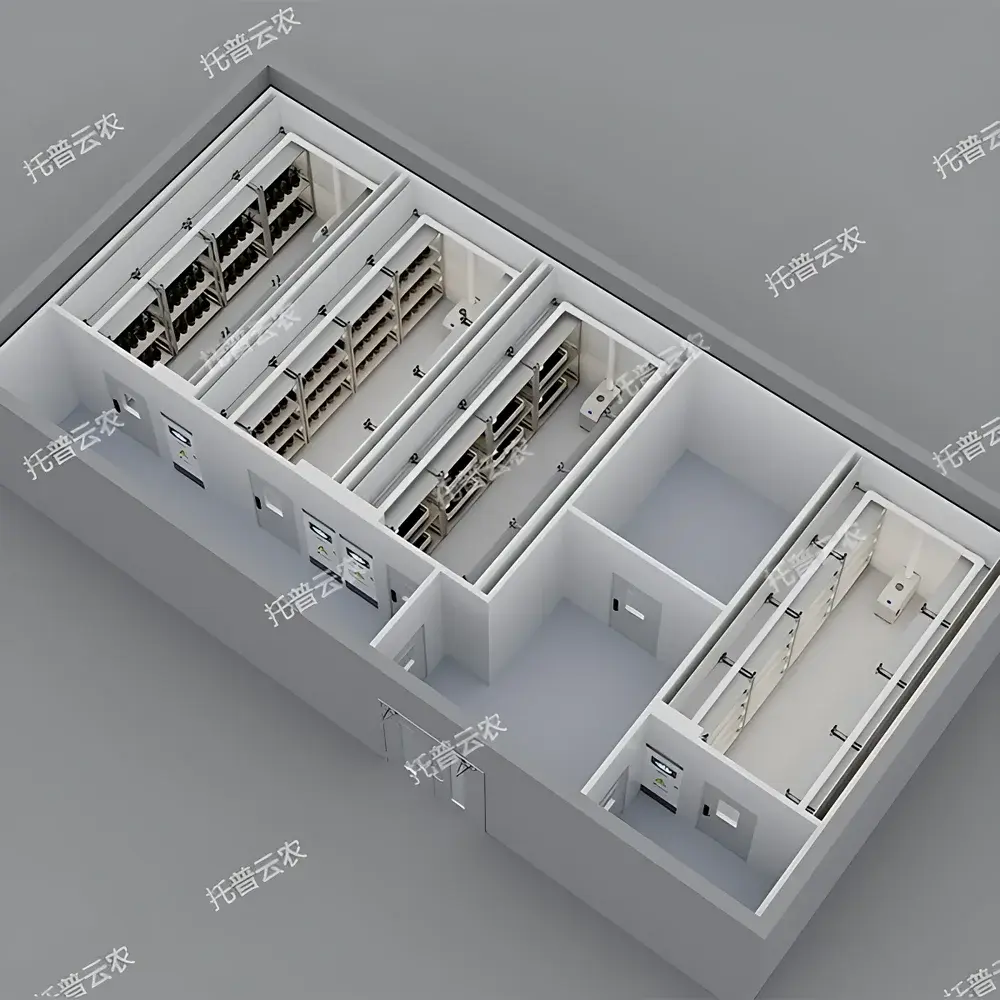
Top Cloud-agri TP-ZWGC Series Fully Enclosed Controlled-Environment Plant Factory
| Brand | Top Cloud-agri |
|---|---|
| Origin | Zhejiang, China |
| Manufacturer Type | Direct Manufacturer |
| Product Origin | Domestic |
| Model | TP-ZWGC Series |
| Pricing | Upon Request |
Overview
The Top Cloud-agri TP-ZWGC Series Fully Enclosed Controlled-Environment Plant Factory is an industrial-scale, hermetically sealed cultivation infrastructure engineered for precision plant physiology research, high-value crop production, and controlled-environment agriculture (CEA) validation. Unlike greenhouse or semi-closed systems, this facility operates on a complete physical isolation principle—eliminating atmospheric exchange with the external environment through airtight architectural envelopes, positive-pressure air handling, and multi-stage filtration. Environmental parameters—including temperature, relative humidity, CO₂ concentration, photosynthetic photon flux density (PPFD), spectral quality, root-zone nutrient delivery, and airflow velocity—are continuously monitored via redundant industrial-grade sensors and regulated in real time by a distributed control system (DCS). This architecture ensures strict reproducibility across growth cycles, enabling compliance with GLP-aligned experimental protocols and scalable GMP-grade production of leafy greens, medicinal herbs, model plants (e.g., Arabidopsis thaliana), and tissue culture-derived propagules.
Key Features
- Hermetic enclosure design with ISO Class 7–8 cleanroom-rated particulate filtration (HEPA/ULPA), eliminating airborne pathogens, pollen, dust, and pest ingress.
- Modular vertical farming architecture supporting 3–10 customizable cultivation tiers; structural frames fabricated from food-grade stainless steel (AISI 304) or aerospace-grade magnesium-aluminum alloy for corrosion resistance and load-bearing integrity.
- LED-based artificial lighting system featuring tunable full-spectrum, red-blue ratio-optimized, or narrowband (e.g., 450 nm, 660 nm) modules—each calibrated to PAR (Photosynthetically Active Radiation) and PPFD uniformity ≥90% across canopy plane.
- Integrated hydroponic, aeroponic, and substrate-based cultivation compatibility, with closed-loop nutrient solution monitoring (EC, pH, DO, temperature) and automated dosing based on real-time sensor feedback and pre-programmed crop-specific recipes.
- Multi-layer environmental control stack: precision HVAC with dew-point cooling, desiccant dehumidification, CO₂ injection (0–2000 ppm range), and laminar airflow management to minimize thermal and vapor gradients within growth zones.
- Industrial IoT backbone with OPC UA–compliant edge gateways, enabling secure data acquisition from >200 sensor nodes per module and deterministic actuator response latency <100 ms.
Sample Compatibility & Compliance
The TP-ZWGC platform supports standardized cultivation of diverse botanical specimens—from microgreens (Lactuca sativa, Brassica rapa), high-value herbs (Mentha spicata, Salvia officinalis), to biopharmaceutical model species (Nicotiana benthamiana, Medicago truncatula). All hardware and firmware components comply with IEC 61000-6-2 (EMC immunity) and IEC 60529 IP54 minimum ingress protection ratings. The system architecture adheres to foundational principles referenced in ASTM E3072 – Standard Guide for Establishing Controlled Environment Agriculture (CEA) Facilities, and its data logging framework supports audit-ready traceability aligned with FDA 21 CFR Part 11 requirements when deployed under validated SOPs.
Software & Data Management
The embedded AI-driven management platform—TopCloud AgriOS—provides centralized orchestration of environmental, lighting, irrigation, and logistics subsystems. It implements rule-based automation and supervised machine learning models trained on multi-season phenotypic datasets to predict optimal setpoint adjustments for biomass accumulation, secondary metabolite expression, or stress-resilience modulation. All operational logs, sensor histories, and control actions are stored in encrypted SQLite databases with optional cloud synchronization (AWS IoT Core or private Kubernetes cluster). Role-based access control (RBAC), electronic signatures, and immutable audit trails meet GLP/GMP documentation standards. Export formats include CSV, NetCDF4, and MIAME-compliant metadata templates for integration with ELN/LIMS environments.
Applications
- Controlled-environment phenotyping for functional genomics and QTL mapping studies under repeatable abiotic stress regimes.
- Year-round production of pathogen-free seedlings and clonal propagules for nurseries and breeding programs.
- Regulatory-compliant cultivation of cannabis cultivars under jurisdictional Good Agricultural and Collection Practices (GACP).
- Urban food security infrastructure for military bases, remote research stations, and disaster-response logistics hubs.
- Academic teaching modules in plant physiology, biosystems engineering, and agricultural data science—equipped with API-accessible telemetry for student-developed control algorithms.
FAQ
What types of crops are validated for use in the TP-ZWGC system?
Leafy vegetables (e.g., spinach, kale), culinary herbs, medicinal plants (e.g., ginseng seedlings, stevia), and model dicots/monocots used in academic and industrial R&D.
Does the system support integration with third-party LIMS or SCADA platforms?
Yes—via RESTful APIs, MQTT brokers, and Modbus TCP protocol stacks compliant with ISA-95 and ISA-88 reference models.
Is remote monitoring and intervention possible during unattended operation?
Fully supported through TLS-encrypted web dashboard and mobile application with configurable alarm thresholds and SMS/email notification triggers.
How is calibration traceability maintained for environmental sensors?
All factory-installed sensors ship with NIST-traceable calibration certificates; field recalibration intervals follow ISO/IEC 17025–recommended schedules and are logged automatically within AgriOS.
Can the system be scaled beyond a single module?
Yes—the architecture employs standardized mechanical/electrical interfaces and unified control topology, enabling seamless expansion to multi-module farms with centralized master control node deployment.





