
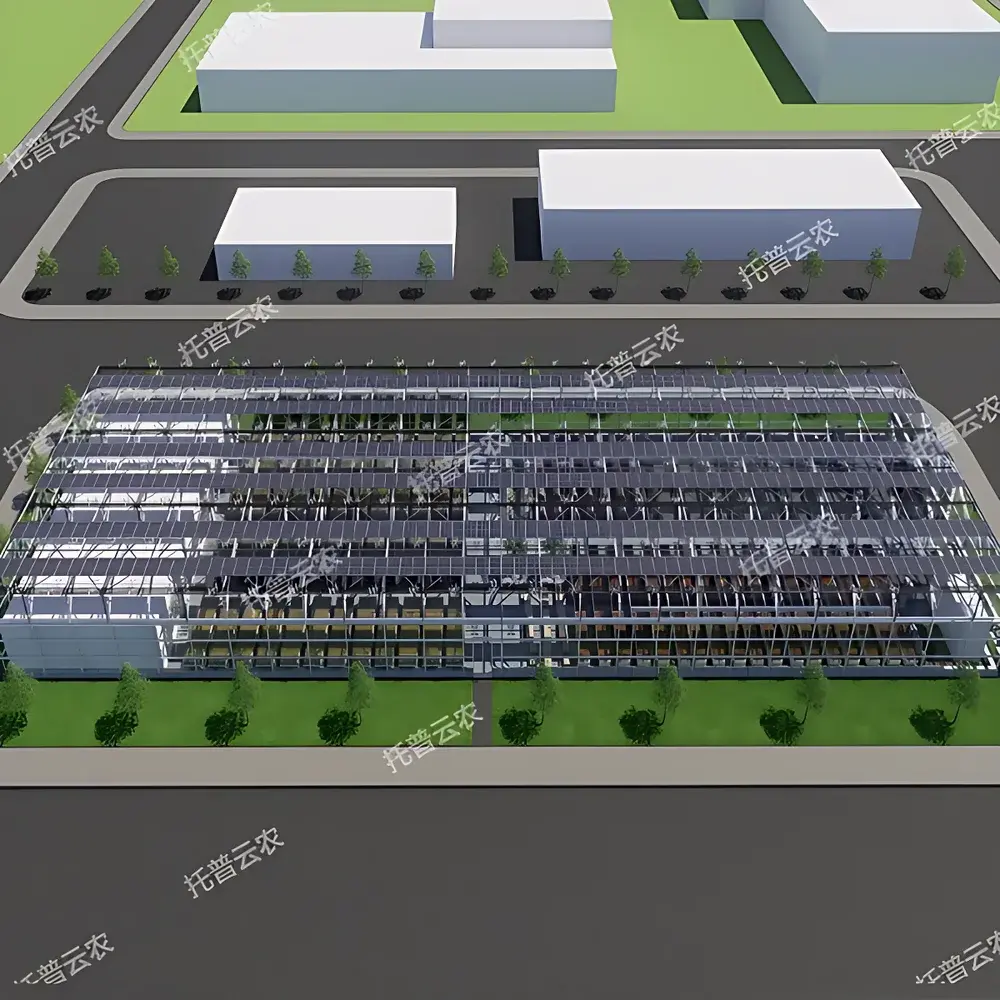
Top Cloud-agri TP–ZWGC Series Greenhouse-Type LED Plant Factory
| Brand | Top Cloud-agri |
|---|---|
| Origin | Zhejiang, China |
| Manufacturer Type | Manufacturer |
| Product Origin | Domestic |
| Model | TP–ZWGC Series |
| Pricing | Available Upon Request |
Overview
The Top Cloud-agri TP–ZWGC Series Greenhouse-Type LED Plant Factory is an integrated controlled-environment agriculture (CEA) platform engineered for precision plant cultivation in semi-closed greenhouse structures. Unlike conventional growth chambers or vertical farms, this system combines structural greenhouse architecture with intelligent environmental control and spectral-tunable LED lighting to support research-grade phenotyping, breeding trials, horticultural production, and seedling propagation. It operates on a closed-loop feedback principle: multi-sensor arrays continuously monitor air temperature, relative humidity, soil moisture & temperature, photosynthetic photon flux density (PPFD), and CO₂ concentration; these real-time data streams are compared against species-specific physiological models—derived from peer-reviewed agronomic databases—to trigger automated actuation of climate, irrigation, and lighting subsystems. The system is not a standalone incubator but a scalable, modular infrastructure platform designed for field-adjacent deployment where natural daylight serves as the primary light source, augmented intelligently by supplemental LED spectra.
Key Features
- Multi-Modal Environmental Regulation: Integrated orchestration of roof vents, inner/outer shading curtains, evaporative cooling pads (fan-and-pad system), precision HVAC units, horizontal air circulation fans, and CO₂ dosing modules—each actuated via rule-based logic or model-predictive control algorithms.
- Spectral-Tunable LED Supplemental Lighting: Motorized, height-adjustable multi-spectrum LED arrays (full-range PAR output: 400–700 nm) with programmable intensity, photoperiod, and spectral ratio (e.g., R:FR, B:R) to modulate photomorphogenesis, flowering time, and secondary metabolite synthesis.
- Smart Hydroponic Integration: Configurable delivery modes—including drip irrigation, micro-sprinklers, nutrient film technique (NFT), deep water culture (DWC), ebb-and-flow (tide), and aeroponics—paired with inline EC/pH sensors and dosing pumps calibrated to crop-specific nutrient solution recipes.
- Distributed Sensor Network: Industrial-grade wireless nodes (IP65 rated) for continuous logging of air RH/T, soil VWC & temperature (at multiple depths), PPFD (cosine-corrected quantum sensor), and CO₂ (NDIR-based), all timestamped with UTC synchronization.
- Tri-Platform Control Architecture: Local PLC-based logic controller (IEC 61131-3 compliant), responsive web dashboard (HTML5/WebSocket), and native iOS/Android application enabling remote parameter adjustment, alarm acknowledgment, and live thermal-camera feed integration (optional).
Sample Compatibility & Compliance
The TP–ZWGC platform supports a broad range of botanical specimens—from Arabidopsis thaliana and rice seedlings to tomato transplants, lettuce cultivars, and ornamental cut flowers—without requiring genetic modification or specialized containment. Its design adheres to IEC 60529 (IP65 enclosure rating for field-deployed sensor nodes), ISO 17025 traceability principles for sensor calibration documentation, and EU Machinery Directive 2006/42/EC for mechanical safety. While not classified as a medical device or GLP-compliant laboratory instrument per se, its data acquisition and audit trail capabilities align with FAO Good Agricultural Practice (GAP) frameworks and can be extended to meet ISO 22000 or GLOBALG.A.P. traceability requirements when paired with certified calibration protocols.
Software & Data Management
Control firmware runs on a deterministic real-time OS with dual-redundant SD card logging (cyclic buffer + event-triggered archival). All environmental datasets are stored in ISO 8601-compliant CSV/Parquet format with embedded metadata (sensor ID, location tag, calibration date, uncertainty budget). The cloud backend supports OData v4 API endpoints for integration into institutional LIMS or farm management software (e.g., Climate FieldView™, Granular™). Audit trails include user login history, parameter change logs with digital signature, and firmware update records—all exportable for internal QA review. Optional FDA 21 CFR Part 11 compliance package includes electronic signature validation, role-based access control (RBAC), and immutable log archiving.
Applications
- Academic plant science labs conducting controlled-environment phenotyping under standardized photothermal regimes
- Breeding programs requiring year-round, season-independent generation advancement for cereal and vegetable crops
- Horticultural extension services demonstrating resource-efficient cultivation techniques for smallholder adoption
- Commercial nurseries optimizing rootstock development and grafting success rates via precise VPD and DLI management
- Urban agriculture R&D centers evaluating crop performance under hybrid solar-LED energy strategies
FAQ
Is the TP–ZWGC system suitable for GxP-regulated research environments?
It supports configurable audit trails and electronic signatures; however, full GxP alignment requires site-specific validation protocols (IQ/OQ/PQ) and third-party calibration certification.
Can the system operate off-grid or with renewable energy sources?
Yes—the PLC and sensor network are compatible with 12/24 VDC inputs, and lighting/HVAC loads can be scheduled to align with solar PV generation profiles using optional energy forecasting modules.
What level of technical support is provided post-installation?
Top Cloud-agri offers remote diagnostics via secure SSH tunnel, annual on-site calibration verification, and firmware updates delivered through authenticated OTA channels.
Are third-party sensors (e.g., Campbell Scientific, Decagon) interoperable?
The system exposes Modbus RTU/TCP and MQTT v3.1.1 interfaces; pre-certified drivers exist for common analog/digital sensors, and custom integration is supported via documented RESTful configuration APIs.




