
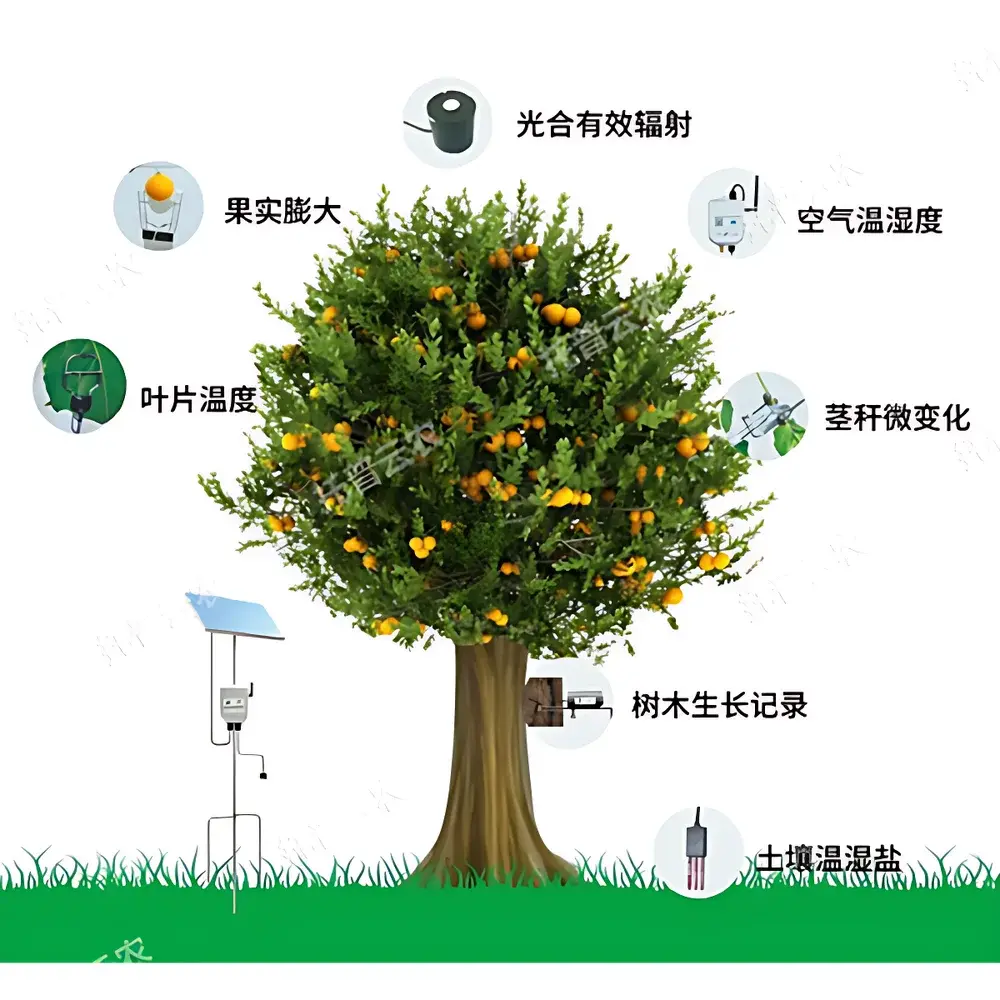
Top Cloud-agri TP-ZWSL Plant Root Growth and Physiological Ecology Monitoring System
| Brand | Top Cloud-agri |
|---|---|
| Origin | Zhejiang, China |
| Manufacturer Type | Direct Manufacturer |
| Product Origin | Domestic (China) |
| Model | TP-ZWSL |
| Pricing | Upon Request |
Overview
The Top Cloud-agri TP-ZWSL Plant Root Growth and Physiological Ecology Monitoring System is a field-deployable, multi-parameter continuous monitoring platform engineered for long-term, non-destructive observation of plant physiological responses to environmental variables. It operates on the principle of real-time in situ sensor fusion—integrating high-resolution analog and digital transducers to capture dynamic biophysical signals across multiple plant organs (stem, leaf, fruit, root zone) and adjacent microenvironments (air, soil, canopy). Unlike discrete sampling methods, this system enables longitudinal analysis of diurnal and seasonal physiological rhythms—including stem sap flow dynamics, leaf thermal regulation, fruit expansion kinetics, and root-zone hydric-electrochemical status—providing empirical datasets essential for mechanistic studies in plant ecophysiology, precision horticulture, and climate-resilient crop modeling.
Key Features
- Multi-layered Sensor Integration: Simultaneous acquisition of 12+ parameters including stem diameter variation (±0.001 mm resolution), fruit growth displacement (15–90 mm range), leaf surface temperature (0–50 °C, ±0.1 °C), photosynthetically active radiation (0–2700 µmol/m²·s, ±1 µmol/m²·s), air temperature/humidity (−40 to 120 °C / 0–100 %RH, ±0.4 °C / ±3 %RH), soil volumetric water content (0–100 %VWC, ±3 % in 0–50 % range), soil temperature (−20 to 70 °C, ±0.5 °C), and soil electrical conductivity (0–23 mS/cm, ±2 %FS).
- Robust Data Integrity Architecture: Onboard flash memory buffers up to 500,000 timestamped records with automatic gap-filling: cached data is transmitted upon network recovery without manual intervention—critical for remote deployments where cellular coverage is intermittent.
- Low-Power Field Operation: Dual-power configuration supports solar panel input (12 V DC) and AC mains (220 V), with integrated rechargeable Li-ion battery delivering ≥200 days of operation at 1-hour transmission intervals. Power consumption is optimized via duty-cycled sensor activation and sleep-mode microcontroller management.
- Georeferenced Deployment: Built-in GPS module logs WGS84 coordinates with each measurement packet, enabling spatial mapping of physiological gradients across experimental plots or orchard zones—compatible with standard GIS workflows.
- Configurable Threshold Alerting: User-defined upper/lower limits per parameter trigger immediate notifications via mobile app push alerts; alarm events include timestamp, sensor ID, deviation magnitude, and location metadata—supporting rapid agronomic response and GLP-aligned incident logging.
Sample Compatibility & Compliance
The TP-ZWSL system is designed for perennial and annual crops, woody species, and controlled-environment research subjects—including but not limited to grapevines, apple trees, rice, maize, tomato, and Arabidopsis thaliana under field, greenhouse, and lysimeter conditions. All sensors comply with IEC 60529 IP67 ingress protection standards for outdoor durability. Calibration protocols align with ISO/IEC 17025 traceability requirements when performed using NIST-traceable reference sources. While not FDA 21 CFR Part 11-certified out-of-the-box, audit trails, user access logs, and immutable data timestamps support GxP-aligned validation documentation for academic and regulatory submissions.
Software & Data Management
The web-based B/S architecture platform provides role-based access (administrator, researcher, technician) via HTTPS-secured interface. Data ingestion occurs through GPRS/4G LTE or USB mass storage mode (CSV export). The platform stores raw and processed data indefinitely with version-controlled backups. Visualization tools include synchronized time-series graphs, scatter plots (e.g., stomatal conductance vs. vapor pressure deficit), and customizable dashboards. Export formats include CSV, Excel (.xlsx), PDF reports, and SVG vector graphics. Firmware updates are delivered over-the-air (OTA) with SHA-256 signature verification. API endpoints (RESTful JSON) enable integration with third-party analytics engines (e.g., R Shiny, Python Pandas pipelines) and institutional LIMS systems.
Applications
- Quantifying drought stress indices via stem shrinkage rate and leaf temperature differentials
- Correlating fruit expansion velocity with irrigation scheduling thresholds
- Validating root-zone water uptake models using concurrent soil moisture, EC, and sap flow data
- Assessing canopy-level energy balance under variable light regimes (PAR + leaf T)
- Supporting QTL mapping studies by linking phenotypic growth dynamics to genotypic markers
- Long-term ecological monitoring of native vegetation responses to microclimate shifts
FAQ
Is the system suitable for underground root imaging or direct root morphology analysis?
No—the TP-ZWSL monitors root-zone environmental proxies (soil moisture, temperature, EC) and aboveground physiological surrogates (stem flow, leaf T); it does not include rhizotron imaging, minirhizotron cameras, or root electrical resistance tomography capabilities.
Can sensor calibration be performed in-house without factory service?
Yes—temperature, humidity, and soil moisture sensors support two-point field calibration via platform-accessible offset/gain adjustment; full recalibration against certified references is recommended annually.
Does the platform support automated statistical outlier detection?
Yes—configurable moving-window standard deviation filters flag anomalous readings in real time; flagged data points are retained with metadata tags for review prior to exclusion.
What is the maximum supported distance between sensor nodes and the central logger?
For wired analog sensors (e.g., stem dendrometers), maximum cable length is 50 m with shielded twisted-pair; for wireless LoRaWAN-enabled add-ons (optional), range extends to 2–5 km line-of-sight in rural settings.
Are historical data exports compatible with MATLAB or Python for custom modeling?
Yes—all exported CSV files include UTC timestamps, sensor IDs, units, and QC flags—structured for direct ingestion into NumPy arrays or pandas DataFrames without preprocessing.






