
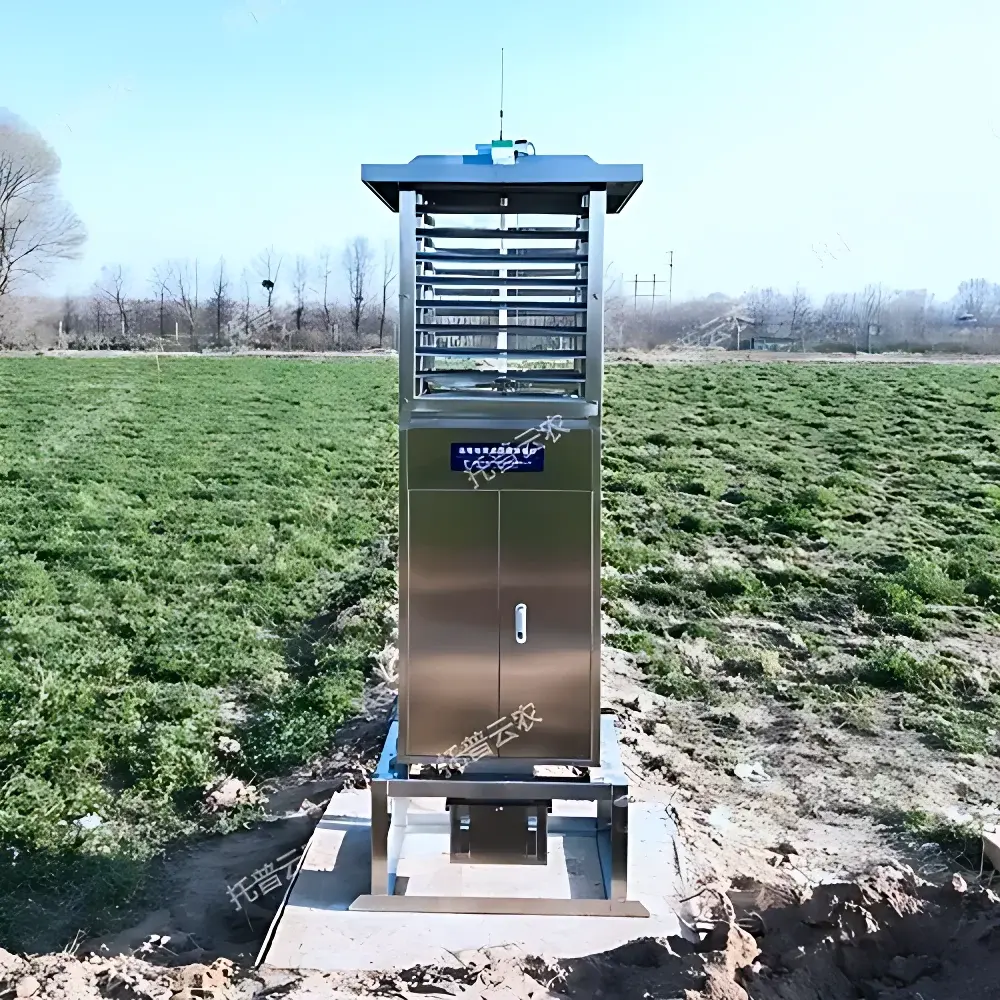
Top Cloud-agri TPCB-II-C6.0plus Intelligent Pest Monitoring System
| Brand | Top Cloud-agri |
|---|---|
| Origin | Zhejiang, China |
| Manufacturer Type | OEM Manufacturer |
| Country of Origin | China |
| Model | TPCB-II-C6.0plus |
| Power Supply | AC 220 V |
| Camera Resolution | 12 MP industrial-grade CMOS sensor |
| Image Capture Interval | Adjustable from 10 minutes to 3 hours per frame |
| Data Upload Speed | ≥1 Mbps via 4G/ethernet/wireless bridge |
| GPS Accuracy | ≤5 m (CEP) |
| Insect Mortality Rate | ≥98% |
| Insect Integrity Rate | ≥95% |
| Heating Chamber Temperature Range | 80–90 °C (dual-zone far-infrared, ±5 °C control accuracy) |
| Rain Separation Efficiency | >99% |
| IP Rating | IP65 |
| Operating Temperature Range | −20 °C to +60 °C |
| Humidity Tolerance | 10–95% RH (non-condensing) |
Overview
The Top Cloud-agri TPCB-II-C6.0plus Intelligent Pest Monitoring System is an automated, IoT-enabled entomological surveillance platform engineered for continuous, unattended field monitoring of agricultural insect populations. It operates on the principle of phototactic attraction—using controlled UV light emission to lure nocturnal flying insects into a standardized trapping chamber—followed by high-fidelity digital imaging, thermal inactivation, and spatially resolved transport for morphological documentation. Unlike passive traps or manual scouting methods, this system integrates real-time image acquisition, georeferenced data logging, and cloud-based analytics to support predictive pest modeling grounded in phenological patterns, historical incidence databases, and environmental correlation matrices (e.g., temperature degree-days, relative humidity thresholds). Designed for deployment across orchards, paddy fields, greenhouse complexes, and border quarantine zones, it delivers traceable, auditable, and time-stamped visual evidence compliant with national phytosanitary reporting frameworks.
Key Features
- Industrial-grade 12-megapixel CMOS camera with auto-focus, low-light enhancement, and programmable exposure control—optimized for sub-millimeter morphological resolution under variable ambient lighting.
- Dual-zone far-infrared heating chamber maintaining precise temperature setpoints (80–90 °C) to ensure ≥98% mortality while preserving ≥95% specimen integrity for taxonomic verification.
- Vibratory dispersion mechanism coupled with precision conveyor belt transport—ensuring uniform monolayer distribution of captured specimens prior to imaging, minimizing occlusion and shadowing artifacts.
- Active rain separation architecture featuring self-draining rain chambers, hydrophobic baffle arrays, and adaptive rain-sensing logic—enabling uninterrupted operation during precipitation events without water ingress or specimen degradation.
- Full remote operability via secure TLS-encrypted web portal and cross-platform mobile application (Android/iOS), supporting real-time command issuance—including lamp activation, heater cycling, conveyor start/stop, and mechanical chamber purge.
- Integrated GPS module with <5 m CEP accuracy and persistent onboard logging—supporting geofencing, theft deterrence, and spatial-temporal correlation of outbreak clusters across distributed sensor networks.
- 7-inch industrial capacitive touchscreen running Android OS with localized Chinese UI; supports offline parameter configuration, scheduled capture windows, and local cache fallback during network outages.
Sample Compatibility & Compliance
The system is validated for monitoring Lepidoptera (e.g., Spodoptera frugiperda, Helicoverpa armigera), Coleoptera (e.g., Anomala corpulenta), Hemiptera (e.g., Nephotettix cincticeps), and Diptera (e.g., Bactrocera dorsalis). Specimen size range: 2–25 mm body length. All hardware components conform to IEC 60529 (IP65), GB/T 17626 (EMC immunity), and GB 4208 (environmental protection). Firmware and cloud infrastructure comply with China’s Cybersecurity Law (CSL) Article 37 data localization requirements. Image metadata includes EXIF timestamps, GPS coordinates, device ID, and calibration checksums—enabling audit readiness for GLP-aligned pest surveillance programs.
Software & Data Management
Data ingestion follows RESTful API architecture with JSON-formatted payloads containing embedded base64-encoded images, structured detection logs, and environmental telemetry (ambient temperature/humidity if optional sensors are installed). The cloud platform supports role-based access control (RBAC), versioned dataset archiving, and export in CSV/GeoJSON formats. Image storage utilizes AES-256 encryption at rest and TLS 1.3 in transit. Audit trails record all user-initiated actions—including parameter modifications, manual captures, and remote device resets—with immutable timestamps aligned to NTP-synchronized server clocks. Optional integration with third-party GIS platforms (e.g., ArcGIS Online, QGIS Server) enables spatiotemporal hotspot mapping using kernel density estimation algorithms.
Applications
- Early-warning surveillance for migratory pests in national border inspection zones.
- Long-term phenology tracking to calibrate degree-day models for Chilo suppressalis and other rice stem borers.
- Validation of biocontrol agent efficacy by quantifying pre- and post-release population trajectories.
- Supporting FAO-IPM guidelines through objective, repeatable metrics for decision support thresholds (DSTs).
- Feeding national pest forecasting databases maintained by provincial agricultural extension centers under MOA supervision.
FAQ
Does the system support integration with existing farm management software (FMS)?
Yes—via documented REST APIs and configurable webhook endpoints compatible with common FMS platforms including FarmLogs, AgriWebb, and domestic systems such as Zhongnong Yun and Jintuo Smart Agriculture.
What is the recommended maintenance interval for optical components?
Lens cleaning and UV lamp replacement are advised every 6 months under continuous operation; full mechanical inspection (vibrator alignment, conveyor tension, heater element resistance) is recommended annually.
Is raw image data accessible for third-party AI model training?
Yes—authenticated users may download timestamped, geotagged image sequences with corresponding metadata JSON files for offline annotation and algorithm development, subject to license agreement terms.
How does the system handle false triggers from non-target objects (e.g., leaves, dust)?
The embedded image processing pipeline applies morphological filtering, motion vector analysis, and aspect-ratio constraints to suppress non-biological artifacts prior to upload; manual review mode allows curators to flag ambiguous frames for reprocessing.
Can the device operate autonomously during extended network outages?
Yes—the onboard 32 GB eMMC storage retains up to 30 days of compressed imagery and sensor logs; synchronization resumes automatically upon network restoration with delta-uploading to avoid redundancy.





