
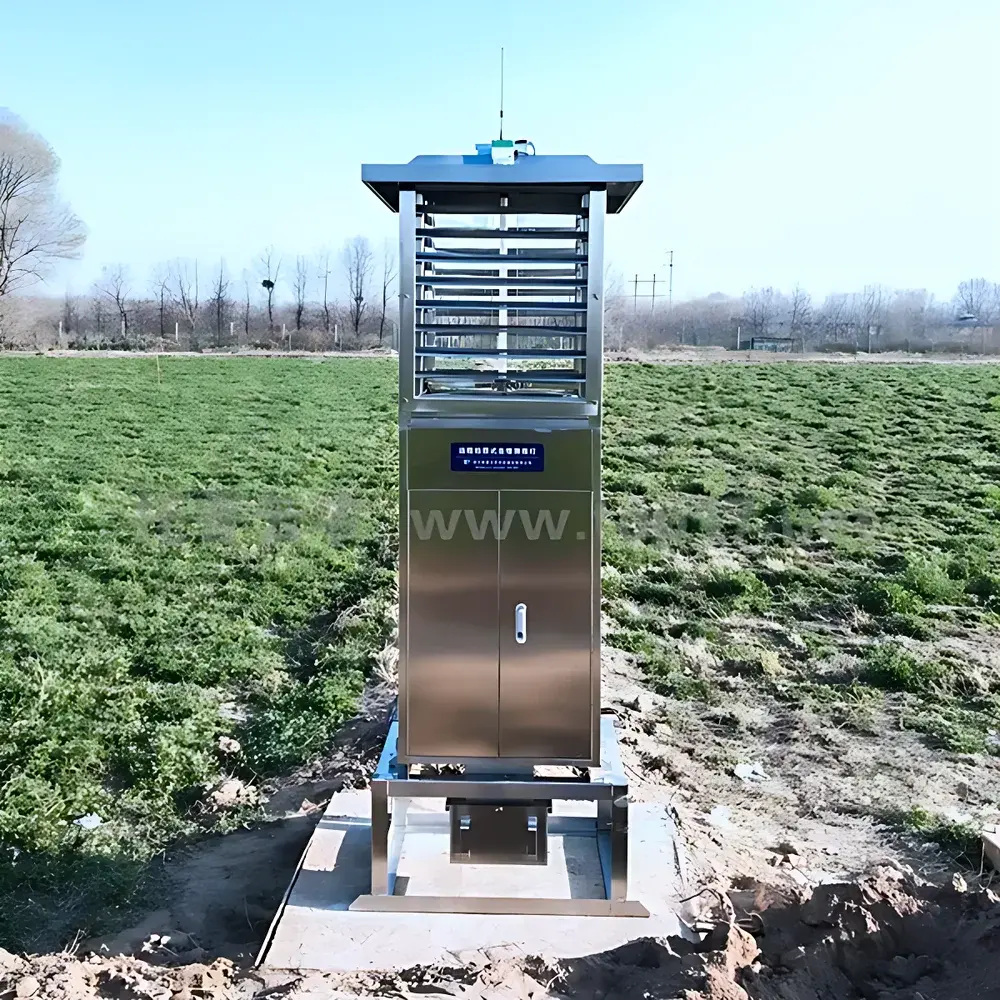
Top Cloud-agri TPCB-III-C 7.0plus IoT-Based Pest Monitoring and Forecasting System
| Brand | Top Cloud-agri |
|---|---|
| Origin | Zhejiang, China |
| Manufacturer Type | OEM/ODM Manufacturer |
| Country of Origin | China |
| Model | TPCB-III-C 7.0plus |
| Power Supply | AC 220 V / DC 12 V (with 100 Ah battery & 320 W solar panel) |
| Network Connectivity | Fiber Optic / Wireless Bridge / 4G Router |
| Camera Resolution | 20 MP Industrial-Grade CMOS Sensor |
| Image Upload Speed | ≥1 Mbps |
| Pest Recognition Accuracy | ≥85% for Sogatella furcifera |
| GPS Positioning | Integrated |
| Operating Temperature Range (Killing/Drying Chamber) | 85 ± 5 °C |
| Pest Mortality Rate | ≥98% |
| Specimen Integrity Rate | ≥95% |
| Photo Capture Interval | Adjustable from 10 min to 3 h |
| Rain Separation | Dual-stage rain-pest separation chamber with auto-drain baffle and weatherproof canopy |
| Lightning Protection | Built-in Class II surge protection |
Overview
The Top Cloud-agri TPCB-III-C 7.0plus IoT-Based Pest Monitoring and Forecasting System is an autonomous, solar-compatible field instrument engineered for continuous, unattended surveillance of nocturnal, phototactic insect populations in agricultural ecosystems. It operates on the principle of UV-light attraction coupled with high-resolution digital imaging and edge-enabled machine vision analytics. Insects are lured by a 365 nm UV lamp into a controlled entry chamber, subjected to thermal euthanasia at 85 ± 5 °C in a dual-zone far-infrared killing and drying unit, then mechanically dispersed and transported via vibratory conveyor onto a calibrated imaging stage. A 20-megapixel industrial CMOS camera captures orthographic macro-images under consistent illumination, enabling both automated taxonomic classification and manual verification. All image metadata—including timestamp, GPS coordinates, ambient temperature/humidity (optional sensor integration), and operational status—are embedded and transmitted in real time to a secure cloud platform compliant with ISO/IEC 27001 information security standards.
Key Features
- Robust 304 stainless steel enclosure with IP65-rated weatherproofing, integrated lightning arresters (IEC 61643-11 Class II), and a self-draining rain-pest separation architecture featuring adjustable louvers and a reinforced canopy—ensuring uninterrupted operation during heavy precipitation.
- Programmable photoperiod control: automatic activation at dusk and deactivation at dawn, with immunity to transient ambient light interference (e.g., vehicle headlights or lightning flashes).
- Configurable capture scheduling: image acquisition intervals programmable from 10 minutes to 3 hours per frame, supporting adaptive monitoring aligned with target pest circadian rhythms (e.g., peak flight activity windows for Cnaphalocrocis medinalis).
- Vibratory specimen dispersion mechanism ensures uniform monolayer distribution across the conveyor belt, minimizing occlusion and maximizing morphological feature visibility for both AI inference and human validation.
- Remote bidirectional command interface: supports over-the-air execution of motorized functions—including conveyor start/stop, UV lamp toggle, heating zone setpoint adjustment, chamber purge cycles, and mechanical repositioning—via encrypted HTTPS API endpoints.
- Integrated GPS module enables georeferenced deployment mapping, historical route tracing, and theft deterrence through real-time location reporting and geofence alerts.
Sample Compatibility & Compliance
The system is validated for monitoring over 100 species of lepidopteran and homopteran pests exhibiting positive phototaxis, including but not limited to Sogatella furcifera (white-backed planthopper), Nilaparvata lugens (brown planthopper), Cnaphalocrocis medinalis (rice leafroller), Chilo suppressalis (striped stem borer), and Sesamia inferens (pink stem borer). Specimen integrity is preserved via controlled thermal processing: mortality ≥98% and morphological completeness ≥95%, satisfying FAO Plant Protection Guidelines for diagnostic-grade entomological sampling. The device complies with GB/T 3543.2–1995 (Chinese National Standard for Field Pest Monitoring Equipment) and incorporates hardware-level safeguards aligned with IEC 62443-3-3 for industrial cybersecurity. Optional environmental sensors (temperature, humidity, rainfall) support correlation analysis per ISO 22000 traceability requirements.
Software & Data Management
Data ingestion follows RESTful architecture with TLS 1.2 encryption and OAuth 2.0 authentication. Raw images are stored in immutable object storage (AWS S3 or on-premise Ceph) with SHA-256 checksums. The cloud analytics engine applies convolutional neural networks trained on annotated field datasets (>2.4 million labeled specimens) to perform species-level classification and count estimation. Recognition confidence scores, bounding box annotations, and temporal density trends are exported in CSV/JSON formats compatible with GIS platforms (QGIS, ArcGIS) and statistical packages (R, Python pandas). Audit trails record all user-initiated actions—including parameter changes, manual corrections, and firmware updates—in accordance with GLP Annex 11 and FDA 21 CFR Part 11 requirements for electronic records and signatures.
Applications
- Regional pest forecasting networks operated by provincial agricultural extension services.
- Smart irrigation and precision pesticide application decision support systems (DSS) integrated with drone-based scouting and variable-rate sprayers.
- Long-term phenological studies tracking climate-driven shifts in pest emergence timing and spatial distribution.
- Validation of biological control agent efficacy in IPM trials through standardized, observer-independent quantification.
- Real-time early warning dissemination to farmer cooperatives via SMS or WeCom push notifications linked to threshold-based alert logic.
FAQ
Does the system require constant internet connectivity to function?
No. Local image capture, thermal processing, and onboard storage continue during network outages. Images queue in internal flash memory (32 GB) and transmit automatically upon reconnection.
Can the recognition model be updated for newly emerging pest threats?
Yes. Firmware and AI model updates are delivered remotely via signed OTA packages, with version rollback capability and cryptographic signature verification.
Is the heating chamber temperature adjustable per species?
Yes. Operators can define independent setpoints for upper and lower far-infrared zones via the web interface to optimize preservation for delicate specimens (e.g., aphids vs. moths).
How is data privacy enforced for multi-user deployments?
Role-based access control (RBAC) enforces granular permissions—field technicians view only assigned devices; agronomists access analytical dashboards; administrators manage user provisioning and audit logs.
What maintenance intervals are recommended for long-term field reliability?
UV lamp replacement every 6,000 hours; cleaning of optical lenses and conveyor belts every 30 days; annual calibration of thermal sensors against NIST-traceable references.
Related Products







