
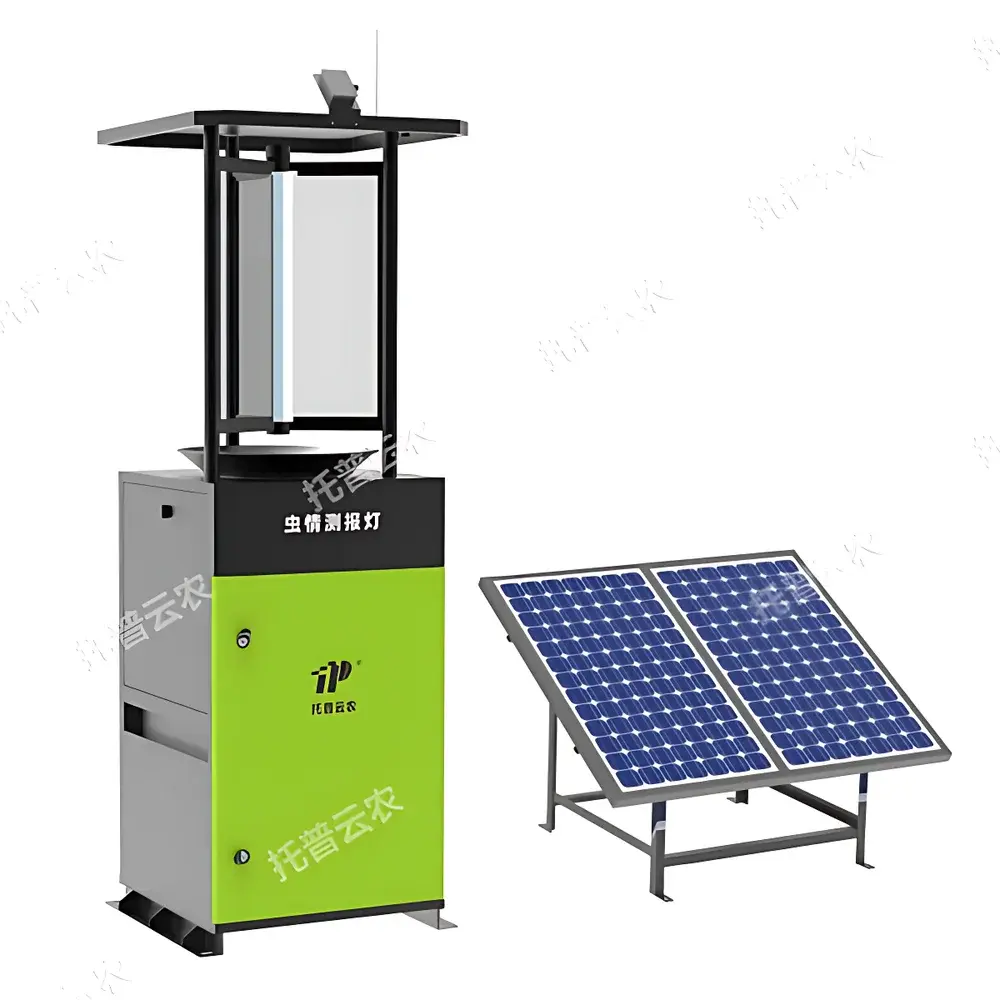
Top Cloud-agri TPCB-III-C4.0 PLUS Solar-Powered Automatic Insect Monitoring and Reporting Trap
| Brand | Top Cloud-agri |
|---|---|
| Origin | Zhejiang, China |
| Manufacturer Type | Direct Manufacturer |
| Country of Origin | China |
| Model | TPCB-III-C4.0 PLUS |
| Power Supply | DC 12V (Solar Panel + Rechargeable Battery) |
| Insect Attraction Light | 20W UV Lamp (Peak Wavelength: 365 nm) |
| Display | 7-inch Capacitive Touchscreen (Android 4.0 OS) |
| Infrared Killing Temperature | 85 ± 5°C (Reaching within 15 min |
| Duration Adjustable | 1–60 min) |
| Infrared Mortality Rate | ≥98% |
| Insect Integrity Rate | ≥95% |
| Time Segmentation | 1–24 Programmable Time Slots |
| Collection Capacity | 8-Compartment Auto-Rotating Tray System |
| Rain Control | Automatic Drainage & Rain/Insect Separation |
| Operating Temperature | 0–70°C |
| Operating Humidity | ≤95% RH |
| Max Power Consumption | ≤210 W |
| Insulation Resistance | >2.5 MΩ |
| Startup Time | <5 s |
| Lightning Protection | Integrated Surge Protection |
| Voltage Stabilization | 160–280 V AC Input Supported (Stabilized to 220 V) |
| Data Connectivity | Built-in Cellular (LTE) or Optional LoRaWAN Module |
| Environmental Sensors (Optional) | Air Temp/RH, Soil Temp/Moisture, Wind Speed/Direction, Illuminance |
Overview
The Top Cloud-agri TPCB-III-C4.0 PLUS is a solar-powered, fully autonomous insect monitoring and reporting system engineered for long-term, unattended deployment in open-field agricultural, forestry, horticultural, and ecological surveillance environments. It operates on the principle of phototactic attraction using narrow-band ultraviolet radiation (365 nm peak), followed by non-chemical mortality induction via controlled far-infrared thermal treatment. Unlike conventional trapping methods relying on adhesives or chemical lures, this system ensures standardized, traceable, and quantifiable insect capture across temporal and spatial gradients—enabling statistical analysis of pest population dynamics, phenological shifts, and migration patterns. Its self-sustaining architecture integrates monocrystalline solar panels, deep-cycle lithium-iron-phosphate (LiFePO₄) battery storage, and intelligent power management to maintain continuous operation through multi-day cloud cover or low-light conditions. Designed for compliance with FAO’s International Standards for Phytosanitary Measures (ISPM No. 6 and No. 27), it supports early-warning systems aligned with national plant protection organizations’ protocols.
Key Features
- Stainless steel enclosure conforming to GB/T 4237, ensuring corrosion resistance in high-humidity and saline coastal environments.
- Dual-layer far-infrared processing chamber enabling sequential killing and desiccation—minimizing microbial degradation and preserving morphological integrity for taxonomic verification.
- 8-position auto-rotating collection tray with time-stamped compartmentalization, preventing cross-contamination between sampling intervals (e.g., hourly, daily, or species-specific cycles).
- Programmable time segmentation (1–24 slots per 24-hour cycle), synchronized with known circadian activity profiles of target pests such as Spodoptera frugiperda, Nilaparvata lugens, and Bemisia tabaci.
- Integrated rain control mechanism featuring hydrophobic channeling, gravity-based drainage, and real-time precipitation threshold detection to prevent water ingress and preserve sample validity during monsoon seasons.
- Robust electrical architecture including lightning surge protection (IEC 61643-11 compliant), wide-input AC voltage stabilization (160–280 V), and automatic power recovery with persistent memory—resuming interrupted cycles post-outage without data loss.
- Capacitive 7-inch touchscreen interface running Android 4.0 firmware, supporting both local configuration and remote OTA updates via encrypted cellular (LTE-M/NB-IoT) or LoRaWAN backhaul.
Sample Compatibility & Compliance
The TPCB-III-C4.0 PLUS is validated for monitoring Lepidoptera, Coleoptera, Hemiptera, Diptera, and Orthoptera taxa commonly associated with staple crops (rice, maize, wheat), cash crops (tobacco, tea, citrus), and forest ecosystems (pine wilt nematode vectors, bark beetles). Its far-infrared treatment protocol meets ISO 21569:2019 requirements for non-destructive biological sample preservation prior to morphological or molecular identification. All electronic subsystems comply with CE EMC Directive 2014/30/EU and RoHS 2011/65/EU. Data logging adheres to GLP-aligned metadata tagging—including GPS coordinates, UTC timestamps, ambient temperature/humidity (when sensors are installed), and operational status codes—facilitating audit-ready export in CSV or XML formats compatible with FAO’s EMPRES-i platform and national pest surveillance databases.
Software & Data Management
Firmware supports dual-mode operation: standalone field mode with onboard data caching (≥30 days at 15-min resolution), and networked telemetry mode with configurable upload intervals (15 min to 24 h). Encrypted payloads include trap status diagnostics (battery SOC, solar yield, sensor health), infrared chamber temperature logs, compartment rotation events, and environmental parameter snapshots. The companion cloud portal (accessible via web browser or mobile app) provides GIS-integrated heatmaps, temporal trend visualizations, automated anomaly alerts (e.g., sudden spike in nocturnal catch volume), and batch export for integration into R, Python (pandas/scikit-learn), or enterprise BI tools. Audit trails meet FDA 21 CFR Part 11 requirements for electronic records, including user authentication, role-based access control, and immutable change logs.
Applications
- Regional pest forecasting networks requiring spatially distributed, time-synchronized capture data for model calibration (e.g., CLIMEX, DYMEX).
- IPM program validation—quantifying pre- and post-intervention pest pressure across treatment zones.
- Quarantine surveillance at ports, border checkpoints, and protected areas to detect invasive species incursions.
- Ecological research on pollinator decline, nocturnal insect biomass trends, and light-pollution impact assessments.
- Smart orchard and vineyard management systems integrating with irrigation and pesticide application scheduling logic.
FAQ
Does the unit require grid electricity?
No. The TPCB-III-C4.0 PLUS operates exclusively on DC 12 V supplied by its integrated solar panel and rechargeable battery system. Grid backup is optional and not required for nominal operation.
Can the infrared killing parameters be customized per insect order?
Yes. Temperature setpoint (80–95°C), dwell time (1–60 min), and chamber activation sequence are programmable via the touchscreen or remote API, allowing optimization for fragile specimens (e.g., parasitoid wasps) versus robust coleopterans.
Is raw image capture supported for AI-based species classification?
Not natively. However, the system’s open RS485/Modbus interface enables third-party camera integration; users may deploy edge AI modules (e.g., NVIDIA Jetson Nano) for real-time imaging synchronized with compartment indexing.
How is data security ensured during wireless transmission?
All cellular or LoRaWAN transmissions use TLS 1.2 encryption with device-specific X.509 certificates. Local data at rest is AES-256 encrypted, and firmware updates are cryptographically signed.
What maintenance intervals are recommended for long-term reliability?
Biannual inspection of UV lamp output (radiometric verification), cleaning of infrared quartz heaters and optical windows, and battery capacity testing (every 24 months) are advised per manufacturer guidelines. No consumables are required beyond periodic lamp replacement (rated life: 5,000 h).
Related Products







