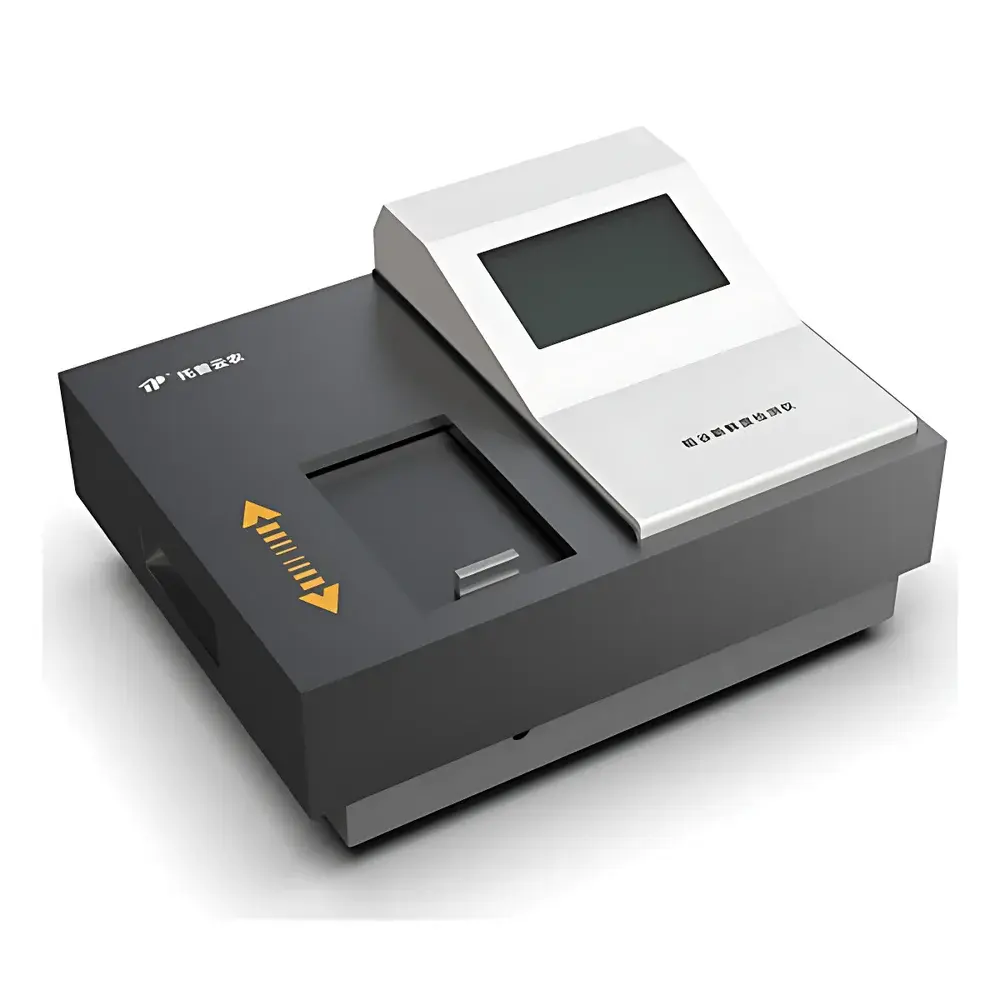
Top Cloud-agri TPDG-1 Rice Freshness Analyzer
| Brand | Top Cloud-agri |
|---|---|
| Origin | Zhejiang, China |
| Manufacturer Type | Direct Manufacturer |
| Country of Origin | China |
| Model | TPDG-1 |
| Pricing | Available Upon Request |
Overview
The Top Cloud-agri TPDG-1 Rice Freshness Analyzer is a dedicated spectrophotometric instrument engineered for the rapid, quantitative assessment of rice freshness—specifically through the determination of free fatty acid (FFA) content, expressed as fatty acid value (FAV), a well-established chemical indicator of lipid oxidation and post-harvest aging in paddy rice. Unlike general-purpose spectrophotometers, the TPDG-1 implements a standardized colorimetric method aligned with national grain quality standards (e.g., GB/T 20569–2006 for paddy rice fatty acid value determination). It operates on the principle of dual-wavelength absorbance measurement (typically at 520 nm and reference wavelength ~720 nm) to eliminate matrix interference from pigments, turbidity, or sample color variation—ensuring high analytical specificity for milled or rough rice samples prior to commercial milling. The system is validated for use in regulated storage and processing environments including national grain reserves, provincial grain inspection centers, and rice milling facilities; it is not intended for finished polished rice (commodity white rice) due to methodological constraints related to starch gelatinization and extractability.
Key Features
- Dual-Wavelength Photometric Detection: Simultaneous measurement at primary and reference wavelengths minimizes baseline drift and optical path artifacts, delivering repeatability within ±0.5%T and photometric stability of ±0.1%T over 3 minutes—meeting performance benchmarks consistent with ISO 7027-compliant instrumentation for routine food quality screening.
- Integrated Sample Preparation Workflow: Includes calibrated mortar set, 100-mesh stainless steel sieve, and pre-qualified 5 mL volumetric pipette—enabling standardized grinding, sieving, and extraction per GB/T 20569 protocol without external labware dependency.
- Self-Contained Reagent System: Proprietary reagent kit (two full sets supplied) contains stabilized chromogenic reagents formulated for FFA quantification via ferric hydroxamate complex formation; each kit supports ≥100 determinations with documented shelf-life stability under ambient storage conditions.
- Embedded Data Handling Architecture: 7-inch capacitive touchscreen interface with intuitive icon-driven navigation; real-time calculation of freshness index (A-value) and FAV (mg KOH/100g) based on built-in calibration curves; automatic timestamping and sample ID assignment.
- Onboard Thermal Printing & Local Storage: Integrated thermal printer produces audit-ready hard copies with instrument ID, date/time stamp, operator code (if configured), and raw absorbance values. Internal flash memory retains ≥100,000 test records with search, filter, and selective deletion functions.
- Ruggedized Industrial Design: Enclosure meets IP20 environmental rating; operating range: 10–45°C ambient temperature, 10–80% RH non-condensing; power input compatibility across global AC grids (80–240 V, 50/60 Hz); net weight: 14.1 kg; footprint optimized for benchtop deployment in QC laboratories and field service vehicles.
Sample Compatibility & Compliance
The TPDG-1 is validated exclusively for unhulled paddy rice (Oryza sativa L.) and brown rice samples meeting ISO 7305:2012 sampling requirements. It complies with Chinese National Standard GB/T 20569–2006 (“Determination of Fatty Acid Value in Paddy Rice”) and supports traceable calibration against certified reference materials (CRMs) traceable to NIM (National Institute of Metrology, China). While not FDA 21 CFR Part 11 compliant out-of-the-box, audit logs (including user actions, calibration events, and result modifications) are stored immutably and exportable in CSV format for GLP/GMP-aligned internal documentation systems. Instrument validation documentation—including installation qualification (IQ), operational qualification (OQ), and performance verification reports—is available upon request for regulatory submissions.
Software & Data Management
No external PC software is required for core operation; all data acquisition, calculation, and reporting occur onboard. Raw spectral data (absorbance at both wavelengths), calculated A-values, and FAV results are stored with metadata (date, time, operator ID if entered, sample ID, reagent lot number). Data export is supported via USB 2.0 port to FAT32-formatted drives in comma-separated values (.csv) format—compatible with LIMS integration, Excel-based trending analysis, or statistical process control (SPC) platforms. Firmware updates are delivered via encrypted USB firmware image files, with version history and checksum verification embedded in the update utility.
Applications
- Quality grading of incoming paddy lots at state grain reserves and central warehouses
- In-process monitoring of storage conditions (temperature/humidity correlation with FAV drift)
- Validation of drying and storage protocols in cooperative mills
- Supporting compliance with China’s “Grain Circulation Supervision Regulations” (Order No. 408)
- Research applications in post-harvest physiology studies on lipid peroxidation kinetics
FAQ
Can the TPDG-1 be used for polished white rice or cooked rice?
No. The method relies on solvent extraction of free fatty acids from intact bran layers; polishing removes the primary oxidation site, and cooking alters lipid solubility and interferes with chromogen formation.
Is third-party calibration certification available?
Yes—certified calibration services with NIM-traceable photometric standards and uncertainty reporting are offered annually or per ISO/IEC 17025 requirements.
Does the instrument support multi-language UI?
The default interface is English; Chinese language firmware is available upon order specification.
What maintenance is required beyond reagent replacement?
Annual optical alignment verification and cuvette path cleaning with isopropyl alcohol; no lamp replacement needed—the LED light source has >50,000-hour rated lifetime.
How is data integrity ensured during power interruption?
All measurements in progress are buffered to non-volatile memory; incomplete tests resume or auto-discard based on configurable timeout settings (default: 30 s).