
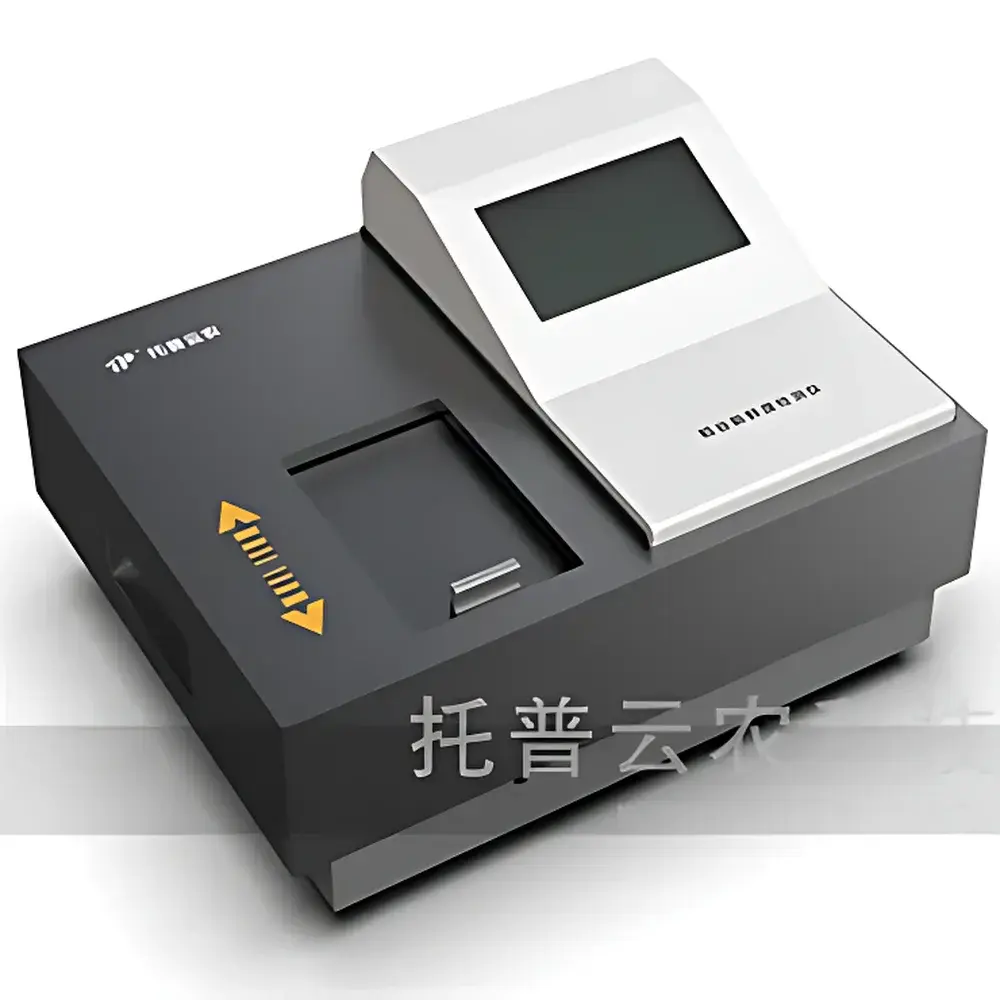
Top Cloud-agri TPDG-1G Grain Freshness Analyzer
| Brand | Top Cloud-agri |
|---|---|
| Origin | Zhejiang, China |
| Manufacturer Type | Direct Manufacturer |
| Country of Origin | China |
| Model | TPDG-1G |
| Pricing | Available Upon Request |
Overview
The Top Cloud-agri TPDG-1G Grain Freshness Analyzer is a dedicated optical spectrophotometric instrument engineered for rapid, non-destructive assessment of rice freshness—specifically targeting Oryza sativa subspecies japonica and indica. It operates on the principle of dual-wavelength absorbance ratio analysis in the visible spectrum (typically 520 nm and 620 nm), quantifying chemical degradation markers—including free fatty acid accumulation, peroxide formation, and pigment oxidation—that correlate with post-harvest storage duration and oxidative deterioration. Unlike generic spectrophotometers, the TPDG-1G integrates standardized sample preparation protocols, reagent-calibrated optical path geometry, and algorithmic normalization to deliver a dimensionless freshness index (A-value), traceable to empirical calibration curves validated against accelerated aging studies and sensory panel consensus. Designed for operational environments ranging from grain silos to accredited food testing laboratories, it meets functional requirements aligned with GB/T 20570–2015 (Chinese National Standard for Rice Freshness Evaluation) and supports method development consistent with ISO 663:2022 (Animal and vegetable fats and oils — Determination of peroxide value) and AOAC Official Method 971.22 (Peroxide Value in Oils and Fats).
Key Features
- Dual-wavelength photometric measurement: Simultaneous detection at two optimized wavelengths minimizes matrix interference from color variation, turbidity, and minor milling residue—ensuring robustness across paddy, brown, and milled rice samples.
- Stabilized optical source: Equipped with a thermally regulated halogen lamp and precision current driver meeting IEC 61000-4-11 immunity standards, delivering ±0.1% transmittance stability over 3 minutes (T/3 min).
- Integrated human-machine interface: 7-inch capacitive touch LCD display with industrial-grade GUI, supporting multilingual menu navigation (English, Chinese), real-time spectral preview, and guided workflow prompts.
- Automated data processing: Onboard microcontroller executes preloaded calibration algorithms (linear and polynomial fitting), computes A-value in <1 minute per 1.00 g ±0.01 g sample, and applies batch correction for ambient temperature drift (10–45°C).
- Embedded thermal printer: Direct thermal printing module compliant with ESC/POS protocol; generates audit-ready reports including timestamp, operator ID, sample ID, A-value, and pass/fail flag relative to user-defined thresholds.
- Pre-formulated reagent kits: CE-certified, lot-controlled test reagents supplied in lyophilized format; each kit enables ≥100 determinations with ≤5% inter-kit CV under GLP-compliant handling.
- High-capacity local storage: Internal 2 GB flash memory retains ≥100,000 test records with full metadata (date/time, operator, sample weight, raw absorbance values, computed A-value); supports selective export via USB 2.0 to CSV or PDF.
Sample Compatibility & Compliance
The TPDG-1G is validated for intact and ground kernels of domestic japonica and indica rice varieties, requiring no solvent extraction or derivatization. Sample homogenization uses the included mortar set (ceramic-lined, 80 mm diameter), followed by standardized sieving through 100-mesh stainless steel mesh (ASTM E11-22 specification). The system complies with electromagnetic compatibility (EMC) per GB/T 18268.1–2010 (IEC 61326-1:2012), electrical safety per GB 4793.1–2007 (IEC 61010-1:2010), and is suitable for use in Class II, Division 2 hazardous locations when operated within specified humidity limits (10–80% RH, non-condensing). While not FDA 21 CFR Part 11–certified out-of-the-box, its audit trail functionality (timestamped records, immutable storage, operator log-in) provides foundational infrastructure for GMP/GLP-aligned validation protocols.
Software & Data Management
Data export is performed via USB mass-storage mode—no proprietary drivers required. Exported files include structured CSV with column headers: “TestID”, “DateTime”, “Operator”, “SampleWeight_g”, “Abs520_nm”, “Abs620_nm”, “A_Value”, “PassFail”. Optional PC software (Windows 10/11, x64) enables trend analysis, statistical process control (SPC) charting (X-bar/R), and integration with LIMS via configurable ODBC connections. Firmware updates are delivered as signed binary packages with SHA-256 checksum verification to ensure integrity during field deployment.
Applications
- Quality assurance in rice procurement at national grain reserves and provincial storage centers
- In-process monitoring during parboiling, drying, and polishing stages in commercial milling facilities
- Method validation and reference material characterization in CNAS-accredited food testing laboratories
- Post-harvest physiology research on lipid oxidation kinetics in agricultural universities and crop science institutes
- Regulatory screening for compliance with China’s “Grain Storage Quality Control Regulations” (NDRC Order No. 15)
FAQ
What rice varieties does the TPDG-1G support?
It is calibrated and validated exclusively for domestic Oryza sativa japonica and indica cultivars. Use with aromatic, glutinous, or imported rice varieties requires independent method verification.
Is external calibration required before each use?
No. The instrument performs automatic zeroing and reference calibration using built-in neutral density filters prior to each measurement cycle. Annual verification with NIST-traceable transmittance standards is recommended.
Can raw absorbance data be accessed for custom modeling?
Yes. Both 520 nm and 620 nm absorbance values are stored in every record and exported in full-resolution CSV format.
What is the maintenance interval for the optical system?
Lamp replacement is recommended every 2,000 operating hours; optical path cleaning (quartz cuvette holder and lens surfaces) is advised quarterly under heavy-use conditions.
Does the device meet international export certification requirements?
It carries CCC mark (China Compulsory Certification) and conforms to RoHS 2011/65/EU. CE marking is available upon request with EU Representative documentation and DoC alignment to Machinery Directive 2006/42/EC and EMC Directive 2014/30/EU.







