
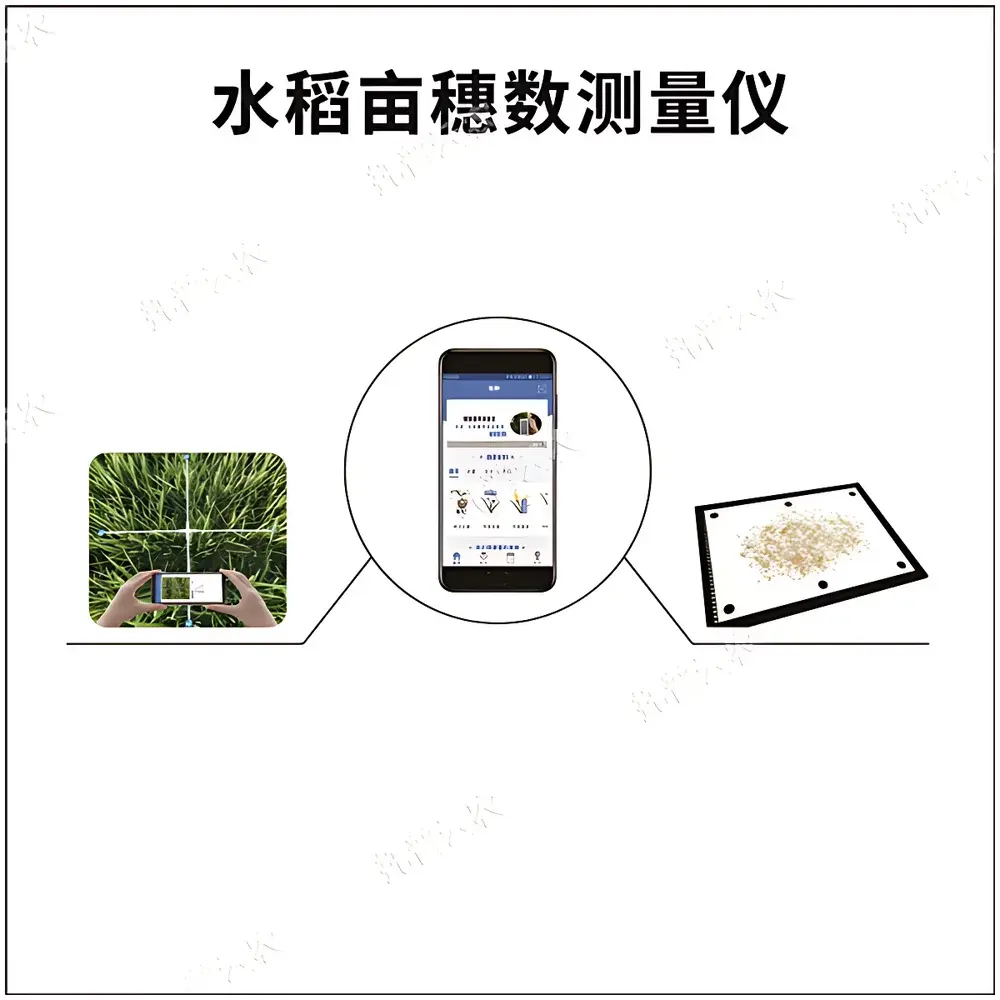
Top Cloud-agri TPDS-1 / TPDS-2 Rice Panicle Counting System
| Brand | Top Cloud-agri |
|---|---|
| Origin | Zhejiang, China |
| Manufacturer Type | Direct Manufacturer |
| Model | TPDS-1 / TPDS-2 |
| Calibration Area Options | 0.25 m² (cross-type) and 0.5 m² (square-type) |
| Measurement Accuracy | ≤ ±5% for panicles per mu (667 m²) |
| Valid Growth Stages | Flowering, Grain Filling, and Milky Ripening stages only |
| Supported Platforms | Android mobile app + Windows PC software (TPDS-2 only) |
| Image Batch Processing Capacity | Up to 48 images per batch |
| Output Format | Excel (.xlsx), with audit-ready metadata export |
| Data Security | Account-based dynamic verification, session-limited concurrent access |
| Hardware Kit Includes | Adjustable cross-type calibrator (765 × 765 × 750–1600 mm), square calibrator (707 × 707 mm), AR-enabled smartphone, Bluetooth selfie stick, and monocular AR glasses |
Overview
The Top Cloud-agri TPDS-1 and TPDS-2 Rice Panicle Counting Systems are field-deployable, vision-based phenotyping instruments engineered for high-throughput, non-destructive quantification of panicle density in paddy fields. Leveraging convolutional neural networks (CNNs) trained on multi-stage rice canopy imagery, the system performs real-time pixel-level segmentation and instance detection of individual panicles within a calibrated field-of-view. Unlike manual counting or traditional sampling methods subject to observer bias and spatial interpolation error, this system delivers reproducible panicle counts per standardized area (1 mu = 667 m²), directly supporting quantitative trait locus (QTL) mapping, yield modeling, and varietal performance evaluation under field conditions. The core measurement principle relies on geometric calibration—via physically deployed reference frames—and deep learning–driven morphological classification, ensuring robustness across varying planting densities, canopy architectures, and lighting conditions typical of open-field rice cultivation.
Key Features
- Two physically distinct calibration standards: a height-adjustable cross-type frame (0.25 m² effective area) optimized for low-density stands, and a rigid square frame (0.5 m²) suited for high-density planting—enabling cross-validated count consistency.
- Augmented Reality (AR)-assisted imaging: Integrated AR glasses synchronize with the mobile application to overlay real-time framing guides and horizon alignment cues, mitigating parallax and perspective distortion during elevated-angle capture.
- Batch image processing engine: Supports concurrent analysis of up to 48 geotagged, timestamped images; computes mean panicle density, standard deviation, and coefficient of variation per experimental plot.
- Interactive correction layer: Touch-enabled manual annotation allows pixel-level addition, deletion, or reclassification of detected panicles—ensuring final count accuracy meets 100% validation thresholds required for publication-grade datasets.
- Dual-platform workflow: TPDS-1 operates exclusively via Android mobile application; TPDS-2 extends functionality with desktop-grade Windows software, cloud synchronization (HTTPS-encrypted), and full audit trail logging compliant with GLP-aligned data integrity protocols.
- Visual differentiation toolkit: Overlays color-coded bounding boxes (blue for main panicles, red for secondary rachis branches) and circular markers for spikelets—enhancing interpretability during dense-canopy analysis.
- Automated agronomic parameter derivation: Inputs grain weight and detected spikelet count to compute thousand-grain weight (TGW); applies user-defined conversion factors for biomass or yield projection modeling.
- Perspective-invariant calibration: Proprietary homography estimation algorithm corrects lens distortion and oblique-angle warping—eliminating need for fixed-height tripods or level-ground constraints.
Sample Compatibility & Compliance
The TPDS systems are validated exclusively for Oryza sativa L. cultivars grown under conventional flooded paddy conditions. Optimal performance is achieved during flowering through milky ripening stages, when panicle morphology is fully extruded and visually discriminable against leaf background. Measurements taken during wax or full maturity stages are excluded due to lodging-induced occlusion and chlorophyll degradation affecting contrast sensitivity. All hardware components—including calibrators and AR optics—comply with ISO 9001:2015 manufacturing controls. Software modules adhere to ALCOA+ principles (Attributable, Legible, Contemporaneous, Original, Accurate, Complete, Consistent, Enduring, Available) for raw image metadata retention. While not FDA 21 CFR Part 11–certified, the TPDS-2 desktop application supports configurable electronic signature workflows and immutable audit logs suitable for internal QA/QC and academic peer review.
Software & Data Management
Data acquisition, processing, and archival follow a tiered architecture: raw images are stored locally with embedded EXIF metadata (GPS coordinates, UTC timestamp, device ID); processed outputs include count matrices, confidence scores per detection, and spatial heatmaps. Export formats include UTF-8–encoded CSV and Excel (.xlsx) files containing all derived metrics plus user-entered contextual fields (variety name, replication ID, treatment code). Cloud sync (TPDS-2 only) employs TLS 1.3 encryption and OAuth 2.0 token-based authentication. Role-based access control permits administrator-defined permissions for data viewing, editing, and sharing—enabling collaborative multi-site trials. All exports retain traceability to original image files via SHA-256 hash references, satisfying FAIR (Findable, Accessible, Interoperable, Reusable) data stewardship requirements.
Applications
- High-resolution phenotyping for genome-wide association studies (GWAS) targeting panicle architecture QTLs.
- Field-scale validation of remote sensing–derived yield proxies using ground-truthed panicle density baselines.
- Accelerated breeding pipeline support: rapid screening of segregating populations across multiple environments.
- Longitudinal monitoring of canopy development dynamics under abiotic stress (e.g., drought, nitrogen deficiency).
- Calibration and validation of digital twin models simulating rice growth and yield formation.
- Extension service deployment for participatory varietal selection with farmer cooperatives.
FAQ
What growth stages are supported for accurate panicle counting?
Flowering, grain filling, and milky ripening stages only. Wax and full maturity stages introduce significant occlusion and color convergence, reducing detection reliability.
Can the system differentiate between primary and secondary panicles?
Yes—via hierarchical CNN inference and customizable morphological filters; users may define size, aspect ratio, and branching angle thresholds in the desktop configuration module.
Is offline operation supported?
Yes. Both TPDS-1 and TPDS-2 operate fully offline during image capture and on-device inference. Cloud sync and advanced statistical reporting require internet connectivity.
How is measurement traceability ensured?
Each exported dataset includes embedded image hashes, calibration frame IDs, GPS coordinates, and operator-assigned trial identifiers—enabling full reconstruction of analytical provenance.
Does the system support other cereal crops?
Not natively. The CNN model is specifically trained on Oryza sativa panicle morphology. Transfer learning for other species (e.g., wheat, barley) requires domain-specific retraining with annotated ground-truth datasets.




