
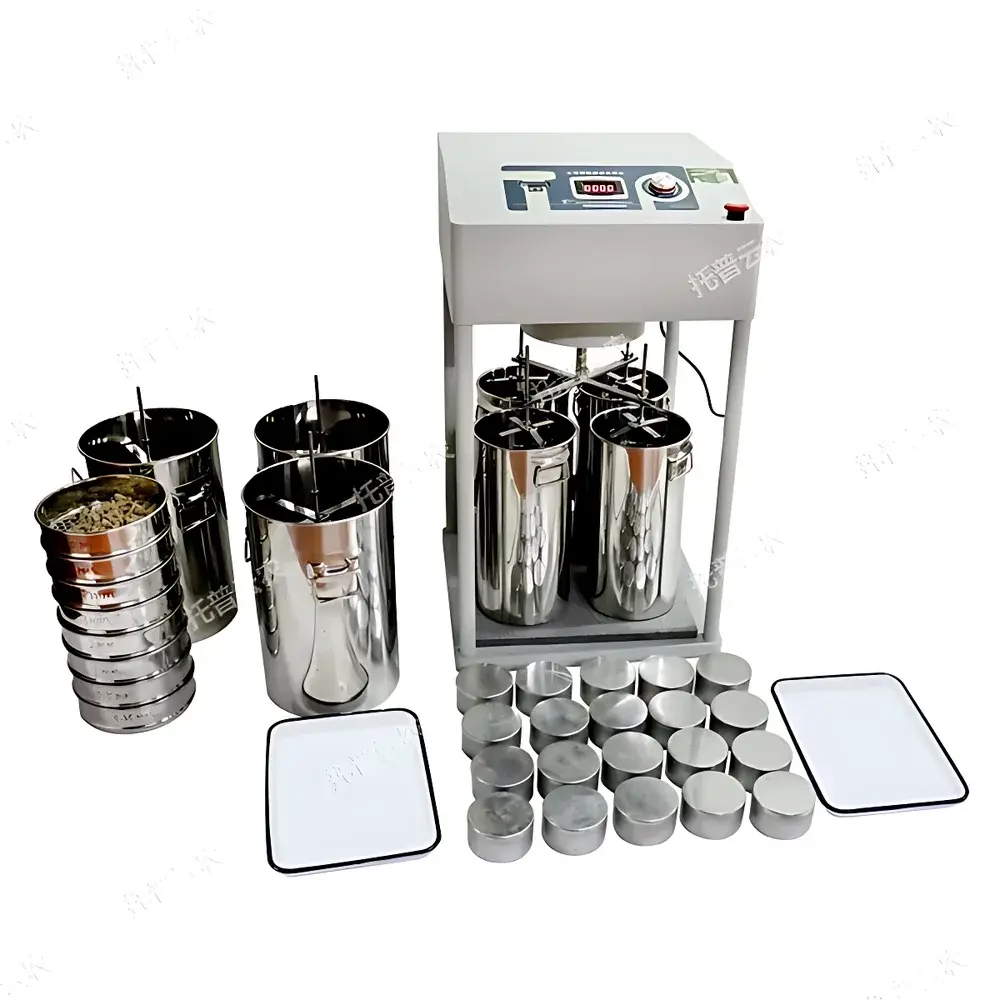
Top Cloud-agri TPF-100 Soil Aggregate Analyzer
| Brand | Top Cloud-agri |
|---|---|
| Origin | Zhejiang, China |
| Manufacturer Type | Manufacturer |
| Country of Origin | Domestic (China) |
| Model | TPF-100 |
| Oscillation Frequency | 4–45 cycles/min |
| Dimensions | 512 mm (L) × 512 mm (W) × 760 mm (H) |
| Motor Speed | 1350 rpm |
| Timing Range | 0–60 min |
| Stroke | 50 mm (vertical motion) |
| Power Supply | 220 V, 50 Hz |
| Max. Power Consumption | 120 W |
| Sieve Tray Capacity | 4 independent stainless-steel sieve stacks |
| Standard Sieve Diameters | 10 cm and 20 cm options |
| Available Aperture Sizes | 0.25, 0.5, 1, 2, 3, 5 mm (10 cm) |
| Construction Material | Stainless steel |
| Safety Features | Emergency stop switch, leakage current protection, grounded chassis |
Overview
The Top Cloud-agri TPF-100 Soil Aggregate Analyzer is a precision mechanical sieving instrument engineered for the quantitative assessment of soil aggregate stability and size distribution. It operates on the principle of standardized wet or dry sieving under controlled vertical oscillation—aligned with established methodologies for evaluating structural integrity of soil aggregates formed by organic matter, clay-humus complexes, iron/aluminum oxides, fungal hyphae, and calcium/magnesium bridges. Designed specifically for research and routine analysis in agricultural science, environmental monitoring, soil conservation, and land degradation studies, the TPF-100 enables reproducible separation of soil particles into discrete size fractions (e.g., macroaggregates >2 mm, microaggregates 0.25–2 mm, and silt/clay <0.25 mm), facilitating downstream interpretation of soil physical quality indicators such as mean weight diameter (MWD), geometric mean diameter (GMD), and aggregate stability index (ASI).
Key Features
- Compliant with national agricultural standard NY/T 1121.19–2008 and forestry standard LY/T 1227–1999 for soil aggregate analysis;
- Four independent stainless-steel sieve stack positions support parallel processing of up to four samples per run, improving throughput and inter-sample comparability;
- Digitally controlled oscillation frequency (4–45 cycles/min) and precise timing (0–60 min, 1-min resolution) ensure methodological consistency across laboratories;
- Vertical reciprocating motion with fixed 50 mm stroke replicates standardized mechanical stress required for aggregate dispersion without excessive fragmentation;
- Low-noise, low-power (≤120 W) induction motor (1350 rpm) coupled with robust stainless-steel frame ensures long-term operational stability and minimal thermal drift;
- Integrated safety architecture includes emergency stop button, earthed chassis, and residual-current device (RCD) protection compliant with IEC 61000-4-5 surge immunity and basic electrical safety requirements;
- Intuitive front-panel interface with LED time/frequency display and rotary knob controls eliminates software dependency and reduces operator training burden.
Sample Compatibility & Compliance
The TPF-100 accommodates both air-dried and pre-wetted soil samples, supporting protocols for water-stable aggregate analysis (WSA) and mechanically stable aggregate determination. Its modular sieve tray system accepts two standard diameters—10 cm and 20 cm—with aperture sets conforming to ISO 565:2022 (Test sieves — Metal wire cloth, perforated metal plate and electroformed sheet — Nominal sizes of openings) and ASTM D6913/D6913M–22 (Standard Test Methods for Particle-Size Distribution of Soil). The instrument’s mechanical design ensures minimal sample attrition during sieving, preserving biologically and chemically mediated binding structures—including hyphal networks and polyvalent cation bridges—that define functional soil aggregation. As such, it supports GLP-aligned workflows where traceability, repeatability, and procedural fidelity are essential for regulatory reporting or peer-reviewed publication.
Software & Data Management
The TPF-100 is a hardware-only analytical platform with no embedded firmware or network connectivity. All operational parameters—including start time, duration, oscillation frequency, and cycle count—are manually set and visually verified via dual-digit LED displays. This analog-digital hybrid architecture eliminates cybersecurity risks, avoids validation overhead associated with computerized systems, and meets the minimal validation requirements of ISO/IEC 17025:2017 Clause 7.7 (Ensuring validity of results) for instruments used in accredited testing laboratories. Users record mass retention per sieve fraction using external analytical balances (not supplied), then compute aggregate distribution metrics using spreadsheet-based templates aligned with USDA-NRCS or FAO-recommended calculation methods. For labs requiring full 21 CFR Part 11 compliance, integration with validated LIMS platforms may be achieved through manual data entry or barcode-assisted logging.
Applications
- Quantifying aggregate stability changes following long-term fertilization, tillage regime shifts, or cover cropping interventions;
- Evaluating erosion susceptibility indices based on macroaggregate depletion rates;
- Assessing restoration progress in degraded soils post-mining or wildfire;
- Supporting carbon sequestration modeling by correlating occluded organic carbon content with aggregate size classes;
- Validating biochar or compost amendment efficacy on structural resilience under simulated rainfall or freeze-thaw cycling;
- Training undergraduate and graduate students in fundamental soil physics laboratory curricula.
FAQ
What standards does the TPF-100 comply with?
It conforms to NY/T 1121.19–2008 (China Agricultural Industry Standard for Soil Testing – Determination of Soil Aggregate Composition) and LY/T 1227–1999 (China Forestry Industry Standard for Soil Analysis – Wet Sieving Method for Soil Aggregates).
Can the TPF-100 perform wet sieving?
Yes—its stainless-steel construction and sealed motor housing allow safe operation with pre-saturated samples when used with appropriate drip trays and drainage setup.
Is calibration required before use?
No formal calibration is mandated; however, users must verify oscillation frequency accuracy using a handheld tachometer and confirm timer deviation ≤±1% annually per ISO/IEC 17025 internal verification guidelines.
Are sieve sets included with the base unit?
Sieve sets are optional accessories; customers select either 10 cm or 20 cm diameter configurations with user-defined aperture combinations.
Does the instrument support automated data export?
No—it is a standalone mechanical analyzer without USB, Ethernet, or Bluetooth interfaces; all data recording is manual or integrated externally via balance-LIMS linkage.







