
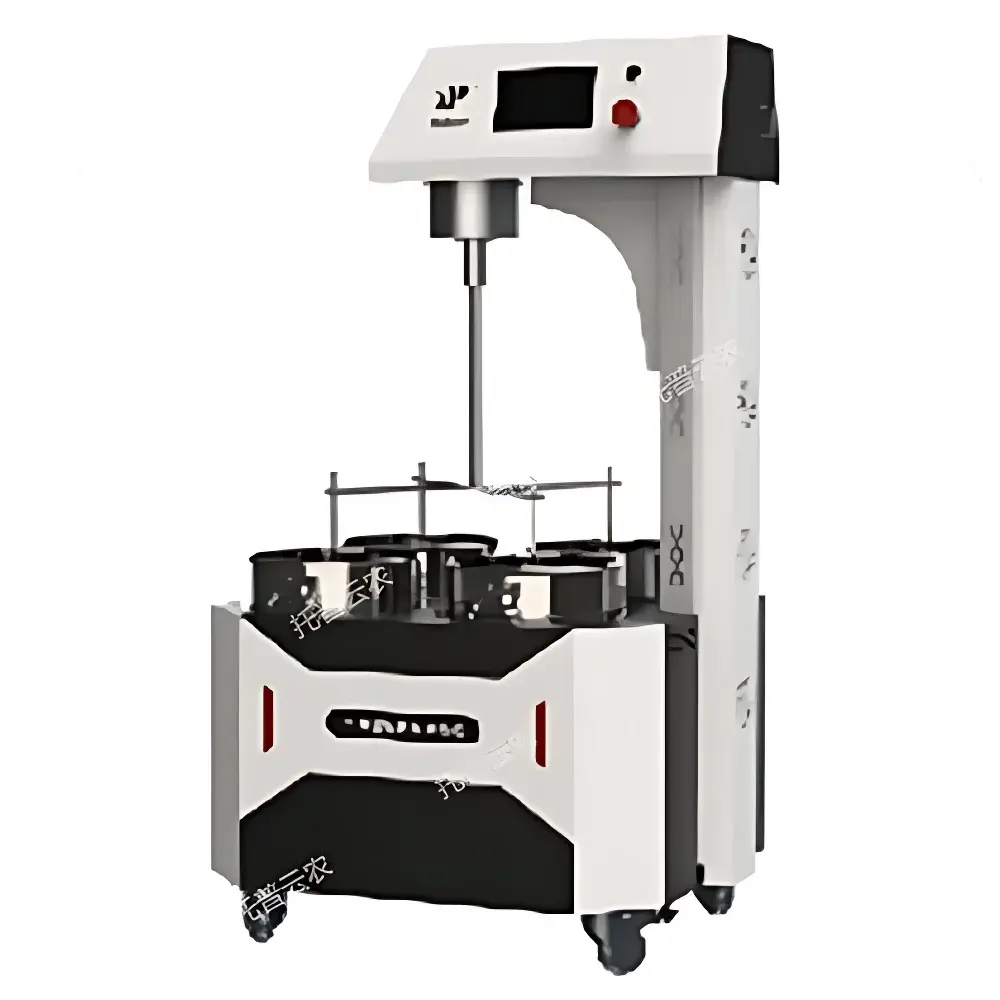
Top Cloud-agri TPF-200 Constant-Temperature Soil Aggregate Analyzer
| Brand | Top Cloud-agri |
|---|---|
| Model | TPF-200 |
| Instrument Type | Multi-functional Soil Aggregate Analyzer |
| Power | 2400 W |
| Oscillation Frequency | 1–45 cycles/min |
| Oscillation Amplitude | 50 mm |
| Temperature Control Range | Ambient to 60 °C |
| Heating Power per Chamber | 600 W (4 chambers) |
| Motor Speed | 1350 rpm |
| Power Supply | AC 220 V, 50 Hz |
| Timer Range | 1–60 min |
| Sample Capacity | 4 independent analysis chambers |
| Sieve Set | Stainless steel, diameters 25 cm (height 40 cm) and 20 cm (height 5 cm), aperture sizes: 10, 7, 5, 3, 2, 1, 0.5, 0.25 mm |
| Construction | 304 stainless steel frame, modular sieve rack, casters with brakes |
Overview
The Top Cloud-agri TPF-200 Constant-Temperature Soil Aggregate Analyzer is an engineered laboratory instrument designed for the quantitative physical separation and classification of soil aggregates under controlled thermal and mechanical conditions. It operates on the principle of wet or dry sieving combined with regulated oscillatory motion and precise temperature stabilization—critical parameters influencing aggregate stability, dispersion behavior, and organic binding integrity. Unlike conventional sieving devices, the TPF-200 maintains consistent thermal conditions across multiple independent sample chambers during analysis, minimizing thermally induced disaggregation artifacts and enabling reproducible assessment of water-stable aggregates (WSA) and mechanically stable aggregates (MSA). This capability supports standardized methodologies aligned with ISO 10930:2022 (Soil quality — Determination of aggregate stability) and ASTM D6913/D6913M (Standard Test Methods for Particle-Size Distribution of Soil by Sieve Analysis), particularly where temperature-dependent cementing agents—such as polysaccharides, fungal hyphae, clay-humus complexes, and Ca²⁺/Mg²⁺ bridging—are under investigation.
Key Features
- Independent chamber temperature control: Four isolated stainless-steel analysis chambers, each equipped with a dedicated 600 W heating element and PID-regulated feedback loop, enable simultaneous testing at distinct temperatures (ambient to 60 °C) without cross-chamber thermal interference.
- Dual-mode sieving compatibility: Supports both wet-sieving (for water-stable aggregate quantification) and dry-sieving (for mechanically stable aggregate distribution), with integrated drainage design and optional peristaltic water delivery modules (not included).
- Modular, tool-free sieve assembly: Standardized 304 stainless-steel sieve sets—including 25 cm × 40 cm tall cylinders and 20 cm × 5 cm shallow trays—with eight calibrated apertures (10, 7, 5, 3, 2, 1, 0.5, and 0.25 mm)—are rapidly installable and compliant with ISO 3310-1 tolerances.
- Precision oscillation system: Adjustable frequency (1–45 cycles/min) and fixed 50 mm amplitude ensure gentle yet effective aggregate breakdown while preserving biologically mediated microstructure; driven by a 1350 rpm induction motor with overload protection.
- Intuitive 7-inch capacitive touchscreen interface: Displays real-time parameters including elapsed time, setpoint temperature, oscillation frequency, chamber status, and countdown timer; supports multi-language firmware (English default) and user-defined protocol storage.
- Enhanced safety architecture: Integrated earth leakage circuit breaker (ELCB), grounding terminal, emergency stop button, and dual-brake omnidirectional casters meet IEC 61010-1 requirements for laboratory electrical equipment.
Sample Compatibility & Compliance
The TPF-200 accommodates bulk soil samples ranging from coarse sandy loams to fine-textured clays, including those rich in organic matter, carbonates, or iron/aluminum oxides. Its non-destructive oscillation profile preserves fragile biological binders—e.g., fungal hyphae, root exudates, and microbial polysaccharides—allowing differentiation between physically robust aggregates and bio-cemented microaggregates. The instrument conforms to GLP documentation standards via timestamped parameter logging and supports audit-ready operation when paired with external data acquisition systems. While not FDA-certified (as it performs physical—not analytical—measurements), its design aligns with USDA-NRCS Soil Survey Laboratory protocols and EU COST Action ES1104 guidelines for aggregate fractionation harmonization.
Software & Data Management
The embedded controller records all operational parameters—including temperature setpoints, oscillation cycles, duration, and chamber ID—for each run. Data export is supported via USB 2.0 port in CSV format, compatible with Excel, R, and Python-based statistical workflows (e.g., aggregate stability index calculation: %WSA = [mass retained on >0.25 mm sieve after wet sieving] / [total dry mass] × 100). No proprietary software installation is required; raw logs include ISO 8601 timestamps and chamber-specific metadata. Optional RS-485 Modbus RTU interface enables integration into centralized lab management platforms supporting IEC 62443-3-3 security profiles.
Applications
- Quantifying water-stable aggregate distribution in long-term field trials assessing tillage impacts, cover cropping efficacy, or biochar amendment effects.
- Evaluating aggregate resilience under simulated climate stressors (e.g., freeze-thaw or wet-dry cycling) via pre-conditioning at controlled temperatures.
- Supporting pedotransfer function development by correlating aggregate size distribution with hydraulic conductivity, infiltration rate, and erodibility indices.
- Validating soil health indicators—including Mean Weight Diameter (MWD) and Geometric Mean Diameter (GMD)—in accordance with Soil Health Institute benchmarking frameworks.
- Teaching core concepts in soil physics and agroecology labs, including colloidal stability, cementation mechanisms, and structure-function relationships in rhizosphere dynamics.
FAQ
What standards does the TPF-200 support for aggregate stability testing?
It facilitates procedures referenced in ISO 10930:2022, ASTM D6913/D6913M, and USDA-NRCS Soil Survey Laboratory Method Manual Chapter 3—particularly for wet-sieving at 25 °C or elevated temperatures to simulate seasonal moisture regimes.
Can sieve mesh sizes be customized beyond the standard set?
Yes—custom aperture configurations (e.g., 0.1 mm, 1.5 mm, or logarithmic series) are available upon request; all machined stainless-steel sieves comply with ISO 3310-1 dimensional tolerances.
Is the unit suitable for use in regulated GMP/GLP environments?
While the TPF-200 itself is not 21 CFR Part 11-compliant out-of-the-box, its deterministic operation, parameter logging, and traceable hardware ID enable qualification (IQ/OQ/PQ) within validated lab workflows when coupled with electronic lab notebook (ELN) integration.
How is temperature uniformity verified across chambers?
Each chamber includes a calibrated PT100 sensor (±0.3 °C accuracy); uniformity is maintained within ±1.5 °C across full load (4 chambers, 60 °C) per IEC 60068-3-5 thermal testing protocols.
What maintenance is required for long-term reliability?
Routine cleaning of sieve surfaces and chamber gaskets is recommended after each use; annual verification of heater output and oscillation frequency calibration using NIST-traceable reference instruments is advised.
Related Products







