
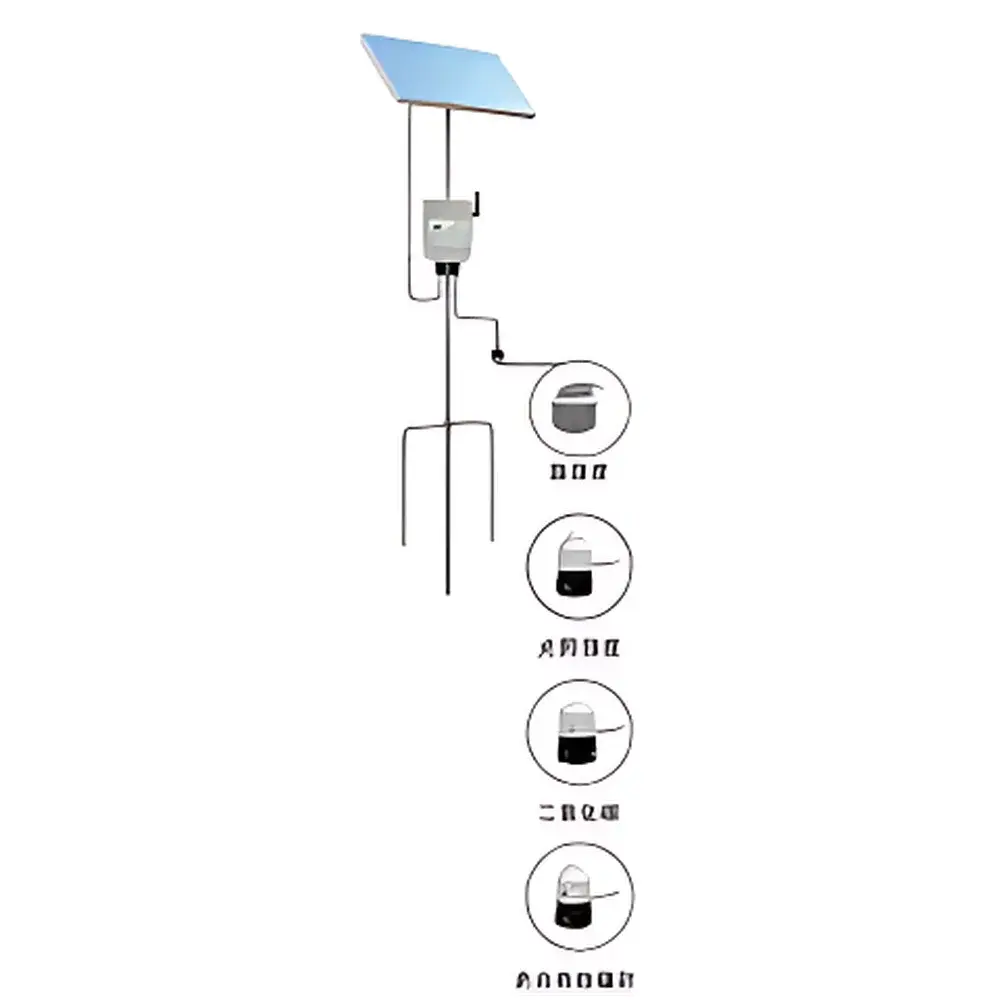
Top Cloud-agri TPFS-GFS-1 Online Photosynthetically Active Radiation (PAR) Sensor
| Brand | Top Cloud-agri |
|---|---|
| Origin | Zhejiang, China |
| Manufacturer Type | OEM/ODM Producer |
| Country of Origin | China |
| Model | TPFS-GFS-1 |
| Power Supply | Solar panel + 220 V AC + Built-in 20 Ah / 3.7 V Li-polymer battery |
| Operating Temperature | −20 °C to +70 °C |
| Enclosure Rating | IP67 |
| Data Storage Capacity | ~500,000 records |
| Wireless Communication | Integrated LTE-M/NB-IoT with SIM card support |
| GPS Module | Embedded real-time geolocation |
| PAR Measurement Range | 0–2700 µmol·m⁻²·s⁻¹ |
| Accuracy | ±1 µmol·m⁻²·s⁻¹ |
| Resolution | 1 µmol·m⁻²·s⁻¹ |
| Sensor Interface | Standardized digital RS-485/Modbus RTU |
| Mounting | Adjustable stainless-steel tripod bracket included |
| Data Upload Interval | Configurable from 1 min to 24 h |
| Alarm Triggers | Threshold-based SMS/Web/LED/Voice alerts |
| Flow Management | Shared cellular data pool across multi-device fleet |
| QR-based Deployment | Zero-touch onboarding via mobile scan |
Overview
The Top Cloud-agri TPFS-GFS-1 Online Photosynthetically Active Radiation (PAR) Sensor is a field-deployable, solar-powered environmental monitoring instrument engineered for continuous, high-fidelity measurement of photosynthetically active radiation—defined as the spectral range from 400 to 700 nm that drives photosynthesis in higher plants, algae, and cyanobacteria. Unlike broadband pyranometers or lux meters, the TPFS-GFS-1 employs a spectrally calibrated silicon photodiode with cosine-corrected optical diffuser and temperature-compensated analog-to-digital conversion to deliver quantitative photon flux density (PFD) in SI-compliant units of µmol·m⁻²·s⁻¹. Its design adheres to the foundational principles outlined in ISO 17166:2019 (E) and ASTM E2915-21 for radiometric sensor performance validation, ensuring traceability to NIST-traceable reference standards. The device operates autonomously in unattended outdoor environments—including greenhouses, open-field agronomy trials, forest canopies, and vertical farming installations—where long-term stability, low power consumption, and resistance to UV degradation and thermal drift are critical.
Key Features
- Solar-harvesting architecture with integrated 10 W monocrystalline panel and intelligent charge management, enabling >200 days of continuous operation on a single battery cycle (20 Ah / 3.7 V Li-polymer)
- IP67-rated waterproof housing with UV-stabilized polycarbonate enclosure and marine-grade stainless-steel mounting hardware for deployment in rain, dust, and high-humidity conditions
- Multi-sensor expandability via standardized Modbus RTU interface—supports up to 32 concurrent sensors (e.g., soil moisture, leaf wetness, CO₂, NDVI) on a single data acquisition node
- Embedded dual-mode wireless connectivity (LTE-M and NB-IoT) with pre-provisioned SIM card and dynamic APN configuration; supports TLS 1.2 encrypted data transmission to cloud endpoints
- Onboard GPS module delivering real-time latitude/longitude/timestamp metadata synchronized with each PAR reading—enabling spatial-temporal mapping in GIS-integrated platforms
- Configurable threshold alarms with multi-channel notification: HTTP webhook, email, SMS, LED status ring, and optional text-to-speech output via auxiliary audio port
- Local data buffering (500,000 records) with time-stamped write cycles and automatic overwrite policy; supports offline operation during network outages with seamless resume-on-reconnect
Sample Compatibility & Compliance
The TPFS-GFS-1 is designed for direct exposure to natural and supplemental light sources without optical filtering or recalibration requirements. Its cosine response error remains within ±3% up to 80° incidence angle per ISO 9060:2018 Class C specifications. The sensor meets electromagnetic compatibility (EMC) requirements per EN 61326-1:2013 and environmental stress testing per IEC 60068-2 series (thermal shock, vibration, salt mist). While not certified under FDA 21 CFR Part 11, its data logging architecture supports ALCOA+ principles (Attributable, Legible, Contemporaneous, Original, Accurate, Complete, Consistent, Enduring, Available) when deployed with validated cloud infrastructure. It is routinely used in GLP-aligned agricultural phenotyping studies and aligns with FAO’s Agroclimatic Monitoring Framework for crop growth modeling inputs.
Software & Data Management
The TPFS-GFS-1 interfaces natively with Top Cloud-agri’s Instrument Cloud Platform—a browser-based SaaS environment accessible via HTTPS with role-based access control (RBAC). The platform provides real-time dashboards with auto-scaled PAR trend charts, historical data export in CSV/NetCDF formats, and configurable statistical summaries (hourly/daily integrals, diurnal averages, PPFD accumulation). Users define custom alarm thresholds per sensor channel, assign escalation paths, and deploy preconfigured crop-specific templates (e.g., “Tomato – High Tunnel”, “Rice – Paddy Field”) that auto-load optimal PAR setpoints and alert logic. Audit trails record all configuration changes, user logins, and data exports in immutable logs compliant with ISO/IEC 27001 information security controls. Optional API integration enables bidirectional synchronization with third-party LIMS, SCADA, or farm management systems (e.g., Climate FieldView, Granular).
Applications
- Dynamic light environment characterization in protected horticulture (greenhouses, plant factories) for optimizing supplemental LED lighting schedules and energy use intensity (kWh·mol⁻¹)
- Field-scale validation of satellite-derived PAR products (e.g., MODIS, Sentinel-3 OLCI) through ground-truth calibration networks
- Long-term ecological monitoring of canopy light interception efficiency in agroforestry and silvopastoral systems
- Controlled-environment agriculture (CEA) research requiring precise PPFD dosing for photomorphogenesis studies (e.g., phytochrome-mediated stem elongation, anthocyanin induction)
- Smart irrigation decision support—correlating PAR-driven evapotranspiration (ET₀) estimates with soil water potential measurements
- Regulatory compliance reporting for greenhouse gas mitigation protocols where light-use efficiency (LUE) serves as a proxy indicator
FAQ
What spectral response does the TPFS-GFS-1 use to define PAR?
It implements a quantum sensor response curve conforming to CIE 1978 PAR action spectrum, with peak sensitivity at 450 nm and 650 nm and <5% deviation across 400–700 nm.
Can the device operate without cellular coverage?
Yes—data is buffered locally and transmitted upon reconnection; no data loss occurs during extended offline periods.
Is firmware update supported remotely?
Yes, over-the-air (OTA) updates are delivered via secure HTTPS push with signature verification and rollback capability.
How is cosine correction validated?
Each unit undergoes factory angular response testing at 0°, 30°, 60°, and 80° incidence angles using a collimated tungsten-halogen source and goniometric stage, with reports available upon request.
Does the system support MQTT or OPC UA protocols?
Native support is limited to Modbus RTU and HTTP(S) RESTful APIs; MQTT bridging is achievable via optional edge gateway modules.
Related Products







